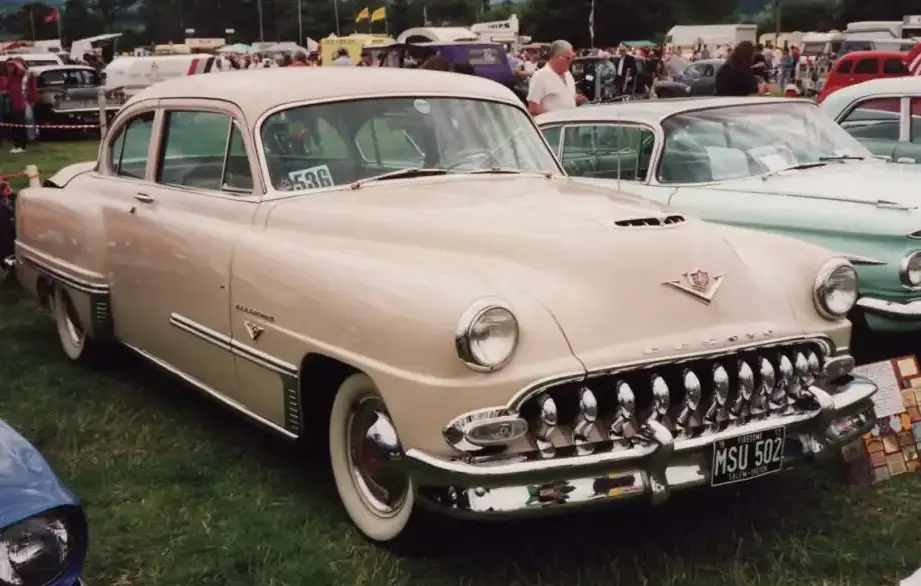
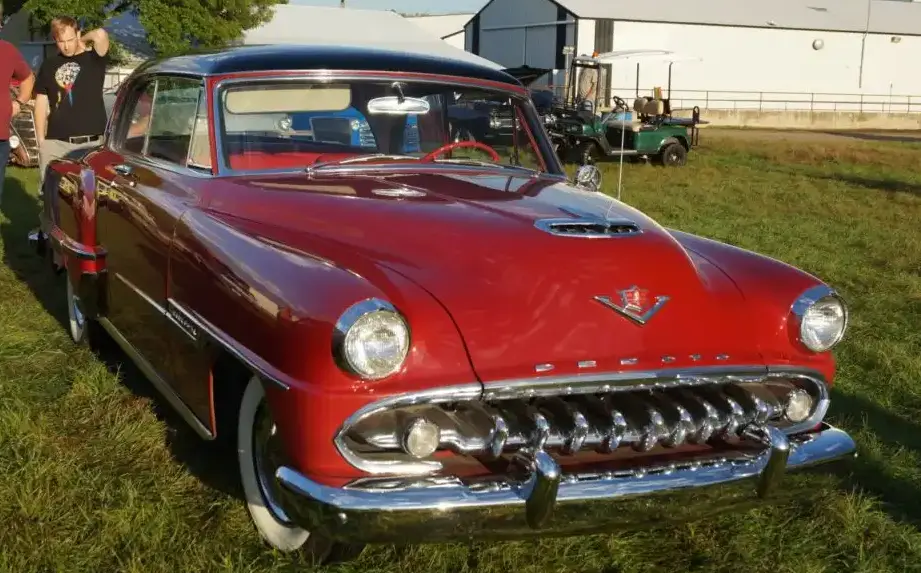
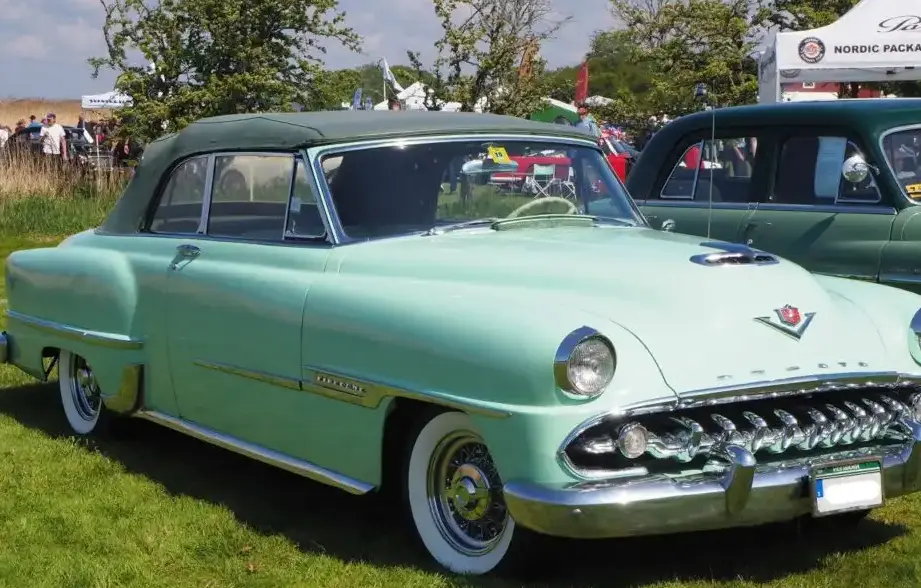
The DeSoto Firedome II Station Wagon, powered by a 4.8-liter V8 engine producing 185 horsepower, represented a significant offering in the American automotive landscape of the mid-1950s. Produced for the 1954 and 1955 model years, this variant of the Firedome line aimed to cater to the growing demand for family-oriented vehicles with a touch of style and power. It was positioned as a premium station wagon within the DeSoto range, offering more space and features than more basic models, but falling below the top-tier DeSoto Adventurer in terms of luxury and performance. The Firedome II Station Wagon was built upon DeSoto’s full-size platform, sharing its basic structure with other Chrysler Corporation vehicles of the era.
Technical Specifications
| Brand | DeSoto |
| Model | Firedome |
| Generation | Firedome II Station Wagon |
| Type (Engine) | 4.8 V8 (185 Hp) |
| Start of production | 1954 |
| End of production | 1955 |
| Powertrain Architecture | Internal Combustion engine |
| Body type | Station wagon (estate) |
| Seats | 6 |
| Doors | 5 |
| Fuel Type | Petrol (Gasoline) |
| Power | 185 Hp @ 4400 rpm |
| Power per litre | 38.8 Hp/l |
| Torque | 332 Nm @ 2800 rpm / 244.87 lb.-ft. @ 2800 rpm |
| Engine Model/Code | S21-1001 |
| Engine displacement | 4769 cm3 / 291.02 cu. in. |
| Number of cylinders | 8 |
| Engine configuration | V-engine |
| Cylinder Bore | 94.49 mm / 3.72 in. |
| Piston Stroke | 84.931 mm / 3.34 in. |
| Compression ratio | 7.5:1 |
| Number of valves per cylinder | 2 |
| Fuel injection system | Carburettor |
| Engine aspiration | Naturally aspirated engine |
| Valvetrain | OHV |
| Engine oil capacity | 4.7 l / 4.97 US qt | 4.14 UK qt |
| Coolant | 21.8 l / 23.04 US qt | 19.18 UK qt |
| Fuel tank capacity | 70 l / 18.49 US gal | 15.4 UK gal |
| Length | 5552 mm / 218.58 in. |
| Width | 1989 mm / 78.31 in. |
| Height | 1539 mm / 60.59 in. |
| Wheelbase | 3200 mm / 125.98 in. |
| Front track | 1529 mm / 60.2 in. |
| Rear (Back) track | 1514 mm / 59.61 in. |
| Ride height (ground clearance) | 160 mm / 6.3 in. |
| Minimum turning circle (turning diameter) | 13.4 m / 43.96 ft. |
| Approach angle | 21° |
| Departure angle | 12° |
| Ramp-over (brakeover) angle | 11° |
| Drivetrain Architecture | The Internal combustion engine (ICE) drives the rear wheels of the vehicle. |
| Drive wheel | Rear wheel drive |
| Number of gears and type of gearbox | 3 gears, manual transmission |
| Front suspension | Independent coil spring |
| Rear suspension | Leaf spring |
| Front brakes | Drum, 305 mm |
| Rear brakes | Drum, 305 mm |
| Steering type | Worm-reduction unit |
| Power steering | Hydraulic Steering |
Powertrain & Engine Architecture
The heart of the Firedome II Station Wagon was the DeSoto S21-1001 4.8-liter (291.02 cubic inch) V8 engine. This engine featured a cast iron block and cylinder heads, with a 7.5:1 compression ratio. It utilized a single Carter carburetor for fuel delivery, and an overhead valve (OHV) valvetrain. The engine’s design was relatively conventional for the era, prioritizing durability and ease of maintenance. The 185 horsepower output was considered respectable for a full-size station wagon in the mid-1950s, providing adequate performance for highway cruising and family transportation. The standard transmission was a three-speed manual, although a PowerFlite automatic transmission was available as an option. The automatic transmission, while offering convenience, did slightly reduce the vehicle’s overall acceleration and fuel economy.
Driving Characteristics
The 1954-1955 DeSoto Firedome II Station Wagon with the 4.8L V8 and manual transmission offered a driving experience typical of large American cars of the period. Acceleration was adequate, but not particularly brisk, with the engine delivering its peak power at 4400 rpm. The three-speed manual transmission required deliberate shifting, and the gear ratios were optimized for cruising rather than rapid acceleration. Compared to the higher-output DeSoto Adventurer, the Firedome felt less powerful, especially when fully loaded with passengers and cargo. The suspension, featuring independent coil springs in the front and leaf springs in the rear, provided a comfortable ride, but handling was somewhat imprecise by modern standards. The large size and weight of the vehicle contributed to noticeable body roll in corners.
Equipment & Trim Levels
The Firedome II Station Wagon came reasonably well-equipped for its time. Standard features included a spacious interior with seating for six passengers, a large cargo area accessible through a rear tailgate, and a basic set of instruments. Interior upholstery was typically cloth and vinyl, with a focus on durability. Optional extras included a radio, heater, whitewall tires, and various trim enhancements. The dashboard layout was relatively simple, with a focus on functionality. The station wagon trim generally included woodgrain accents on the dashboard and door panels, adding a touch of visual appeal.
Chassis & Braking
The Firedome II Station Wagon utilized a body-on-frame construction, common for American cars of the era. The chassis was robust and designed to handle the weight of the vehicle and its passengers. The front suspension featured independent coil springs, providing a smoother ride compared to solid axles. The rear suspension employed leaf springs, which were well-suited for carrying heavy loads. Braking was accomplished via drum brakes on all four wheels, measuring 305mm in diameter. While adequate for the time, the drum brakes lacked the stopping power and fade resistance of modern disc brakes. Steering was handled by a worm-reduction unit, with optional hydraulic power steering available for easier maneuverability.
Market Reception & Comparison
The DeSoto Firedome II Station Wagon was generally well-received by critics and consumers. It was praised for its spacious interior, comfortable ride, and stylish design. However, some reviewers noted that the engine’s performance was adequate but not exceptional, and the handling was somewhat imprecise. Compared to other station wagons of the era, such as the Ford Country Squire and the Chevrolet Bel Air wagon, the Firedome offered a similar level of space and comfort, but with a slightly more upscale image. Fuel economy was typical for a large American car of the 1950s, averaging around 12-15 miles per gallon. Reliability was generally good, although maintenance costs could be relatively high due to the complexity of the V8 engine.
Legacy
The DeSoto Firedome II Station Wagon represents a significant chapter in American automotive history. While DeSoto as a brand ultimately faded away in the 1960s, the Firedome II Station Wagon remains a popular choice among classic car enthusiasts. The 4.8-liter V8 engine, while not known for its high performance, proved to be relatively durable and reliable. Today, well-maintained examples of the Firedome II Station Wagon are sought after by collectors and restorers. The availability of parts can be a challenge, but a dedicated community of DeSoto enthusiasts helps to keep these classic vehicles on the road. The Firedome II Station Wagon serves as a reminder of a bygone era of American automotive design and engineering, when large, comfortable, and stylish station wagons were a staple of family life.