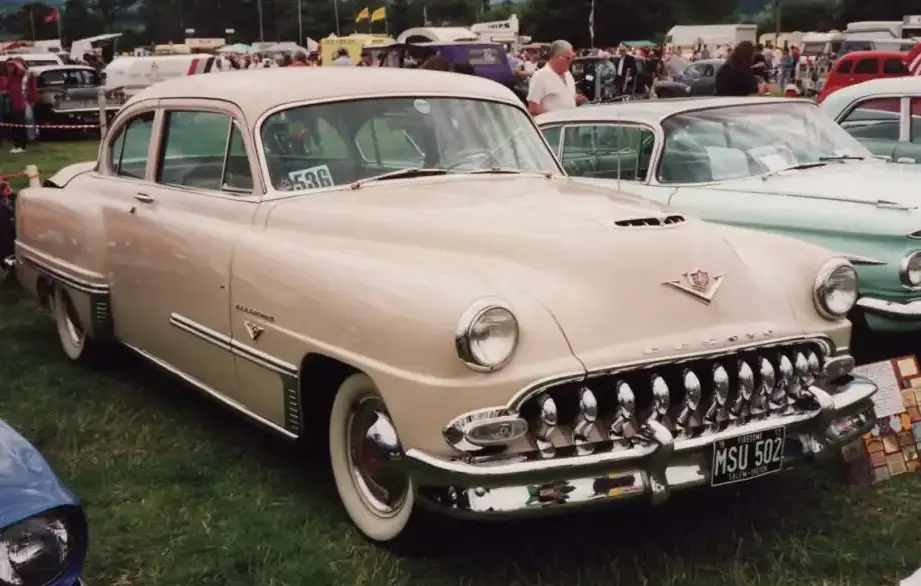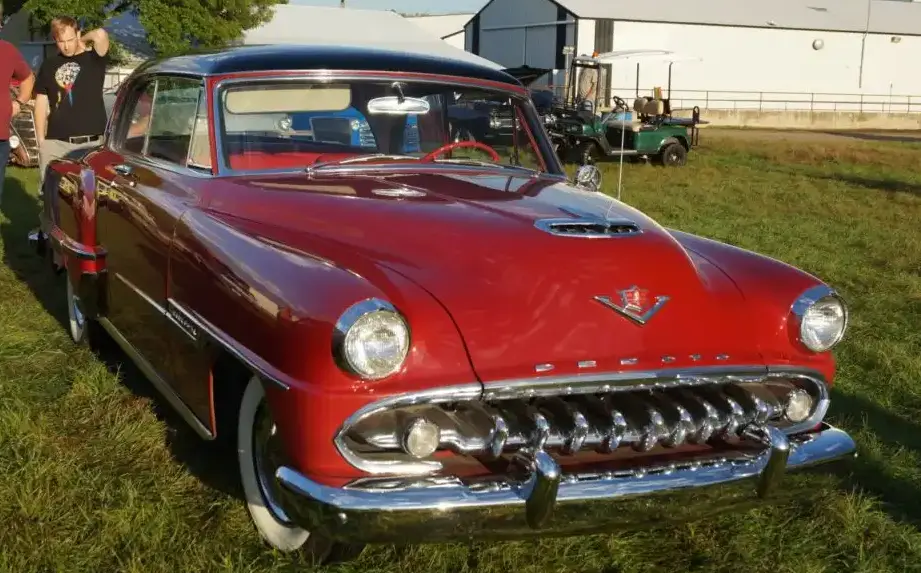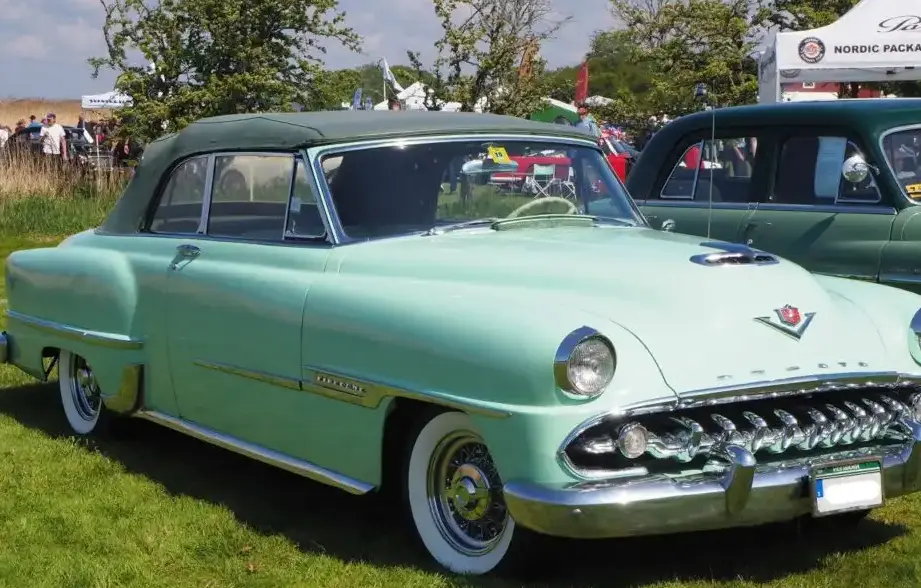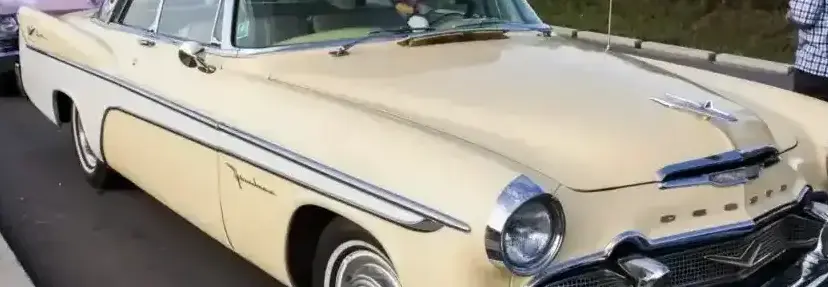
The DeSoto Firedome II Two-Door Sportsman, specifically the 1956 facelifted model, represented a significant offering from the Chrysler Corporation’s mid-range brand. Produced from 1955 to 1956, the Firedome II aimed to blend style, performance, and comfort in the burgeoning post-war American automotive market. This particular variant, equipped with the 5.4-liter V8 engine producing 230 horsepower, occupied a sweet spot in the Firedome lineup, offering a substantial power upgrade over the base models while remaining more accessible than the top-tier DeSoto Adventurer. The “Sportsman” designation denoted the two-door coupe body style, emphasizing a more youthful and sporty appeal.
Technical Specifications
| Brand | DeSoto |
| Model | Firedome |
| Generation | Firedome II Two-Door Sportsman (facelift 1956) |
| Type (Engine) | 5.4 V8 (230 Hp) |
| Start of production | 1955 |
| End of production | 1956 |
| Powertrain Architecture | Internal Combustion engine |
| Body type | Coupe |
| Seats | 6 |
| Doors | 2 |
| Fuel Type | Petrol (Gasoline) |
| Power | 230 Hp @ 4400 rpm |
| Power per litre | 42.5 Hp/l |
| Torque | 414 Nm @ 2800 rpm / 305.35 lb.-ft. @ 2800 rpm |
| Engine Model/Code | S23 |
| Engine displacement | 5408 cm3 / 330.02 cu. in. |
| Number of cylinders | 8 |
| Engine configuration | V-engine |
| Cylinder Bore | 94.49 mm / 3.72 in. |
| Piston Stroke | 96.52 mm / 3.8 in. |
| Compression ratio | 8.5:1 |
| Number of valves per cylinder | 2 |
| Fuel injection system | Carburettor |
| Engine aspiration | Naturally aspirated engine |
| Valvetrain | OHV |
| Engine oil capacity | 3.8 l / 4.02 US qt | 3.34 UK qt |
| Coolant | 22.7 l / 23.99 US qt | 19.97 UK qt |
| Fuel tank capacity | 79 l / 20.87 US gal | 17.38 UK gal |
| Length | 5611 mm / 220.91 in. |
| Width | 1989 mm / 78.31 in. |
| Height | 1473 mm / 57.99 in. |
| Wheelbase | 3200 mm / 125.98 in. |
| Front track | 1534 mm / 60.39 in. |
| Rear (Back) track | 1514 mm / 59.61 in. |
| Front overhang | 930 mm / 36.61 in. |
| Rear overhang | 1481 mm / 58.31 in. |
| Minimum turning circle (turning diameter) | 13.4 m / 43.96 ft. |
| Approach angle | 19° |
| Departure angle | 11° |
| Ramp-over (brakeover) angle | 12° |
| Drivetrain Architecture | The Internal combustion engine (ICE) drives the rear wheels of the vehicle. |
| Drive wheel | Rear wheel drive |
| Number of gears and type of gearbox | 3 gears, manual transmission |
| Front suspension | Independent coil spring |
| Rear suspension | Leaf spring |
| Front brakes | Drum, 305 mm |
| Rear brakes | Drum, 305 mm |
| Steering type | Worm-reduction unit |
| Power steering | Hydraulic Steering |
Powertrain & Engine Architecture
The heart of the 1956 DeSoto Firedome II Sportsman was the DeSoto S23 5.4-liter (330 cubic inch) V8 engine. This engine, part of Chrysler’s “Hemi” family (though not a true hemispherical head design like later iterations), featured a cast iron block and aluminum cylinder heads. It utilized a single Carter carburetor for fuel delivery and an overhead valve (OHV) valvetrain. The 8.5:1 compression ratio contributed to the engine’s 230 horsepower output at 4400 rpm and 414 Nm (305.35 lb-ft) of torque at 2800 rpm. The engine was paired with a standard three-speed manual transmission, delivering power to the rear wheels. While an automatic transmission was offered on other Firedome models, the Sportsman typically came equipped with the manual, catering to drivers seeking a more engaging driving experience.
Driving Characteristics
The 1956 Firedome II Sportsman, with its 230 hp V8 and three-speed manual transmission, offered a spirited driving experience for the era. While not a dedicated sports car, the combination provided ample power for highway cruising and confident acceleration. The manual transmission allowed for greater driver control, although the gear ratios were relatively widely spaced by modern standards. Compared to the base DeSoto models with smaller engines, the Firedome II felt significantly more responsive. However, it didn’t possess the outright performance of the higher-end DeSoto Adventurer, which featured a more powerful engine and different tuning. The leaf spring rear suspension provided a comfortable ride, but handling was typical of large American cars of the 1950s – prioritizing comfort over cornering precision.
Equipment & Trim Levels
The Firedome II Sportsman was reasonably well-equipped for its time. Standard features included a full-width bench seat upholstered in cloth and vinyl, a steering wheel, and basic instrumentation. The interior trim was generally conservative, reflecting the DeSoto brand’s positioning as a step above Plymouth but below Chrysler. Optional extras included power steering, a radio, whitewall tires, and upgraded interior materials. The “Sportsman” trim level didn’t denote a significant increase in standard equipment over other Firedome II models, but it did emphasize a more youthful aesthetic with its two-door coupe body style.
Chassis & Braking
The Firedome II Sportsman rode on a traditional body-on-frame chassis. The front suspension utilized independent coil springs, providing a relatively smooth ride. The rear suspension employed leaf springs, a common setup for American cars of the period. Braking was accomplished via drum brakes on all four wheels, measuring 305 mm in diameter. While adequate for the time, the drum brakes lacked the stopping power and fade resistance of modern disc brake systems. Power steering was available as an option, making maneuvering the large DeSoto easier, particularly in urban environments.
Market Reception & Comparison
The 1956 DeSoto Firedome II Sportsman was generally well-received by automotive critics. It was praised for its stylish design, comfortable ride, and strong V8 engine. However, some reviewers noted the car’s large size and relatively basic interior compared to some of its competitors. Compared to other DeSoto models, the Firedome II offered a compelling balance of performance and value. It was more affordable than the Adventurer, yet provided a significant power upgrade over the base models. In the broader market, it competed with other mid-range American cars such as the Ford Fairlane and Chevrolet Bel Air.
Legacy
The DeSoto Firedome II Sportsman, while not a long-lived model, holds a significant place in automotive history as a representative of 1950s American design and engineering. The 5.4-liter V8 engine proved to be relatively durable, and many examples remain on the road today. However, finding parts can be challenging due to the limited production numbers and the age of the vehicle. The Firedome II Sportsman is now a sought-after classic car, appealing to collectors and enthusiasts who appreciate its vintage styling and robust powertrain. Its enduring appeal lies in its embodiment of a bygone era of American automotive optimism and exuberance.