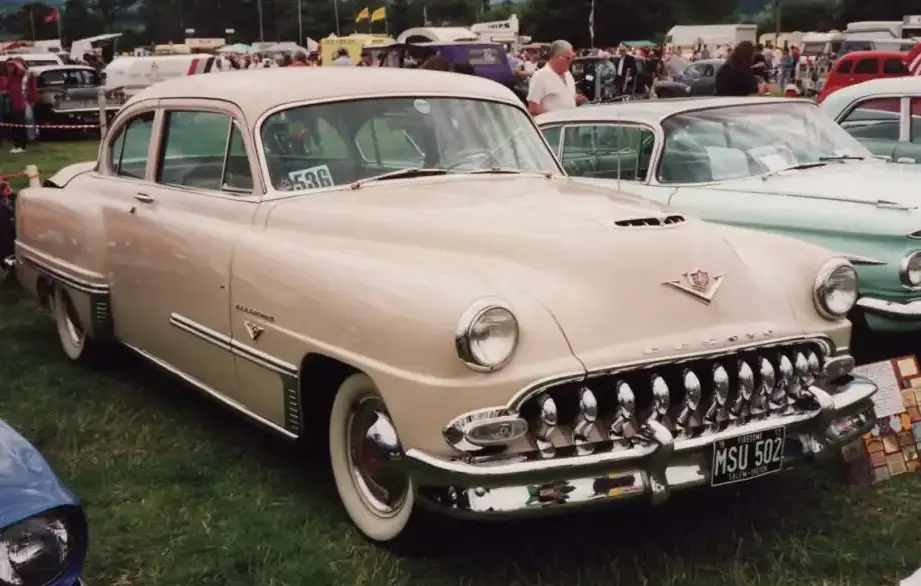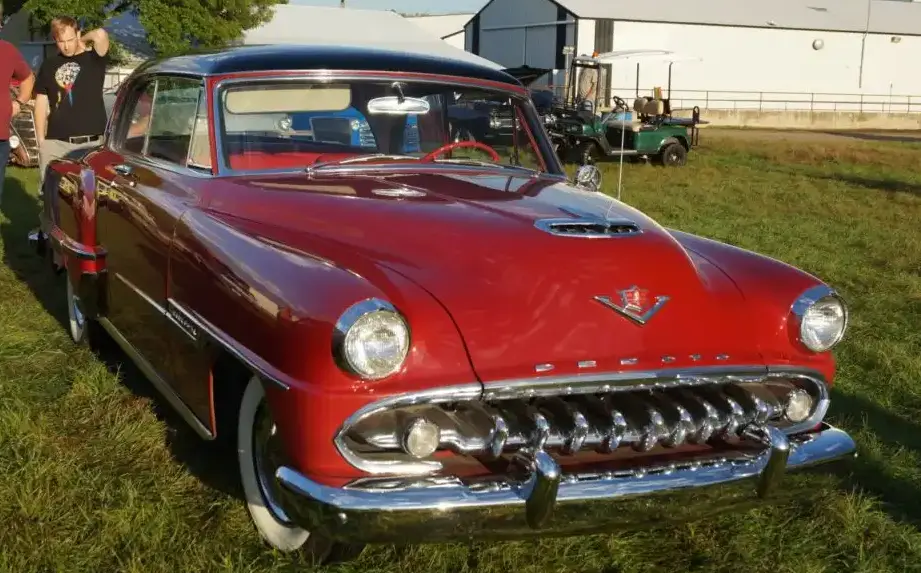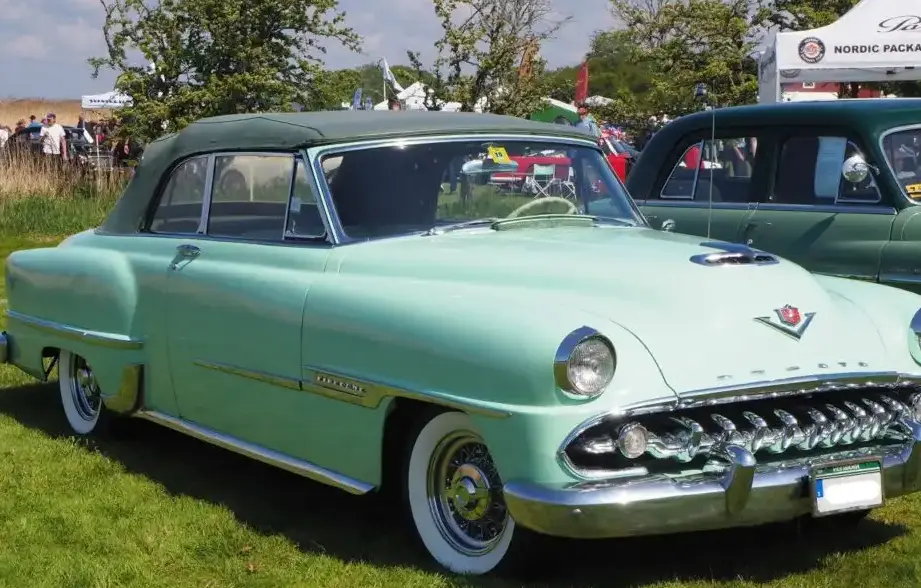
The DeSoto Firedome III Four-Door Sedan, equipped with a 5.6-liter V8 engine and TorqueFlite automatic transmission, was a key offering from the Chrysler Corporation’s DeSoto division during the 1956 and 1957 model years. Positioned as a mid-range model within the Firedome lineup, it aimed to strike a balance between performance, comfort, and style for the American family. This variant was part of the broader Firedome III generation, notable for its distinctive styling and advancements in automotive technology for the era. It played a crucial role in DeSoto’s strategy to establish a market position between the more affordable Plymouth and the luxury-focused Chrysler brands.
Technical Specifications
| Brand | DeSoto |
| Model | Firedome |
| Generation | Firedome III Four-Door Sedan |
| Type (Engine) | 5.6 V8 (270 Hp) TorqueFlite |
| Start of production | 1956 |
| End of production | 1957 |
| Powertrain Architecture | Internal Combustion engine |
| Body type | Sedan |
| Seats | 6 |
| Doors | 4 |
| Fuel Type | Petrol (Gasoline) |
| Power | 270 Hp @ 4600 rpm |
| Power per litre | 48.3 Hp/l |
| Torque | 475 Nm @ 2400 rpm / 350.34 lb.-ft. @ 2400 rpm |
| Engine Model/Code | S25 |
| Engine displacement | 5588 cm3 / 341 cu. in. |
| Number of cylinders | 8 |
| Engine configuration | V-engine |
| Cylinder Bore | 96.01 mm / 3.78 in. |
| Piston Stroke | 96.52 mm / 3.8 in. |
| Compression ratio | 9.25:1 |
| Number of valves per cylinder | 2 |
| Fuel injection system | Carburettor |
| Engine aspiration | Naturally aspirated engine |
| Valvetrain | OHV |
| Engine oil capacity | 4.7 l / 4.97 US qt | 4.14 UK qt |
| Coolant | 19.9 l / 21.03 US qt | 17.51 UK qt |
| Fuel tank capacity | 87 l / 22.98 US gal | 19.14 UK gal |
| Length | 5537 mm / 217.99 in. |
| Width | 1986 mm / 78.19 in. |
| Height | 1448 mm / 57.01 in. |
| Wheelbase | 3200 mm / 125.98 in. |
| Front track | 1549 mm / 60.98 in. |
| Rear (Back) track | 1516 mm / 59.69 in. |
| Front overhang | 879 mm / 34.61 in. |
| Rear overhang | 1458 mm / 57.4 in. |
| Ride height (ground clearance) | 137 mm / 5.39 in. |
| Minimum turning circle (turning diameter) | 13.1 m / 42.98 ft. |
| Approach angle | 17.7° |
| Departure angle | 13.3° |
| Ramp-over (brakeover) angle | 9.8° |
| Drivetrain Architecture | The Internal combustion engine (ICE) drives the rear wheels of the vehicle. |
| Drive wheel | Rear wheel drive |
| Number of gears and type of gearbox | 3 gears, automatic transmission TorqueFlite |
| Front suspension | Independent coil spring |
| Rear suspension | Leaf spring |
| Steering type | Worm-reduction unit |
Powertrain & Engine Architecture
The DeSoto Firedome III’s powertrain centered around the S25 5.6-liter (341 cubic inch) V8 engine. This engine featured a cast iron block paired with aluminum cylinder heads, a relatively sophisticated design for the mid-1950s. It utilized a single Carter carburetor, producing a rated 270 horsepower at 4,600 rpm and 475 Nm (350 lb-ft) of torque at 2,400 rpm. The engine employed an overhead valve (OHV) configuration with two valves per cylinder. The standard transmission was the TorqueFlite three-speed automatic. This transmission was lauded for its smooth operation and durability, appealing to DeSoto buyers who prioritized convenience over a manual gearbox. The TorqueFlite’s design incorporated a compact torque converter and planetary gearsets, contributing to its efficiency and reliability.
Driving Characteristics
The combination of the 270 hp V8 and the TorqueFlite automatic delivered a comfortable and capable driving experience. While not a high-performance vehicle by contemporary standards, the Firedome III offered brisk acceleration for its time. The TorqueFlite transmission’s gear ratios were optimized for cruising, making it well-suited for highway travel. Compared to DeSoto models equipped with smaller engines, the Firedome III provided a noticeable increase in power and responsiveness. However, it didn’t quite match the performance of the higher-end Chrysler models featuring larger displacement V8s. The rear suspension, utilizing leaf springs, provided a generally comfortable ride, though it lacked the sophistication of independent suspension systems found on some competing vehicles. Steering was relatively heavy, typical for cars of this era, but provided a solid feel on the road.
Equipment & Trim Levels
The Firedome III Four-Door Sedan came standard with a generous array of features for the mid-1950s. These included full wheel covers, whitewall tires, a two-tone paint scheme, and a spacious interior upholstered in cloth and vinyl. Power steering and power brakes were available as optional extras. The dashboard featured a prominent instrument cluster displaying gauges for speed, fuel level, coolant temperature, and oil pressure. The interior trim was generally conservative in style, reflecting the DeSoto’s positioning as a family-oriented vehicle. Optional equipment included a radio, heater, and air conditioning, though these were considered relatively expensive upgrades.
Chassis & Braking
The Firedome III was built on a conventional body-on-frame chassis. The front suspension utilized independent coil springs, while the rear suspension employed leaf springs. This configuration aimed to balance ride comfort and handling. The braking system consisted of drum brakes on all four wheels. While adequate for the time, the drum brakes lacked the stopping power and fade resistance of disc brakes, which were not yet widely adopted. Steering was accomplished via a worm-reduction unit, providing relatively heavy but precise steering feel. The chassis design prioritized durability and ease of maintenance, reflecting the engineering philosophies of the era.
Market Reception & Comparison
The DeSoto Firedome III generally received positive reviews from automotive critics. It was praised for its stylish design, comfortable ride, and reliable powertrain. However, some critics pointed out that it lacked the refinement and performance of competitors like the Buick Roadmaster and the Oldsmobile 98. Fuel economy was typical for a full-size American car of the 1950s, averaging around 15-18 miles per gallon. Compared to other DeSoto models, the Firedome III offered a compelling value proposition, providing a significant upgrade in performance and features without the higher price tag of the Chrysler-branded vehicles. It successfully positioned itself as a desirable mid-range option for families seeking a comfortable and stylish sedan.
Legacy
The DeSoto Firedome III, despite its relatively short production run, remains a popular choice among classic car enthusiasts. The 5.6-liter V8 engine and TorqueFlite transmission are known for their durability and relative ease of maintenance. While parts availability can be challenging, a dedicated network of suppliers caters to the classic DeSoto market. Today, well-preserved examples of the Firedome III Four-Door Sedan are highly sought after by collectors, serving as a nostalgic reminder of the American automotive landscape of the 1950s. The car’s robust construction and relatively simple mechanical design contribute to its enduring appeal and ensure that many examples continue to be enjoyed on roads and at car shows decades after their initial production. The Firedome III represents a significant chapter in DeSoto’s history and a testament to the engineering and design of the mid-20th century.