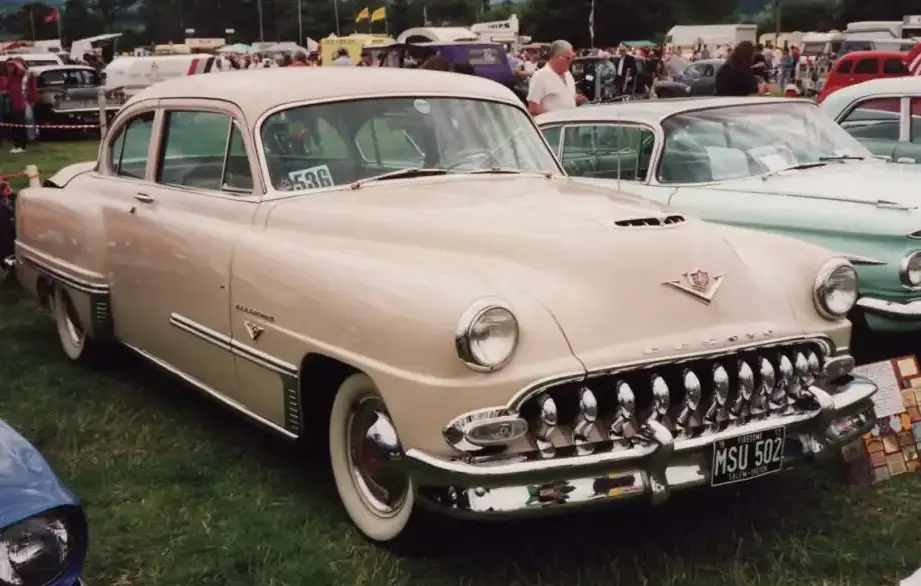
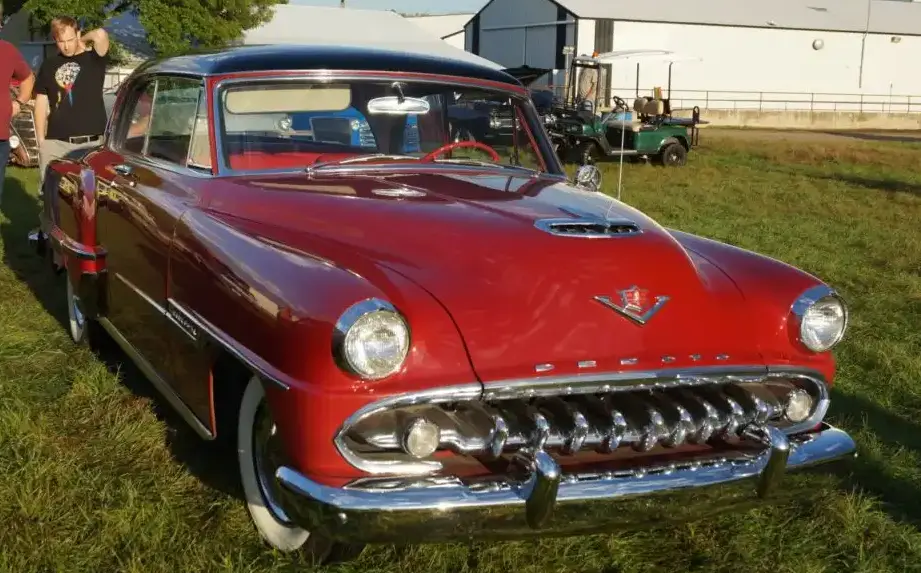
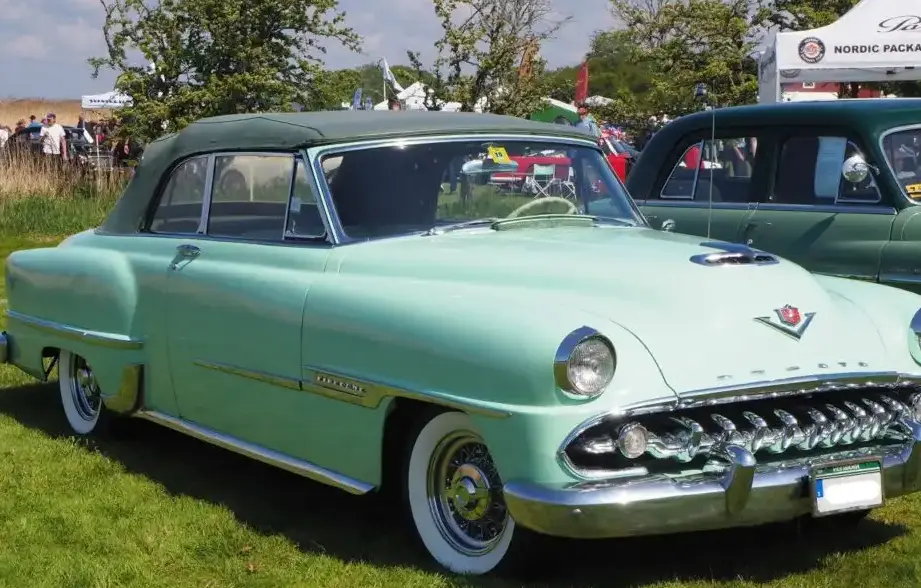
The DeSoto Firedome Sportsman Coupe, specifically the 1954 facelift model powered by the 4.5-liter V8 engine and PowerFlite automatic transmission, represented a significant offering in the mid-range of DeSoto’s lineup. Produced for the 1953 and 1954 model years, this iteration of the Firedome aimed to blend style, comfort, and performance within the burgeoning post-war American automotive market. It sat above the entry-level DeSoto Deluxe and below the more luxurious DeSoto Adventurer in terms of price and features, targeting buyers seeking a well-appointed and capable family coupe.
Technical Specifications
| Brand | DeSoto |
| Model | Firedome |
| Generation | Firedome Sportsman Coupe (facelift 1954) |
| Type (Engine) | 4.5 V8 (170 Hp) PowerFlite |
| Start of production | 1953 |
| End of production | 1954 |
| Powertrain Architecture | Internal Combustion engine |
| Body type | Coupe |
| Seats | 6 |
| Doors | 2 |
| Fuel Type | Petrol (Gasoline) |
| Power | 170 Hp @ 4400 rpm |
| Power per litre | 37.6 Hp/l |
| Torque | 346 Nm @ 2400 rpm |
| Torque (lb.-ft.) | 255.2 lb.-ft. @ 2400 rpm |
| Engine Model/Code | S19-1001 |
| Engine displacement | 4524 cm3 |
| Engine displacement (cu. in.) | 276.07 cu. in. |
| Number of cylinders | 8 |
| Engine configuration | V-engine |
| Cylinder Bore | 92.075 mm |
| Cylinder Bore (in.) | 3.63 in. |
| Piston Stroke | 84.931 mm |
| Piston Stroke (in.) | 3.34 in. |
| Compression ratio | 7.5:1 |
| Number of valves per cylinder | 2 |
| Fuel injection system | Carburettor |
| Engine aspiration | Naturally aspirated engine |
| Valvetrain | OHV |
| Engine oil capacity | 4.7 l |
| Engine oil capacity (US qt) | 4.97 US qt |
| Engine oil capacity (UK qt) | 4.14 UK qt |
| Coolant capacity | 21.8 l |
| Coolant capacity (US qt) | 23.04 US qt |
| Coolant capacity (UK qt) | 19.18 UK qt |
| Fuel tank capacity | 64 l |
| Fuel tank capacity (US gal) | 16.91 US gal |
| Fuel tank capacity (UK gal) | 14.08 UK gal |
| Length | 5448 mm |
| Length (in.) | 214.49 in. |
| Width | 1969 mm |
| Width (in.) | 77.52 in. |
| Height | 1632 mm |
| Height (in.) | 64.25 in. |
| Wheelbase | 3188 mm |
| Wheelbase (in.) | 125.51 in. |
| Front track | 1403 mm |
| Front track (in.) | 55.24 in. |
| Rear track | 1438 mm |
| Rear track (in.) | 56.61 in. |
| Front overhang | 940 mm |
| Front overhang (in.) | 37.01 in. |
| Rear overhang | 1321 mm |
| Rear overhang (in.) | 52.01 in. |
| Ride height (ground clearance) | 178 mm |
| Ride height (ground clearance) (in.) | 7.01 in. |
| Drag coefficient (Cd) | 0.6 |
| Minimum turning circle | 12.8 m |
| Minimum turning circle (ft.) | 41.99 ft. |
| Approach angle | 23° |
| Departure angle | 17° |
| Ramp-over angle | 15° |
| Drivetrain Architecture | Rear wheel drive |
| Number of gears | 2 |
| Gearbox type | automatic transmission PowerFlite |
| Front suspension | Independent coil spring |
| Rear suspension | Leaf spring |
| Front brakes | Drum, 305 mm |
| Rear brakes | Drum, 305 mm |
| Steering type | Worm-reduction unit |
| Power steering | Hydraulic Steering |
Powertrain & Engine Architecture
The heart of the 1954 DeSoto Firedome Sportsman Coupe was the S19-1001 4.5-liter (276.07 cubic inch) V8 engine. This engine featured a cast iron block and aluminum cylinder heads, utilizing a conventional overhead valve (OHV) valvetrain with two valves per cylinder. Fuel delivery was managed by a Carter carburetor, a common setup for the era. The 7.5:1 compression ratio was typical for the time, balancing performance with the availability of regular gasoline. The PowerFlite automatic transmission, a two-speed unit, was the sole transmission option for this model. It was a relatively new design for DeSoto, offering smoother shifts compared to earlier automatics, but lacked the sophistication of later multi-speed transmissions. The PowerFlite was known for its durability, but its limited gear selection meant the engine often operated at higher RPMs, impacting fuel economy.
Driving Characteristics
The combination of the 170 horsepower V8 and the two-speed PowerFlite transmission resulted in a driving experience that prioritized comfortable cruising over outright acceleration. While the engine produced adequate torque (255.2 lb.-ft.), the limited number of gears in the PowerFlite meant that the engine had to work harder to maintain speed, especially when climbing hills or passing. Compared to Firedomes equipped with a manual transmission, the automatic version felt noticeably less responsive. However, the PowerFlite’s ease of use appealed to a broader range of drivers, particularly those seeking a more relaxed driving experience. The car’s substantial weight (approximately 3,700 lbs) also contributed to its less sporty feel.
Equipment & Trim Levels
The Firedome Sportsman Coupe came standard with a respectable array of features for the mid-1950s. The interior typically featured cloth and vinyl upholstery, with a focus on comfort and spaciousness. Standard equipment included a heater, a basic radio, and full wheel covers. Optional extras included power steering (a popular choice), power brakes, and a more elaborate radio with a rear speaker. The dashboard layout was typical of the era, featuring a large speedometer and auxiliary gauges. The two-tone paint schemes were a hallmark of DeSoto styling during this period, adding to the car’s visual appeal.
Chassis & Braking
The Firedome Sportsman Coupe utilized a body-on-frame construction, common for American cars of the time. The front suspension employed independent coil springs, providing a relatively comfortable ride. The rear suspension, however, relied on a traditional leaf spring setup, which was less sophisticated but durable. Braking was accomplished via drum brakes on all four wheels, measuring 305 mm in diameter. While adequate for the car’s weight and performance, the drum brakes lacked the stopping power of later disc brake systems. Hydraulic steering was standard, making the car relatively easy to maneuver, especially at low speeds.
Market Reception & Comparison
The 1954 DeSoto Firedome Sportsman Coupe was generally well-received by automotive critics. It was praised for its stylish design, comfortable interior, and smooth ride. However, the PowerFlite transmission was sometimes criticized for its lack of responsiveness and its impact on fuel economy. Compared to other DeSoto models, the Firedome offered a good balance of features and price. It was more affordable than the Adventurer, but offered more standard equipment than the Deluxe. In terms of competition, the Firedome faced rivals from Ford, Chevrolet, and Plymouth, all of which offered similar models with comparable features and performance.
Legacy
Today, the 1954 DeSoto Firedome Sportsman Coupe is a sought-after classic car, particularly among enthusiasts of 1950s American automobiles. The S19-1001 V8 engine, while not known for being particularly high-strung, proved to be relatively reliable when properly maintained. The PowerFlite transmission, while simple in design, is also generally durable. However, finding parts for these cars can be challenging, and restoration projects can be expensive. The Firedome Sportsman Coupe represents a significant chapter in DeSoto’s history, embodying the optimism and style of the post-war era. Its enduring appeal lies in its classic design, comfortable ride, and the nostalgic charm of a bygone era of American automotive engineering.