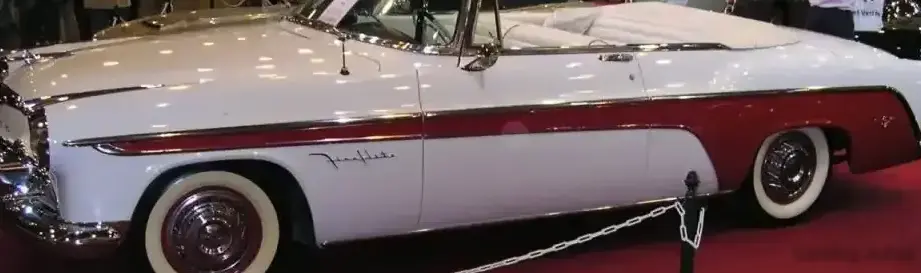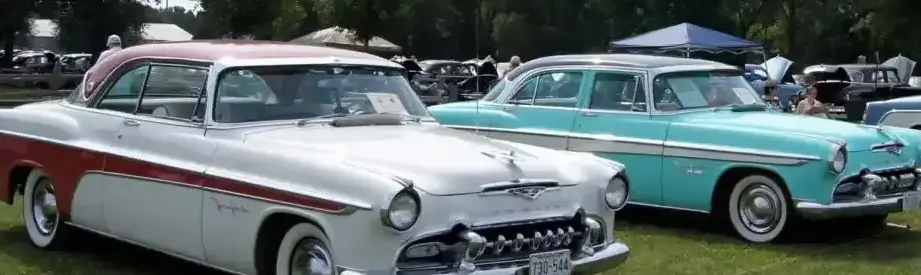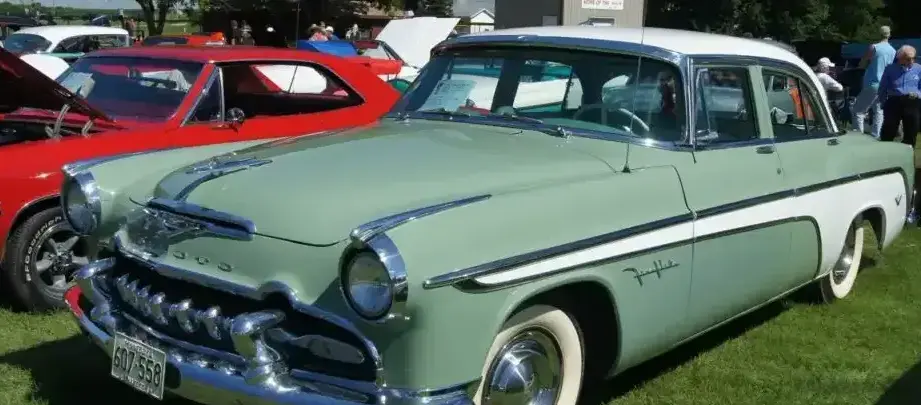
The DeSoto Fireflite I Four-Door Sedan, powered by a 4.8-liter V8 engine producing 200 horsepower, represented a significant offering from the DeSoto division of Chrysler Corporation during the 1954 and 1955 model years. Positioned as a full-size automobile, the Fireflite aimed to blend style, comfort, and performance within the mid-range of DeSoto’s lineup. It was a key model during a period of optimistic post-war American automotive design, characterized by bold styling and increasing engine displacement. The Fireflite I was built on the Chrysler A-body platform, shared with other Chrysler-branded vehicles.
Technical Specifications
| Brand | DeSoto |
| Model | Fireflite |
| Generation | Fireflite I Four-Door Sedan |
| Type (Engine) | 4.8 V8 (200 Hp) |
| Start of production | 1954 |
| End of production | 1955 |
| Powertrain Architecture | Internal Combustion engine |
| Body type | Sedan |
| Seats | 6 |
| Doors | 4 |
| Fuel Type | Petrol (Gasoline) |
| Weight-to-power ratio | 8.8 kg/Hp, 113.4 Hp/tonne |
| Weight-to-torque ratio | 4.8 kg/Nm, 210.3 Nm/tonne |
| Power | 200 Hp @ 4400 rpm |
| Power per litre | 41.9 Hp/l |
| Torque | 371 Nm @ 2800 rpm, 273.64 lb.-ft. @ 2800 rpm |
| Engine Model/Code | S22-1001 |
| Engine displacement | 4769 cm3, 291.02 cu. in. |
| Number of cylinders | 8 |
| Engine configuration | V-engine |
| Cylinder Bore | 94.49 mm, 3.72 in. |
| Piston Stroke | 84.931 mm, 3.34 in. |
| Compression ratio | 7.5:1 |
| Number of valves per cylinder | 2 |
| Fuel injection system | Carburettor |
| Engine aspiration | Naturally aspirated engine |
| Valvetrain | OHV |
| Engine oil capacity | 4.7 l, 4.97 US qt | 4.14 UK qt |
| Coolant | 22.7 l, 23.99 US qt | 19.97 UK qt |
| Kerb Weight | 1764 kg, 3888.95 lbs |
| Fuel tank capacity | 76 l, 20.08 US gal | 16.72 UK gal |
| Length | 5535 mm, 217.91 in |
| Width | 1989 mm, 78.31 in |
| Height | 1539 mm, 60.59 in |
| Wheelbase | 3200 mm, 125.98 in |
| Front track | 1529 mm, 60.2 in |
| Rear (Back) track | 1514 mm, 59.61 in |
| Front overhang | 930 mm, 36.61 in |
| Rear overhang | 1405 mm, 55.31 in |
| Ride height (ground clearance) | 160 mm, 6.3 in |
| Minimum turning circle (turning diameter) | 13.4 m, 43.96 ft |
| Approach angle | 21° |
| Departure angle | 12° |
| Ramp-over (brakeover) angle | 11° |
| Drivetrain Architecture | The Internal combustion engine (ICE) drives the rear wheels of the vehicle. |
| Drive wheel | Rear wheel drive |
| Number of gears and type of gearbox | 3 gears, manual transmission |
| Front suspension | Independent coil spring |
| Rear suspension | Leaf spring |
| Front brakes | Drum, 305 mm |
| Rear brakes | Drum, 305 mm |
| Steering type | Worm-reduction unit |
| Power steering | Hydraulic Steering |
Powertrain & Engine Architecture
The heart of the Fireflite I was the DeSoto S22-1001 4.8-liter (291 cubic inch) V8 engine. This engine featured a cast iron block and cylinder heads, with a 7.5:1 compression ratio. It utilized a single Carter carburetor for fuel delivery, and an overhead valve (OHV) valvetrain. The engine’s design was relatively conventional for the era, prioritizing durability and ease of maintenance. The 200 horsepower output was respectable for the time, providing adequate performance for cruising and highway driving. The engine was mated to a standard three-speed manual transmission, delivering power to the rear wheels. While an automatic transmission was offered on other DeSoto models, it wasn’t a standard option on the base Fireflite.
Driving Characteristics
The 1954-1955 DeSoto Fireflite I with the 4.8L V8 and manual transmission offered a driving experience typical of American cars of the period. The three-speed manual gearbox provided a direct connection to the engine, allowing for relatively spirited acceleration. However, the engine’s peak torque of 371 Nm (273.64 lb-ft) was delivered at 2800 rpm, meaning drivers needed to downshift to access its full potential. Compared to the more powerful DeSoto models equipped with larger displacement engines, the Fireflite I felt less eager to accelerate, but it offered a more economical driving experience. The leaf spring rear suspension provided a comfortable ride on most road surfaces, but it wasn’t particularly sporty in handling. The worm-reduction steering, while assisted by hydraulics, lacked the precision of more modern steering systems.
Equipment & Trim Levels
The Fireflite I Four-Door Sedan was positioned as a well-equipped, but not overly luxurious, vehicle. Standard features included a spacious interior with seating for six passengers, a full-width bench seat, and a basic instrument panel. Interior upholstery was typically cloth, with vinyl trim. Optional extras included a radio, heater, whitewall tires, and two-tone paint schemes. The Fireflite I’s trim level was generally considered to be a step above the base DeSoto models, but below the more upscale Fireflite Deluxe.
Chassis & Braking
The Fireflite I utilized a body-on-frame construction, common for American cars of the era. The chassis featured an independent coil spring suspension at the front, providing a relatively comfortable ride. The rear suspension employed a traditional leaf spring setup. Braking duties were handled by drum brakes on all four wheels, measuring 305 mm in diameter. While adequate for the vehicle’s weight and performance, the drum brakes lacked the stopping power of disc brakes. The hydraulic steering system provided some assistance, but required a considerable amount of effort at low speeds.
Market Reception & Comparison
The 1954-1955 DeSoto Fireflite I was generally well-received by automotive critics and consumers. It was praised for its stylish design, spacious interior, and comfortable ride. However, some critics noted that the base Fireflite I’s performance was somewhat underwhelming compared to other full-size cars equipped with larger engines. Compared to the higher-trim Fireflite Deluxe, the base Fireflite I offered less luxurious features and a slightly less powerful engine. In terms of fuel economy, the Fireflite I was typical for a full-size American car of the period, achieving around 13-15 miles per gallon. Reliability was generally good, although the carburetor required periodic adjustment and maintenance.
Legacy
The DeSoto Fireflite I, while not a groundbreaking vehicle, played an important role in the history of the DeSoto brand. It represented a solid, reliable, and stylish offering in the full-size American car market. Today, the Fireflite I is a popular choice among classic car enthusiasts, particularly those seeking a well-preserved example of 1950s American automotive design. The 4.8-liter V8 engine is known for its durability and relative simplicity, making it a relatively easy engine to maintain and repair. While parts availability can be a challenge, a dedicated network of classic DeSoto parts suppliers exists. The Fireflite I remains a testament to the optimistic and stylish era of American automotive history.