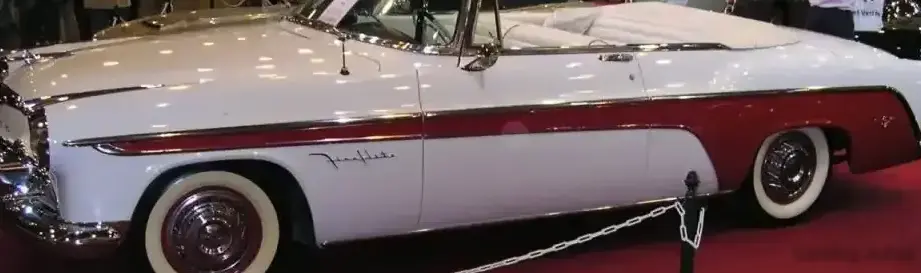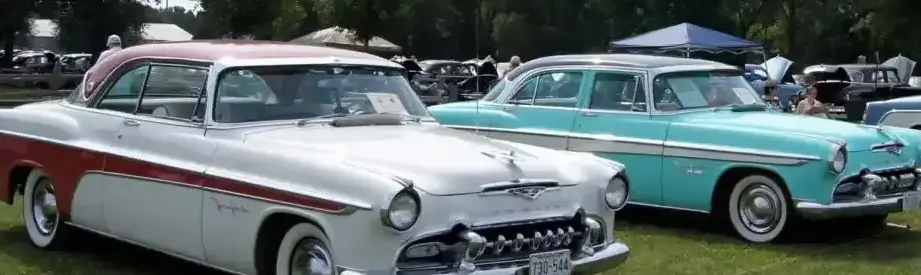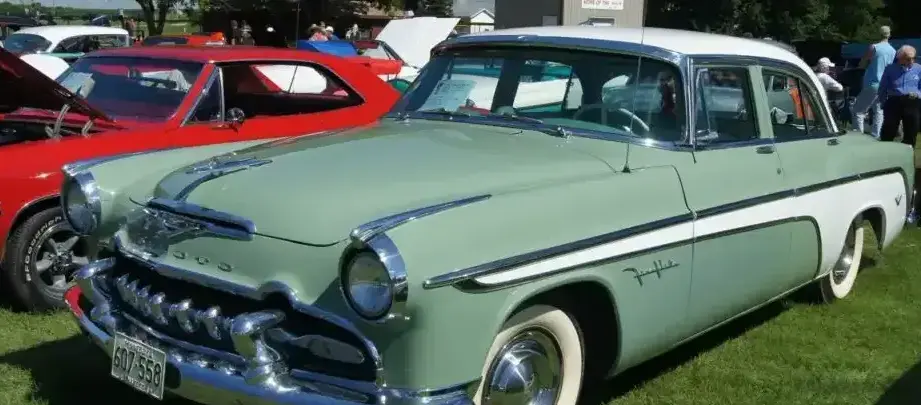
The DeSoto Fireflite I Four-Door Sedan, powered by a 4.8-liter V8 engine and paired with a PowerFlite automatic transmission, represented a significant offering from the Chrysler Corporation’s DeSoto division during the 1954 and 1955 model years. Positioned as a mid-range offering within the Fireflite lineup, it aimed to provide a balance of style, comfort, and performance for American families. The Fireflite, introduced as a replacement for the DeSoto Deluxe, was intended to elevate the brand’s image and compete more effectively with rivals like Buick and Oldsmobile. This particular configuration, the 4.8L V8 with the PowerFlite, was a popular choice, offering a smoother driving experience than the available manual transmission options.
Technical Specifications
| Brand | DeSoto |
| Model | Fireflite |
| Generation | Fireflite I Four-Door Sedan |
| Type (Engine) | 4.8 V8 (200 Hp) PowerFlite |
| Start of production | 1954 |
| End of production | 1955 |
| Powertrain Architecture | Internal Combustion engine |
| Body type | Sedan |
| Seats | 6 |
| Doors | 4 |
| Fuel Type | Petrol (Gasoline) |
| Acceleration 0 – 60 mph | 12.8 sec |
| Power | 200 Hp @ 4400 rpm |
| Power per litre | 41.9 Hp/l |
| Torque | 371 Nm @ 2800 rpm |
| Torque (lb.-ft.) | 273.64 lb.-ft. @ 2800 rpm |
| Engine Model/Code | S22-1001 |
| Engine displacement | 4769 cm3 |
| Engine displacement (cu. in.) | 291.02 cu. in. |
| Number of cylinders | 8 |
| Engine configuration | V-engine |
| Cylinder Bore | 94.49 mm |
| Cylinder Bore (in.) | 3.72 in. |
| Piston Stroke | 84.931 mm |
| Piston Stroke (in.) | 3.34 in. |
| Compression ratio | 7.5:1 |
| Number of valves per cylinder | 2 |
| Fuel injection system | Carburettor |
| Engine aspiration | Naturally aspirated engine |
| Valvetrain | OHV |
| Engine oil capacity | 4.7 l |
| Engine oil capacity (US qt) | 4.97 US qt |
| Engine oil capacity (UK qt) | 4.14 UK qt |
| Coolant capacity | 22.7 l |
| Coolant capacity (US qt) | 23.99 US qt |
| Coolant capacity (UK qt) | 19.97 UK qt |
| Fuel tank capacity | 76 l |
| Fuel tank capacity (US gal) | 20.08 US gal |
| Fuel tank capacity (UK gal) | 16.72 UK gal |
| Length | 5535 mm |
| Length (in.) | 217.91 in. |
| Width | 1989 mm |
| Width (in.) | 78.31 in. |
| Height | 1539 mm |
| Height (in.) | 60.59 in. |
| Wheelbase | 3200 mm |
| Wheelbase (in.) | 125.98 in. |
| Front track | 1529 mm |
| Front track (in.) | 60.2 in. |
| Rear track | 1514 mm |
| Rear track (in.) | 59.61 in. |
| Front overhang | 930 mm |
| Front overhang (in.) | 36.61 in. |
| Rear overhang | 1405 mm |
| Rear overhang (in.) | 55.31 in. |
| Ride height (ground clearance) | 160 mm |
| Ride height (ground clearance) (in.) | 6.3 in. |
| Minimum turning circle | 13.4 m |
| Minimum turning circle (ft.) | 43.96 ft. |
| Approach angle | 21° |
| Departure angle | 12° |
| Ramp-over angle | 11° |
| Drivetrain Architecture | Rear wheel drive |
| Drive wheel | Rear wheel drive |
| Number of gears | 2 |
| Gearbox type | automatic transmission PowerFlite |
| Front suspension | Independent coil spring |
| Rear suspension | Leaf spring |
| Front brakes | Drum, 305 mm |
| Rear brakes | Drum, 305 mm |
| Steering type | Worm-reduction unit |
| Power steering | Hydraulic Steering |
Powertrain & Engine Architecture
The heart of the 1954-1955 DeSoto Fireflite was the S22-1001 4.8-liter (291.02 cubic inch) V8 engine. This engine featured a cast iron block and cylinder heads, with a 7.5:1 compression ratio. It utilized a single Carter carburetor for fuel delivery and an overhead valve (OHV) valvetrain. The engine produced 200 horsepower at 4400 rpm and 371 Nm (273.64 lb.-ft.) of torque at 2800 rpm. The PowerFlite automatic transmission, a two-speed unit, was specifically designed by Chrysler to handle the V8’s output. It was a relatively simple transmission, relying on a fluid coupling and planetary gearsets for smooth, albeit not particularly quick, shifts. The PowerFlite was known for its smoothness and ease of use, making it a popular choice for drivers prioritizing comfort over performance.
Driving Characteristics
The Fireflite I with the 4.8L V8 and PowerFlite offered a comfortable and relaxed driving experience. Acceleration to 60 mph took approximately 12.8 seconds, which was respectable for the era but slower than comparable models equipped with manual transmissions or larger engines. The PowerFlite’s two-speed configuration meant that gear changes were relatively infrequent, and the engine often operated at higher RPMs, contributing to a noticeable level of engine noise. However, the automatic transmission eliminated the need for clutch operation and manual gear selection, appealing to drivers seeking convenience. The car’s substantial weight (approximately 3,700 lbs) and the PowerFlite’s inherent inefficiencies also impacted fuel economy, which was typical for full-size American cars of the 1950s.
Equipment & Trim Levels
The Fireflite I Four-Door Sedan came standard with a generous array of features for the time. These included a spacious interior upholstered in cloth and vinyl, a full-width bench seat, and a large trunk. Standard exterior features included chrome trim, whitewall tires, and a prominent DeSoto grille. Optional extras included power steering (a popular choice), power brakes, a radio, a heater, and two-tone paint schemes. The interior trim was generally conservative, reflecting the era’s emphasis on practicality and comfort. The dashboard featured a straightforward layout with clearly marked gauges and controls.
Chassis & Braking
The Fireflite I rode on a 3200 mm (125.98 inch) wheelbase and featured an independent coil spring suspension in the front and a leaf spring suspension in the rear. This setup provided a reasonably comfortable ride, although it wasn’t particularly sporty. Braking was accomplished via drum brakes on all four wheels, measuring 305 mm in diameter. While adequate for the car’s weight and performance, the drum brakes lacked the stopping power of more modern braking systems. Steering was handled by a worm-reduction unit, with optional hydraulic power steering available for easier maneuverability.
Market Reception & Comparison
The 1954-1955 DeSoto Fireflite was generally well-received by critics and consumers. It was praised for its stylish design, comfortable ride, and reliable V8 engine. However, some reviewers noted that the PowerFlite automatic transmission could feel sluggish compared to manual transmissions, and the car’s fuel economy was relatively poor. Compared to other Fireflite models, such as those equipped with the larger 5.3L V8, the 4.8L version offered a more affordable entry point into the Fireflite range. It appealed to buyers who prioritized comfort and convenience over outright performance. Compared to competitors like the Buick Special and Oldsmobile 88, the Fireflite offered a similar level of luxury and refinement at a competitive price point.
Legacy
The DeSoto Fireflite I Four-Door Sedan, particularly the 4.8L V8/PowerFlite combination, has become a sought-after classic car among collectors and enthusiasts. The S22-1001 V8 engine is known for its durability and relative simplicity, making it relatively easy to maintain. While the PowerFlite transmission can require occasional servicing, it is generally a reliable unit. Today, well-preserved examples of the Fireflite I command respectable prices in the used car market, reflecting their historical significance and enduring appeal. The car represents a quintessential example of 1950s American automotive design and engineering, embodying the optimism and prosperity of the post-war era.