Technical Specifications
| Brand | DeSoto |
| Model | Fireflite |
| Generation | Fireflite I Sportsman |
| Type (Engine) | 4.8 V8 (200 Hp) PowerFlite |
| Start of production | 1954 |
| End of production | 1955 |
| Powertrain Architecture | Internal Combustion engine |
| Body type | Coupe |
| Seats | 6 |
| Doors | 2 |
| Fuel Type | Petrol (Gasoline) |
| Power | 200 Hp @ 4400 rpm |
| Power per litre | 41.9 Hp/l |
| Torque | 371 Nm @ 2800 rpm |
| Torque (lb-ft) | 273.64 lb.-ft. @ 2800 rpm |
| Engine Model/Code | S22-1001 |
| Engine displacement | 4769 cm3 |
| Engine displacement (cu. in.) | 291.02 cu. in. |
| Number of cylinders | 8 |
| Engine configuration | V-engine |
| Cylinder Bore | 94.49 mm |
| Cylinder Bore (in.) | 3.72 in. |
| Piston Stroke | 84.931 mm |
| Piston Stroke (in.) | 3.34 in. |
| Compression ratio | 7.5:1 |
| Number of valves per cylinder | 2 |
| Fuel injection system | Carburettor |
| Engine aspiration | Naturally aspirated engine |
| Valvetrain | OHV |
| Engine oil capacity | 4.7 l |
| Engine oil capacity (US qt) | 4.97 US qt |
| Engine oil capacity (UK qt) | 4.14 UK qt |
| Coolant capacity | 22.7 l |
| Coolant capacity (US qt) | 23.99 US qt |
| Coolant capacity (UK qt) | 19.97 UK qt |
| Fuel tank capacity | 76 l |
| Fuel tank capacity (US gal) | 20.08 US gal |
| Fuel tank capacity (UK gal) | 16.72 UK gal |
| Length | 5535 mm |
| Length (in.) | 217.91 in. |
| Width | 1989 mm |
| Width (in.) | 78.31 in. |
| Height | 1539 mm |
| Height (in.) | 60.59 in. |
| Wheelbase | 3200 mm |
| Wheelbase (in.) | 125.98 in. |
| Front track | 1529 mm |
| Front track (in.) | 60.2 in. |
| Rear track | 1514 mm |
| Rear track (in.) | 59.61 in. |
| Front overhang | 930 mm |
| Front overhang (in.) | 36.61 in. |
| Rear overhang | 1405 mm |
| Rear overhang (in.) | 55.31 in. |
| Ride height (ground clearance) | 160 mm |
| Ride height (ground clearance) (in.) | 6.3 in. |
| Minimum turning circle | 13.4 m |
| Minimum turning circle (ft.) | 43.96 ft. |
| Approach angle | 21° |
| Departure angle | 12° |
| Ramp-over angle | 11° |
| Drivetrain Architecture | Rear wheel drive |
| Number of gears | 2 |
| Gearbox type | Automatic transmission PowerFlite |
| Front suspension | Independent coil spring |
| Rear suspension | Leaf spring |
| Front brakes | Drum, 305 mm |
| Rear brakes | Drum, 305 mm |
| Steering type | Worm-reduction unit |
| Power steering | Hydraulic Steering |
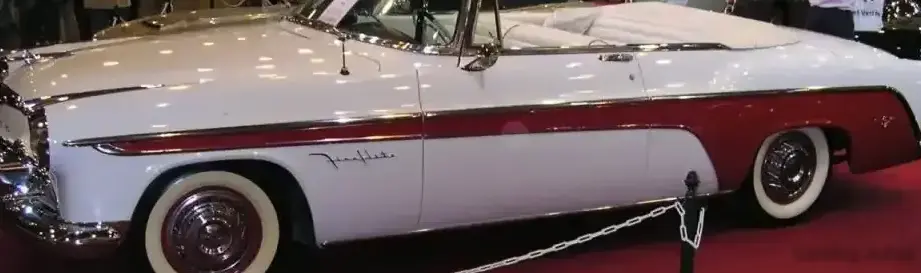
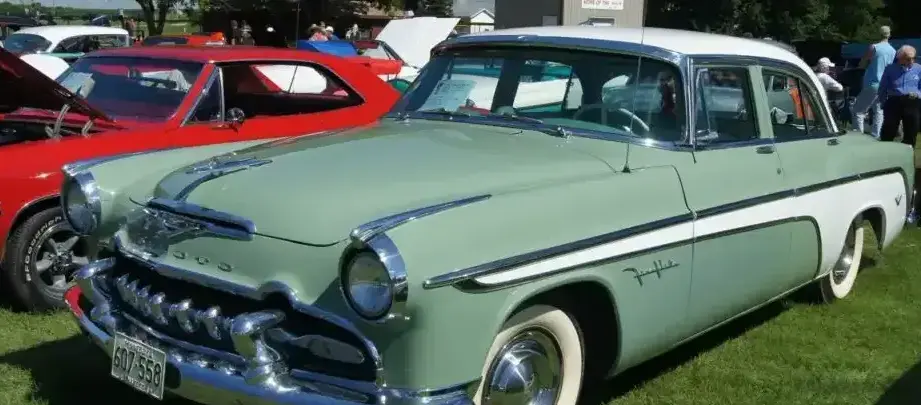
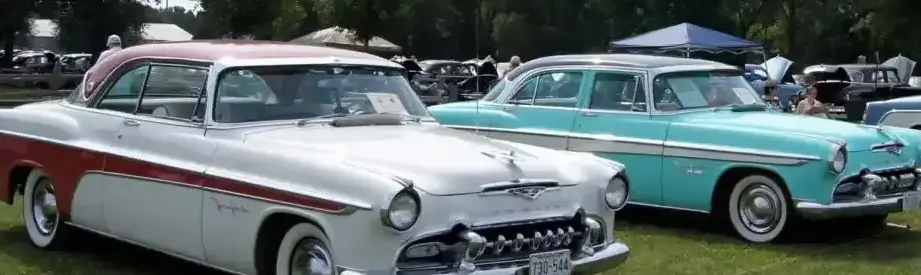
The DeSoto Fireflite I Sportsman, powered by a 4.8-liter V8 engine and paired with the PowerFlite automatic transmission, was a notable offering in the American automotive market of the mid-1950s. Produced for the 1954 and 1955 model years, this variant occupied a middle ground within the Fireflite range, aiming to provide a balance between performance and the convenience of an automatic gearbox. It was part of the first generation of the Fireflite line, a model designed to revitalize the DeSoto brand with more contemporary styling and engineering. The “Sportsman” designation indicated a coupe body style, targeting buyers who desired a stylish and comfortable grand tourer.
Powertrain & Engine Architecture
At the heart of the Fireflite I Sportsman lay the DeSoto S22-1001 4.8-liter (291.02 cubic inch) V8 engine. This engine featured a cast iron block and aluminum cylinder heads, a relatively advanced design for the period. It employed a conventional overhead valve (OHV) valvetrain with two valves per cylinder. Fuel delivery was handled by a Carter carburetor, a common setup for American V8s of the time. The 7.5:1 compression ratio represented a compromise between maximizing performance and accommodating the fuel quality typically available in the mid-1950s. The PowerFlite automatic transmission, a two-speed unit, was a significant selling point for buyers who prioritized ease of driving over outright performance. Introduced by Chrysler Corporation in 1953, it offered smoother shifts compared to earlier automatic transmission designs.
Driving Characteristics
The 200 horsepower and 273.64 lb-ft of torque generated by the 4.8-liter V8 were sufficient for comfortable cruising and passing maneuvers. However, the two-speed PowerFlite transmission limited its acceleration potential when compared to Fireflite models equipped with a manual transmission. The automatic gearbox prioritized smooth operation and convenience, but it lacked the responsiveness and gear selection control offered by a manual. The gear ratios were optimized for highway driving, resulting in a relaxed driving experience at higher speeds. Conversely, initial acceleration could feel somewhat sluggish. Compared to the higher-output versions of the Fireflite, the 1954-1955 4.8L automatic configuration was geared towards a more relaxed and comfortable driving experience.
Equipment & Trim Levels
The Sportsman trim level provided a reasonably well-equipped vehicle. Standard features included a spacious interior with bench seating for six passengers, a full-width windshield, and a heater. Interior upholstery typically consisted of cloth and vinyl, with color options varying based on the exterior paint choice. Optional extras included power steering (a popular choice), power brakes, a radio, and whitewall tires. The dashboard featured a straightforward layout with basic instrumentation, including a speedometer, fuel gauge, and temperature gauge. The Sportsman trim generally positioned itself in the middle of the Fireflite lineup, offering a balance between comfort and features without incurring the added expense of the top-tier models.
Chassis & Braking
The Fireflite I Sportsman utilized a body-on-frame construction, a common practice for American cars of the era. The front suspension employed independent coil springs, providing a relatively comfortable ride. The rear suspension featured leaf springs, which were robust and capable of supporting the car’s weight. Braking was accomplished by drum brakes on all four wheels, measuring 305 mm in diameter. While adequate for the time, the drum brakes lacked the stopping power of later disc brake systems. Steering was via a worm-reduction unit, and power steering was available as an option, simplifying maneuverability, particularly at low speeds.
Market Reception & Comparison
The DeSoto Fireflite I Sportsman was generally well-received by automotive critics, who lauded its stylish design and comfortable ride. However, the two-speed PowerFlite transmission occasionally drew criticism for its lack of responsiveness. Compared to other American cars of the same period, the Fireflite offered a good balance of performance, comfort, and features. Fuel economy was typical for a large American V8 of the 1950s, averaging around 14-16 miles per gallon. Reliability was generally good, although the carburetor required periodic adjustment and maintenance. The Fireflite competed with models from Buick, Oldsmobile, and Mercury.
Legacy
The DeSoto Fireflite I Sportsman, particularly the 4.8-liter V8/PowerFlite combination, represents a significant chapter in American automotive history. Although DeSoto as a brand ultimately disappeared in the 1960s, the Fireflite models remain popular among classic car enthusiasts. The 4.8-liter V8 engine is known for its durability and relative simplicity, making it a relatively straightforward engine to maintain and rebuild. Today, well-preserved examples of the Fireflite I Sportsman are highly sought after by collectors, and the car continues to be enjoyed as a nostalgic reminder of the 1950s automotive era. The PowerFlite transmission, while not renowned for its performance, has proven to be reasonably reliable when properly maintained.