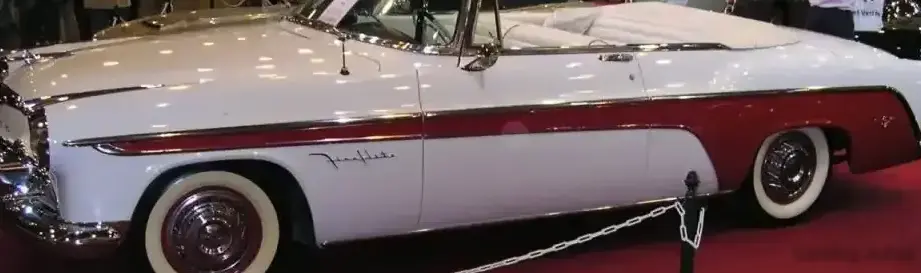
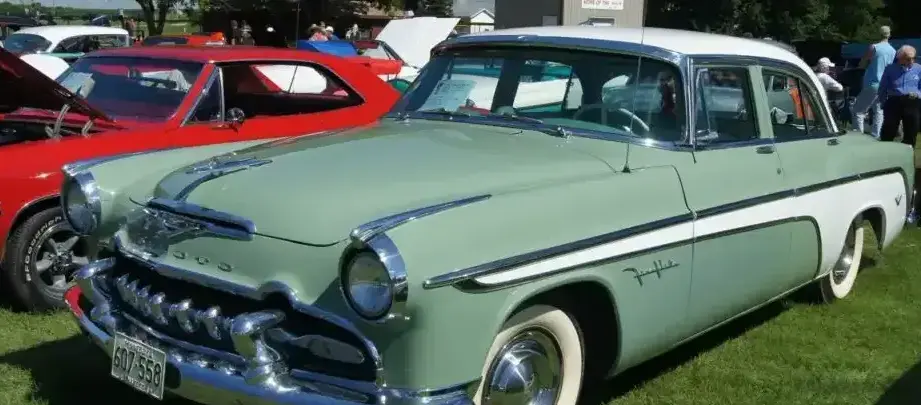
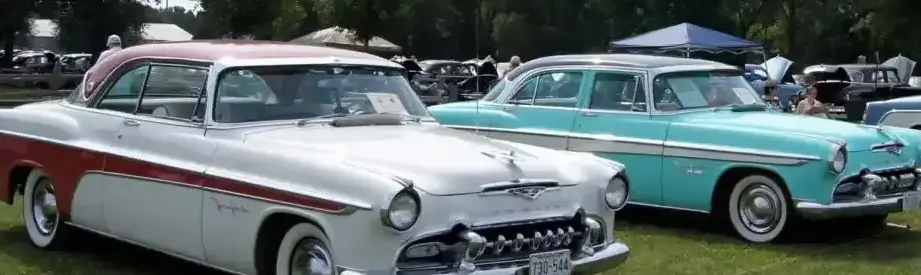
The DeSoto Fireflite II Two-Door Sportsman, equipped with a 5.4-liter V8 engine producing 255 horsepower and paired with a PowerFlite automatic transmission, represented a significant offering in the mid-1950s American automotive landscape. Produced for the 1955 and 1956 model years, this variant occupied a sweet spot within the Fireflite range, balancing performance with the convenience of an automatic gearbox. It was part of the broader Fireflite II generation, a restyling of the original Fireflite introduced in 1952, and aimed at buyers seeking a stylish and powerful coupe.
Technical Specifications
| Brand | DeSoto |
| Model | Fireflite |
| Generation | Fireflite II Two-Door Sportsman |
| Type (Engine) | 5.4 V8 (255 Hp) PowerFlite |
| Start of production | 1955 |
| End of production | 1956 |
| Powertrain Architecture | Internal Combustion engine |
| Body type | Coupe |
| Seats | 6 |
| Doors | 2 |
| Fuel Type | Petrol (Gasoline) |
| Power | 255 Hp @ 4400 rpm |
| Power per litre | 47.2 Hp/l |
| Torque | 475 Nm @ 3200 rpm / 350.34 lb.-ft. @ 3200 rpm |
| Engine Model/Code | S24 |
| Engine displacement | 5408 cm3 / 330.02 cu. in. |
| Number of cylinders | 8 |
| Engine configuration | V-engine |
| Cylinder Bore | 94.49 mm / 3.72 in. |
| Piston Stroke | 96.52 mm / 3.8 in. |
| Compression ratio | 8.5:1 |
| Number of valves per cylinder | 2 |
| Fuel injection system | Carburettor |
| Engine aspiration | Naturally aspirated engine |
| Valvetrain | OHV |
| Engine oil capacity | 3.8 l / 4.02 US qt | 3.34 UK qt |
| Coolant | 22.7 l / 23.99 US qt | 19.97 UK qt |
| Fuel tank capacity | 79 l / 20.87 US gal | 17.38 UK gal |
| Length | 5611 mm / 220.91 in. |
| Width | 1989 mm / 78.31 in. |
| Height | 1473 mm / 57.99 in. |
| Wheelbase | 3200 mm / 125.98 in. |
| Front track | 1534 mm / 60.39 in. |
| Rear (Back) track | 1514 mm / 59.61 in. |
| Front overhang | 930 mm / 36.61 in. |
| Rear overhang | 1481 mm / 58.31 in. |
| Minimum turning circle (turning diameter) | 13.4 m / 43.96 ft. |
| Approach angle | 19° |
| Departure angle | 11° |
| Ramp-over (brakeover) angle | 12° |
| Drivetrain Architecture | The Internal combustion engine (ICE) drives the rear wheels of the vehicle. |
| Drive wheel | Rear wheel drive |
| Number of gears and type of gearbox | 2 gears, automatic transmission PowerFlite |
| Front suspension | Independent coil spring |
| Rear suspension | Leaf spring |
| Front brakes | Drum, 305 mm |
| Rear brakes | Drum, 305 mm |
| Steering type | Worm-reduction unit |
| Power steering | Hydraulic Steering |
Powertrain & Engine Architecture
The heart of the Fireflite II Sportsman was the DeSoto S24 5.4-liter (330 cubic inch) V8 engine. This engine featured a cast iron block and aluminum cylinder heads, utilizing an overhead valve (OHV) configuration. It employed a single Carter carburetor, providing fuel delivery to the engine. The 8.5:1 compression ratio was typical for the era, balancing performance and the ability to run on contemporary gasoline. The engine’s robust design and relatively simple mechanicals made it fairly reliable for its time. The PowerFlite automatic transmission, a two-speed unit, was a key component of this variant. It offered smooth, albeit not particularly quick, gear changes, catering to drivers prioritizing comfort and ease of use over outright performance. The PowerFlite was known for its durability, but its limited number of gears meant the engine often operated at higher RPMs during highway cruising.
Driving Characteristics
The 255 horsepower and 350 lb-ft of torque provided by the 5.4L V8 were substantial for the mid-1950s. However, the two-speed PowerFlite transmission limited the engine’s ability to fully exploit its power potential. Acceleration was brisk, but not as exhilarating as versions equipped with a manual transmission. The automatic transmission’s gear ratios were optimized for everyday driving, providing adequate performance in city traffic and on moderate inclines. Highway cruising was comfortable, but the engine tended to run at higher RPMs, impacting fuel economy. Compared to other Fireflite trims, such as those with higher output engines, the 5.4L automatic offered a more relaxed driving experience, sacrificing some performance for convenience.
Equipment & Trim Levels
The Fireflite II Two-Door Sportsman with the 5.4L V8 and PowerFlite transmission was positioned as a mid-range offering within the Fireflite lineup. Standard features included a spacious interior with comfortable bench seating, a full complement of gauges, and a stylish dashboard design. Upholstery typically consisted of durable cloth or vinyl materials. Optional extras included power steering (a popular choice), power brakes, a radio, and whitewall tires. The “Sportsman” designation indicated a slightly more upscale trim level, often featuring additional chrome trim and more refined interior appointments.
Chassis & Braking
The Fireflite II Sportsman utilized a body-on-frame construction, typical of American cars of the era. The front suspension employed independent coil springs, providing a relatively comfortable ride. The rear suspension featured leaf springs, which were robust and capable of handling the car’s weight. Braking was accomplished via drum brakes on all four wheels. While adequate for the time, the drum brakes lacked the stopping power of modern disc brake systems. Steering was handled by a worm-reduction unit, and power steering was available as an option, making maneuvering the large coupe easier.
Market Reception & Comparison
The DeSoto Fireflite II Two-Door Sportsman 5.4L V8/PowerFlite combination was generally well-received by automotive critics. It was praised for its smooth ride, powerful engine, and stylish design. However, the two-speed automatic transmission was often criticized for limiting the engine’s performance potential and contributing to higher fuel consumption. Compared to other Fireflite trims, the automatic version appealed to buyers who prioritized comfort and convenience over outright speed. It offered a compelling alternative to competitors like the Ford Fairlane and Chevrolet Bel Air, providing a similar level of luxury and performance.
Legacy
The DeSoto Fireflite II Two-Door Sportsman, while not as iconic as some of its contemporaries, remains a desirable classic car today. The 5.4L V8 engine, while not the most powerful DeSoto offered, is known for its durability and relative simplicity. The PowerFlite transmission, while limited in its gear selection, is also considered a reliable unit. Finding well-preserved examples can be challenging, but the Fireflite II Sportsman offers a glimpse into the optimistic and stylish era of 1950s American automotive design. Parts availability can be an issue, but a dedicated community of DeSoto enthusiasts helps to keep these classic cars on the road.