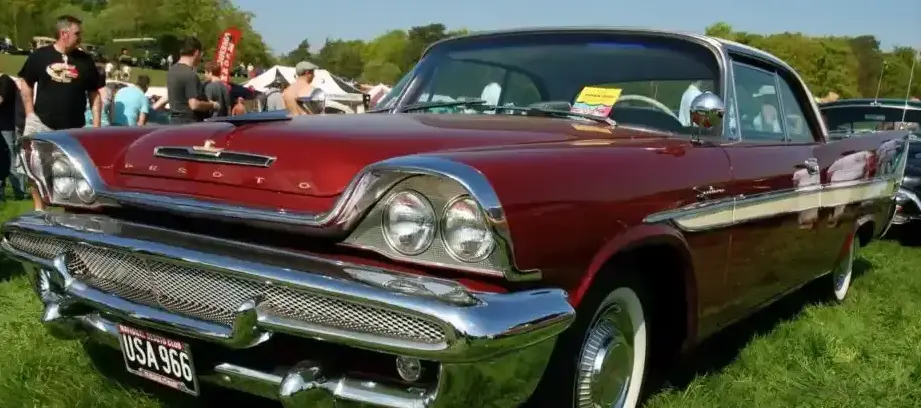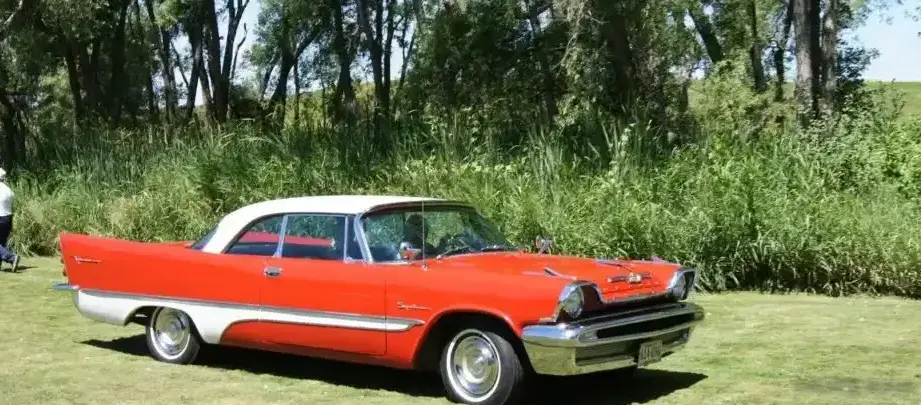
The DeSoto Firesweep I 2-Door Sportsman, powered by a 5.3-liter V8 engine producing 245 horsepower, represented a significant offering from the Chrysler Corporation’s DeSoto division during the 1956 and 1957 model years. Positioned as a stylish and relatively affordable performance coupe, the Firesweep aimed to capture a segment of the American car market seeking a blend of luxury and spirited driving. It was part of the first generation of the Firesweep line, a model intended to revitalize the DeSoto brand with modern styling and engineering. The Sportsman trim, specifically, emphasized a more youthful and sporty aesthetic compared to the more conservatively appointed Firesweep models.
Technical Specifications
| Brand | DeSoto |
| Model | Firesweep |
| Generation | Firesweep I 2-Door Sportsman |
| Type (Engine) | 5.3 V8 (245 Hp) |
| Start of production | 1956 |
| End of production | 1957 |
| Powertrain Architecture | Internal Combustion engine |
| Body type | Coupe |
| Seats | 6 |
| Doors | 2 |
| Fuel Type | Petrol (Gasoline) |
| Power | 245 Hp @ 4400 rpm |
| Power per litre | 46 Hp/l |
| Torque | 434 Nm @ 2400 rpm |
| Torque (lb.-ft.) | 320.1 lb.-ft. @ 2400 rpm |
| Engine Model/Code | S27 |
| Engine displacement | 5326 cm3 |
| Engine displacement (cu. in.) | 325.01 cu. in. |
| Number of cylinders | 8 |
| Engine configuration | V-engine |
| Cylinder Bore | 93.73 mm |
| Cylinder Bore (in.) | 3.69 in. |
| Piston Stroke | 96.52 mm |
| Piston Stroke (in.) | 3.8 in. |
| Compression ratio | 8.5:1 |
| Number of valves per cylinder | 2 |
| Fuel injection system | Carburettor |
| Engine aspiration | Naturally aspirated engine |
| Valvetrain | OHV |
| Engine oil capacity | 4.7 l |
| Engine oil capacity (US qt) | 4.97 US qt |
| Engine oil capacity (UK qt) | 4.14 UK qt |
| Coolant | 19.9 l |
| Coolant (US qt) | 21.03 US qt |
| Coolant (UK qt) | 17.51 UK qt |
| Fuel tank capacity | 76 l |
| Fuel tank capacity (US gal) | 20.08 US gal |
| Fuel tank capacity (UK gal) | 16.72 UK gal |
| Length | 5481 mm |
| Length (in.) | 215.79 in. |
| Width | 1986 mm |
| Width (in.) | 78.19 in. |
| Height | 1440 mm |
| Height (in.) | 56.69 in. |
| Wheelbase | 3099 mm |
| Wheelbase (in.) | 122.01 in. |
| Front track | 1547 mm |
| Front track (in.) | 60.91 in. |
| Rear track | 1516 mm |
| Rear track (in.) | 59.69 in. |
| Front overhang | 925 mm |
| Front overhang (in.) | 36.42 in. |
| Rear overhang | 1458 mm |
| Rear overhang (in.) | 57.4 in. |
| Ride height (ground clearance) | 137 mm |
| Ride height (ground clearance) (in.) | 5.39 in. |
| Minimum turning circle | 13.1 m |
| Minimum turning circle (ft.) | 42.98 ft. |
| Approach angle | 18.9° |
| Departure angle | 12.9° |
| Ramp-over angle | 10.2° |
| Drivetrain Architecture | Rear wheel drive |
| Drive wheel | Rear wheel drive |
| Number of gears | 3 |
| Type of gearbox | Manual transmission |
| Front suspension | Independent coil spring |
| Rear suspension | Leaf spring |
| Steering type | Worm-reduction unit |
Powertrain & Engine Architecture
The heart of the Firesweep I 2-Door Sportsman was the DeSoto S27 5.3-liter (325 cubic inch) V8 engine. This engine, a member of Chrysler’s “Hemi” family (though not a true hemispherical head design), featured overhead valves (OHV) and a two-barrel carburetor. The 8.5:1 compression ratio contributed to the engine’s 245 horsepower output at 4400 rpm and 320.1 lb.-ft. of torque at 2400 rpm. The engine’s robust construction and relatively simple design made it reliable for the era. The standard transmission for the Sportsman was a three-speed manual, although a PowerFlite two-speed automatic transmission was offered as an option. The automatic, while providing convenience, did slightly diminish the car’s acceleration performance.
Driving Characteristics
The 1956-1957 Firesweep I 2-Door Sportsman with the 5.3L V8 and manual transmission offered a reasonably spirited driving experience for its time. While not a dedicated sports car, the engine provided ample power for highway cruising and brisk acceleration. The three-speed manual gearbox allowed for driver control, but the shift linkage wasn’t particularly precise by modern standards. The rear-wheel-drive layout and leaf spring rear suspension provided a comfortable, if somewhat floaty, ride. Compared to the automatic transmission version, the manual offered a more engaging driving experience and slightly improved fuel economy. The Sportsman’s handling was typical of large American cars of the era – body roll was noticeable in corners, and the steering wasn’t particularly quick.
Equipment & Trim Levels
The Firesweep I 2-Door Sportsman was positioned as a mid-range offering within the DeSoto lineup. Standard features included a full wheel cover, two-tone paint schemes, a deluxe steering wheel, and a generously sized interior. The interior typically featured cloth and vinyl upholstery, with options for different color combinations. The dashboard was characterized by a wide, horizontally oriented design with a prominent instrument cluster. Optional extras included power steering, power brakes, a radio, a heater, and whitewall tires. The Sportsman trim also included unique badging and exterior trim elements to differentiate it from other Firesweep models.
Chassis & Braking
The Firesweep I rode on a conventional body-on-frame chassis. The front suspension utilized independent coil springs, providing a more comfortable ride than a solid axle. The rear suspension employed leaf springs, a common design for American cars of the period. Brakes were hydraulic drum brakes on all four wheels, though some later models may have featured front disc brakes as an option. Steering was accomplished via a worm-reduction unit, which provided relatively heavy but solid steering feel. The overall chassis design prioritized ride comfort over sporty handling.
Market Reception & Comparison
The DeSoto Firesweep I 2-Door Sportsman received generally positive reviews from automotive journalists of the time. Critics praised its stylish design, comfortable interior, and strong V8 engine. However, some noted that the car lacked the refinement and handling of some of its European competitors. Compared to other DeSoto models, the Firesweep offered a more youthful and sporty image. Within the broader American market, it competed with similar offerings from Ford, Chevrolet, and Plymouth. The Firesweep’s fuel economy was typical for a large American car of the era, averaging around 15-18 miles per gallon. Reliability was generally good, although DeSoto’s overall reputation for long-term durability wasn’t as strong as some other brands.
Legacy
The DeSoto Firesweep I 2-Door Sportsman, while not a massive sales success, remains a fondly remembered example of 1950s American automotive design. The 5.3-liter V8 engine proved to be a durable and reliable powerplant, and many examples are still on the road today. The Firesweep’s combination of style, performance, and relative affordability made it an appealing choice for buyers seeking a distinctive and enjoyable driving experience. In the used car market, well-maintained Firesweep Sportsman models are sought after by collectors and enthusiasts, representing a piece of American automotive history.