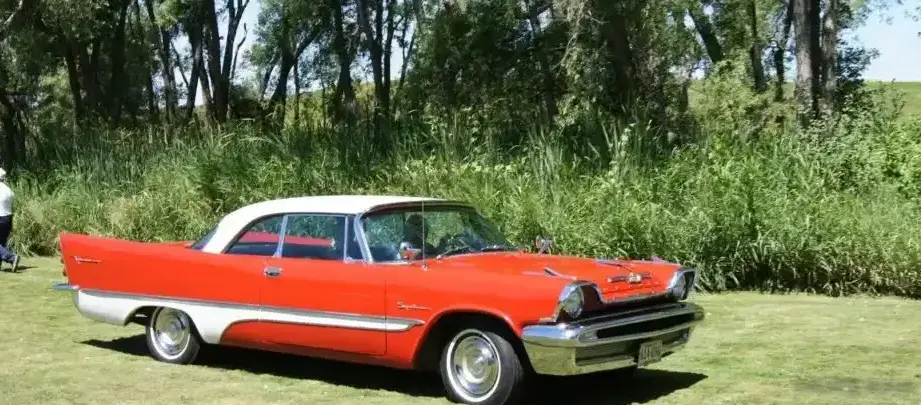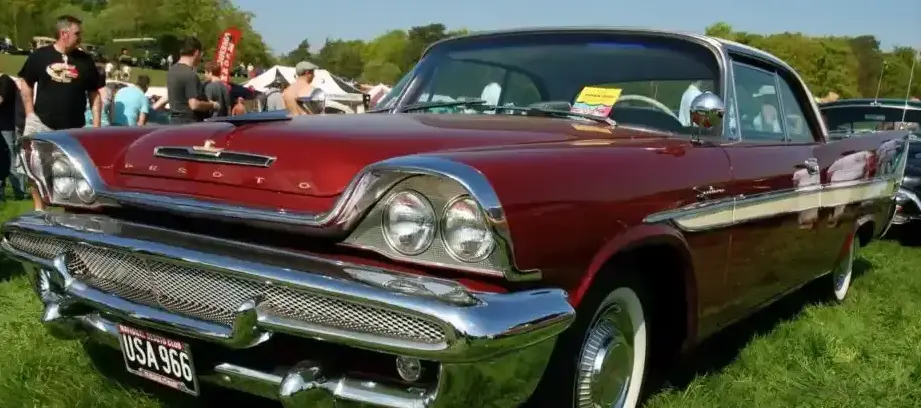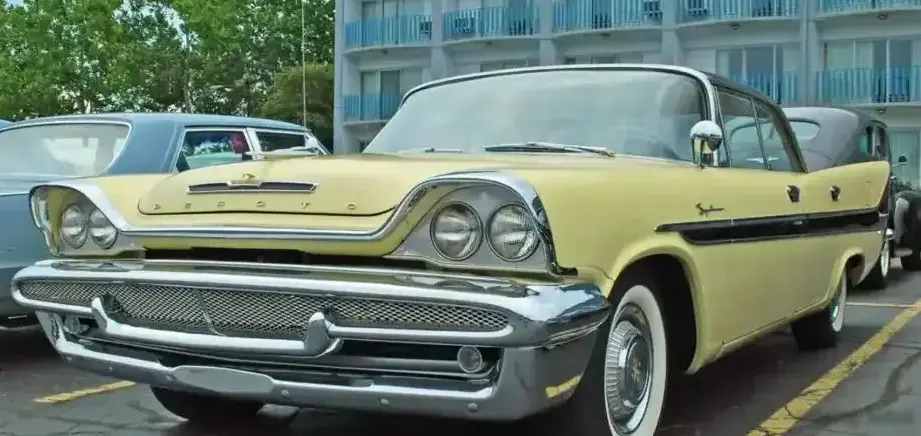
The DeSoto Firesweep I 4-Door Sportsman, specifically the 1958 facelifted model equipped with the PowerPack 5.7 V8 engine producing 295 horsepower, represents a pivotal moment in the final years of the DeSoto marque. Produced from 1957 to 1958, this iteration of the Firesweep aimed to blend styling with performance in the American full-size sedan segment. It sat within the broader Firesweep range, which was DeSoto’s entry-level offering, positioned below the more luxurious DeSoto Adventurer. The 1958 model year saw significant styling revisions, including a more prominent grille and revised tailfin treatment, intended to attract buyers in a competitive market.
Technical Specifications
| Brand | DeSoto |
| Model | Firesweep |
| Generation | Firesweep I 4-Door Sportsman (facelift 1958) |
| Type (Engine) | PowerPack 5.7 V8 (295 Hp) |
| Start of production | 1957 |
| End of production | 1958 |
| Powertrain Architecture | Internal Combustion engine |
| Body type | Sedan |
| Seats | 6 |
| Doors | 4 |
| Fuel Type | Petrol (Gasoline) |
| Power | 295 Hp @ 4600 rpm |
| Power per litre | 51.4 Hp/l |
| Torque | 522 Nm @ 2800 rpm |
| Torque (lb-ft) | 385.01 lb.-ft. @ 2800 rpm |
| Engine displacement | 5735 cm3 |
| Engine displacement (cu. in.) | 349.97 cu. in. |
| Number of cylinders | 8 |
| Engine configuration | V-engine |
| Cylinder Bore | 103.12 mm (4.06 in.) |
| Piston Stroke | 85.85 mm (3.38 in.) |
| Compression ratio | 10:1 |
| Number of valves per cylinder | 2 |
| Fuel injection system | Carburettor |
| Engine aspiration | Naturally aspirated engine |
| Valvetrain | OHV |
| Engine oil capacity | 3.8 l (4.02 US qt | 3.34 UK qt) |
| Coolant capacity | 16.1 l (17.01 US qt | 14.17 UK qt) |
| Fuel tank capacity | 87 l (22.98 US gal | 19.14 UK gal) |
| Length | 5499 mm (216.5 in.) |
| Width | 1989 mm (78.31 in.) |
| Height | 1443 mm (56.81 in.) |
| Wheelbase | 3099 mm (122.01 in.) |
| Front track | 1547 mm (60.91 in.) |
| Rear track | 1516 mm (59.69 in.) |
| Front overhang | 940 mm (37.01 in.) |
| Rear overhang | 1461 mm (57.52 in.) |
| Ride height (ground clearance) | 142 mm (5.59 in.) |
| Minimum turning circle | 14.2 m (46.59 ft.) |
| Approach angle | 16.5° |
| Departure angle | 11.4° |
| Ramp-over angle | 10.5° |
| Drivetrain Architecture | Rear wheel drive |
| Drive wheel | Rear wheel drive |
| Number of gears | 3 |
| Type of gearbox | Manual transmission |
| Front suspension | Independent coil spring |
| Rear suspension | Leaf spring |
| Front brakes | Drum, 279 mm |
| Rear brakes | Drum, 279 mm |
| Steering type | Worm-reduction unit |
Powertrain & Engine Architecture
The heart of the 1958 Firesweep Sportsman was the DeSoto PowerPack 5.7-liter (349.97 cubic inch) V8 engine. This engine, designated with various codes depending on specific configurations, was a cornerstone of DeSoto’s performance offerings. The 1958 version featured a cast iron block and cylinder heads, with a 10:1 compression ratio. Fuel delivery was managed by a Carter carburetor, a common setup for the era. The engine utilized an overhead valve (OHV) valvetrain with two valves per cylinder. The PowerPack designation indicated a higher output version of the 5.7L, achieved through a revised camshaft and improved exhaust manifold design. The engine produced 295 horsepower at 4600 rpm and 522 Nm (385 lb-ft) of torque at 2800 rpm. This power was delivered to the rear wheels through a standard three-speed manual transmission.
Driving Characteristics
The 1958 Firesweep with the 5.7L V8 and manual transmission offered a respectable driving experience for its time. While not a sports car, the engine provided ample power for highway cruising and acceleration. The three-speed manual gearbox, while relatively simple, required deliberate shifting. Compared to other DeSoto models, like those equipped with the smaller 4.8L V8, the PowerPack engine delivered a noticeable performance boost. However, it didn’t match the performance of the larger engines found in the Chrysler New Yorker or Imperial models. The leaf spring rear suspension provided a comfortable ride, but handling was typical of large American sedans of the era – somewhat soft and prone to body roll.
Equipment & Trim Levels
The Firesweep I 4-Door Sportsman, even in its base form, offered a reasonable level of standard equipment for the late 1950s. Standard features included a spacious interior with bench seating for six passengers, a full-width dashboard with a combination of analog gauges, and a steering wheel. The interior trim typically consisted of cloth and vinyl upholstery. Optional extras included power steering, power brakes, a radio, and whitewall tires. The “Sportsman” designation indicated a slightly more upscale trim level, often including additional chrome trim and upgraded interior materials.
Chassis & Braking
The Firesweep I rode on a body-on-frame chassis, a common construction method for American cars of the period. The front suspension utilized independent coil springs, providing a more comfortable ride compared to solid axles. The rear suspension employed leaf springs, which were robust and capable of handling the car’s weight. Braking was accomplished via drum brakes on all four wheels, measuring 279mm in diameter. While adequate for the time, the drum brakes lacked the stopping power of modern disc brake systems. Steering was handled by a worm-reduction unit, which provided a relatively indirect steering feel.
Market Reception & Comparison
The 1958 DeSoto Firesweep faced stiff competition from other American automakers, including Ford, Chevrolet, and Plymouth. Critics generally praised the Firesweep’s styling and the performance of the PowerPack V8 engine. However, some reviewers noted the car’s relatively high price compared to its competitors. Fuel economy, typical for a large American sedan of the era, was not a strong point. Compared to the base Firesweep models with the smaller engine, the 5.7L version offered a significant performance advantage, but at a higher cost. Reliability was generally considered average for the period, with some owners reporting issues with the carburetor and electrical system.
Legacy
The DeSoto Firesweep, and the 1958 facelifted model in particular, represents a poignant chapter in American automotive history. The DeSoto brand was discontinued in 1961 due to declining sales and competition within the Chrysler Corporation. Today, the 1958 Firesweep is a sought-after classic car, particularly those equipped with the PowerPack 5.7 V8 engine. While parts availability can be a challenge, the engine’s robust design and relatively simple mechanics make it a viable candidate for restoration. The 1958 Firesweep serves as a reminder of a bygone era of American automotive design and engineering, embodying the optimism and style of the late 1950s.