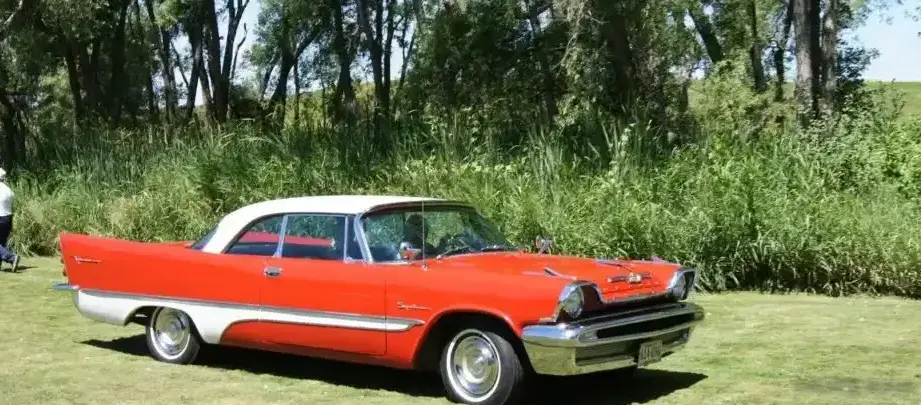
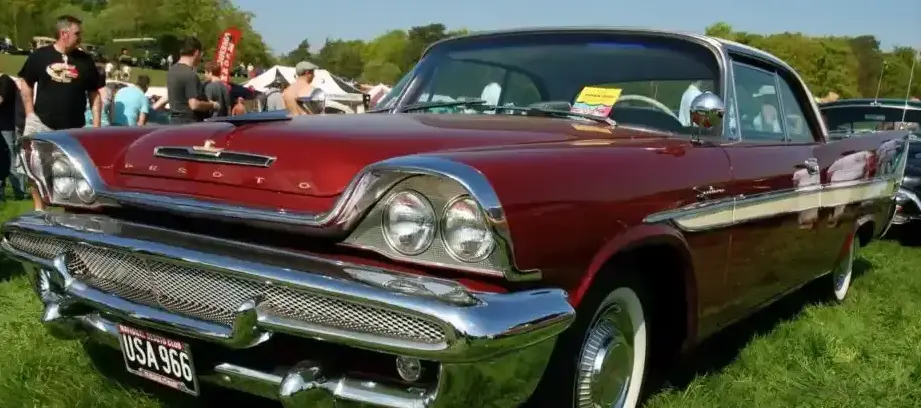
The DeSoto Firesweep I Convertible, particularly the 1959 facelifted model, represents a pivotal, though ultimately short-lived, chapter in the history of the DeSoto division of Chrysler Corporation. Produced for only two model years (1958-1959), the Firesweep was positioned as DeSoto’s entry-level full-size offering, aiming to bridge the gap between the more affordable Plymouth and the luxury-oriented Chrysler models. The 1959 model year saw a significant restyling, characterized by more restrained tailfins and revised trim, reflecting a shift in automotive design trends. This article will focus specifically on the 1959 Firesweep I Convertible equipped with the 5.9-liter (361 cubic inch) V8 engine producing 295 horsepower.
Technical Specifications
| Brand | DeSoto |
| Model | Firesweep |
| Generation | Firesweep I Convertible (facelift 1959) |
| Type (Engine) | 5.9 V8 (295 Hp) |
| Start of production | 1958 |
| End of production | 1959 |
| Powertrain Architecture | Internal Combustion engine |
| Body type | Cabriolet, Coupe |
| Seats | 6 |
| Doors | 2 |
| Fuel Type | Petrol (Gasoline) |
| Weight-to-power ratio | 6.1 kg/Hp, 163.8 Hp/tonne |
| Weight-to-torque ratio | 3.4 kg/Nm, 293.7 Nm/tonne |
| Power | 295 Hp @ 4600 rpm |
| Power per litre | 49.9 Hp/l |
| Torque | 529 Nm @ 2400 rpm, 390.17 lb.-ft. @ 2400 rpm |
| Engine displacement | 5916 cm3, 361.02 cu. in. |
| Number of cylinders | 8 |
| Engine configuration | V-engine |
| Cylinder Bore | 104.65 mm, 4.12 in. |
| Piston Stroke | 85.85 mm, 3.38 in. |
| Compression ratio | 10:1 |
| Number of valves per cylinder | 2 |
| Fuel injection system | Carburettor |
| Engine aspiration | Naturally aspirated engine |
| Valvetrain | OHV |
| Engine oil capacity | 4.7 l, 4.97 US qt | 4.14 UK qt |
| Coolant | 16.1 l, 17.01 US qt | 14.17 UK qt |
| Kerb Weight | 1801 kg, 3970.53 lbs |
| Fuel tank capacity | 76 l, 20.08 US gal | 16.72 UK gal |
| Length | 5514 mm, 217.09 in |
| Width | 1999 mm, 78.7 in |
| Wheelbase | 3099 mm, 122.01 in |
| Front track | 1547 mm, 60.91 in |
| Rear (Back) track | 1516 mm, 59.69 in |
| Ride height (ground clearance) | 140 mm, 5.51 in |
| Minimum turning circle (turning diameter) | 14.2 m, 46.59 ft |
| Approach angle | 15° |
| Departure angle | 10° |
| Ramp-over (brakeover) angle | 10.4° |
| Drivetrain Architecture | The Internal combustion engine (ICE) drives the rear wheels of the vehicle. |
| Drive wheel | Rear wheel drive |
| Number of gears and type of gearbox | 3 gears, manual transmission |
| Front suspension | Independent torsion bar, double wishbone |
| Rear suspension | Leaf spring |
| Front brakes | Drum, 279 mm |
| Rear brakes | Drum, 279 mm |
| Steering type | Worm-reduction unit |
Introduction
The 1959 DeSoto Firesweep Convertible with the 295 hp V8 engine occupied a unique position within the DeSoto lineup. It was the most affordable convertible offered by the brand, targeting buyers who desired the style and prestige of a full-size American car but were mindful of cost. The Firesweep was built on the Chrysler A-body platform, shared with models like the Dodge Coronet and Plymouth Fury, but featured DeSoto-specific styling and trim. The 1959 facelift aimed to modernize the car’s appearance, moving away from the excessive chrome and large tailfins that characterized the late 1950s. Despite the improvements, the Firesweep, and the DeSoto brand as a whole, were discontinued after 1961 due to declining sales and internal restructuring within Chrysler.
Powertrain & Engine Architecture
The heart of the 1959 Firesweep Convertible was the 5.9-liter (361 cubic inch) Chrysler B-series V8 engine. This engine, designated with various codes depending on specific configurations, produced 295 horsepower at 4600 rpm and 400 lb-ft of torque at 2400 rpm. The engine utilized a cast iron block and cylinder heads, with a two-barrel carburetor handling fuel delivery. The valvetrain employed an overhead valve (OHV) configuration with two valves per cylinder. The engine’s design was relatively conventional for the era, prioritizing durability and ease of maintenance. The standard transmission for this model was a three-speed manual, though a TorqueFlite automatic transmission was available as an option. The automatic transmission, a three-speed unit, was a popular choice, offering smoother operation and convenience, though at the expense of some performance.
Driving Characteristics
The 1959 Firesweep Convertible, equipped with the 295 hp V8 and the three-speed manual transmission, offered a respectable driving experience for its time. Acceleration was adequate, but not particularly brisk, with a focus on smooth cruising rather than outright speed. The manual transmission allowed for greater driver control, but the large size and weight of the car (approximately 3,970 lbs) meant that frequent shifting was necessary. The automatic transmission, while providing ease of use, resulted in a noticeable reduction in acceleration and responsiveness. The torsion bar front suspension provided a comfortable ride, while the leaf spring rear suspension offered adequate handling, though it could be prone to bouncing over uneven surfaces. Steering was accomplished through a worm-reduction unit, which provided a somewhat vague and indirect feel.
Equipment & Trim Levels
The 1959 Firesweep Convertible, even in its base configuration, offered a reasonable level of standard equipment. Interior appointments included cloth and vinyl upholstery, a basic instrument panel with speedometer, fuel gauge, and ammeter, and a two-spoke steering wheel. Optional extras included power steering, power brakes, a radio, heater, and whitewall tires. The convertible top was manually operated. Trim levels were relatively limited, with most customization options revolving around color choices and the addition of optional accessories. The Firesweep aimed for a balance between affordability and comfort, offering a step up in features from the base Plymouth models without the full luxury of a Chrysler.
Chassis & Braking
The Firesweep Convertible utilized a body-on-frame construction, typical of American cars of the era. The chassis featured an independent torsion bar suspension at the front and a leaf spring suspension at the rear. Brakes were drum brakes on all four wheels, providing adequate stopping power for the car’s weight and performance. The braking system was not particularly sophisticated by modern standards, lacking power assist in the base configuration. Steering was handled by a worm-reduction unit, which offered relatively heavy steering feel. The car’s relatively long wheelbase (122.01 inches) contributed to a stable ride, but also made it less nimble in tight corners.
Market Reception & Comparison
The 1959 DeSoto Firesweep Convertible received mixed reviews from automotive critics. While praised for its styling and comfortable ride, it was often criticized for its lack of performance compared to some of its competitors, particularly those equipped with larger engines. Compared to the higher-end DeSoto Adventurer, the Firesweep offered less power and fewer luxury features, but at a significantly lower price point. Against the Dodge Coronet and Plymouth Fury, the Firesweep offered a more refined interior and a slightly more prestigious image. Fuel economy, typical for a large American car of the era, was relatively poor. Reliability was generally good, but the car’s complex mechanical systems required regular maintenance.
Legacy
The 1959 DeSoto Firesweep Convertible, while not a commercial success, holds a significant place in automotive history as a representative of the late 1950s American car design. Today, surviving examples are sought after by collectors and enthusiasts, particularly those in original condition. The 5.9-liter V8 engine is known for its durability and relative simplicity, making it a relatively easy engine to maintain and rebuild. The Firesweep’s legacy is one of a stylish, comfortable, and ultimately ill-fated attempt to establish DeSoto as a viable competitor in the full-size car market. The car serves as a reminder of a bygone era of American automotive design and engineering.