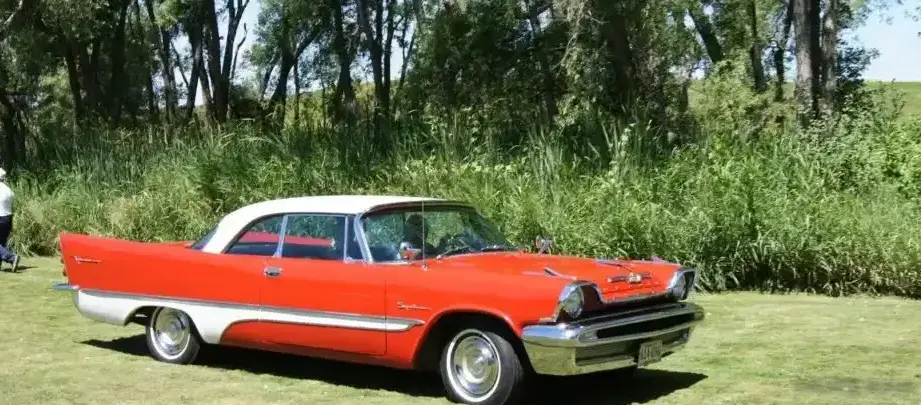
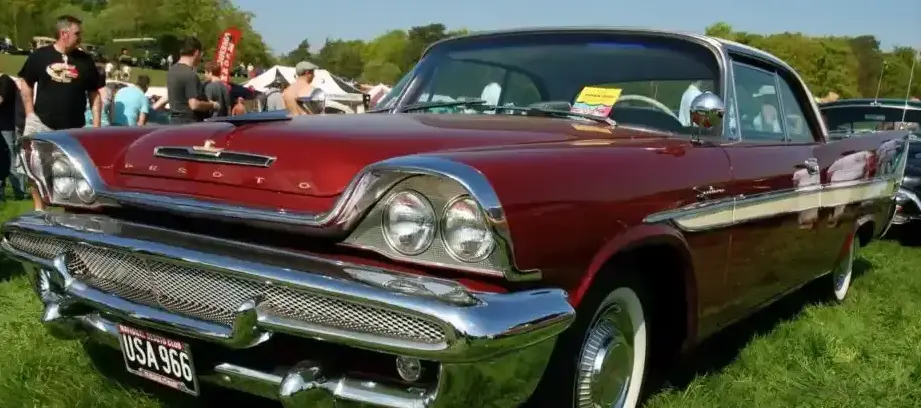
The DeSoto Firesweep I Convertible, particularly the 1959 facelifted model, represents a pivotal moment in the brand’s history, arriving just before its eventual discontinuation. Produced for the 1958 and 1959 model years, the Firesweep was DeSoto’s full-size offering, positioned as a step up from the more economical DeSoto Diplomat. The 1959 model year saw a significant restyling, featuring more pronounced tailfins and revised trim, attempting to capture the burgeoning tastes of the late 1950s American automotive market. This specific variant, equipped with the 5.9-liter V8 engine producing 295 horsepower and paired with the PowerFlite automatic transmission, was a mid-range offering within the Firesweep lineup, balancing performance with the convenience expected by the average American driver.
Technical Specifications
| Brand | DeSoto |
| Model | Firesweep |
| Generation | Firesweep I Convertible (facelift 1959) |
| Type (Engine) | 5.9 V8 (295 Hp) PowerFlite |
| Start of production | 1958 |
| End of production | 1959 |
| Powertrain Architecture | Internal Combustion engine |
| Body type | Cabriolet, Coupe |
| Seats | 6 |
| Doors | 2 |
| Fuel Type | Petrol (Gasoline) |
| Power | 295 Hp @ 4600 rpm |
| Power per litre | 49.9 Hp/l |
| Torque | 529 Nm @ 2400 rpm / 390.17 lb.-ft. @ 2400 rpm |
| Engine displacement | 5916 cm3 / 361.02 cu. in. |
| Number of cylinders | 8 |
| Engine configuration | V-engine |
| Cylinder Bore | 104.65 mm / 4.12 in. |
| Piston Stroke | 85.85 mm / 3.38 in. |
| Compression ratio | 10:1 |
| Number of valves per cylinder | 2 |
| Fuel injection system | Carburettor |
| Engine aspiration | Naturally aspirated engine |
| Valvetrain | OHV |
| Engine oil capacity | 4.7 l / 4.97 US qt | 4.14 UK qt |
| Coolant | 16.1 l / 17.01 US qt | 14.17 UK qt |
| Fuel tank capacity | 76 l / 20.08 US gal | 16.72 UK gal |
| Length | 5514 mm / 217.09 in. |
| Width | 1999 mm / 78.7 in. |
| Wheelbase | 3099 mm / 122.01 in. |
| Front track | 1547 mm / 60.91 in. |
| Rear (Back) track | 1516 mm / 59.69 in. |
| Ride height (ground clearance) | 140 mm / 5.51 in. |
| Minimum turning circle (turning diameter) | 14.2 m / 46.59 ft. |
| Approach angle | 15° |
| Departure angle | 10° |
| Ramp-over (brakeover) angle | 10.4° |
| Drivetrain Architecture | The Internal combustion engine (ICE) drives the rear wheels of the vehicle. |
| Drive wheel | Rear wheel drive |
| Number of gears and type of gearbox | 2 gears, automatic transmission PowerFlite |
| Front suspension | Independent torsion bar, double wishbone |
| Rear suspension | Leaf spring |
| Front brakes | Drum, 279 mm |
| Rear brakes | Drum, 279 mm |
| Steering type | Worm-reduction unit |
Powertrain & Engine Architecture
The heart of this Firesweep variant was the DeSoto 5.9-liter (361 cubic inch) V8 engine. This engine, part of the Chrysler B-series engine family, featured a cast iron block and cylinder heads, with an overhead valve (OHV) configuration. The 10:1 compression ratio and a four-barrel carburetor contributed to the engine’s 295 horsepower output. The PowerFlite automatic transmission, a three-speed unit, was a staple of Chrysler products during this era. It was known for its smooth operation, though it wasn’t particularly sophisticated by modern standards. The PowerFlite utilized a torque converter for smooth launches and gear changes, and while it lacked a manual shift option, it provided a comfortable driving experience for the typical DeSoto buyer. The engine’s design prioritized low-end torque, making it well-suited for cruising and everyday driving, even with the relatively heavy Firesweep body.
Driving Characteristics
The 1959 Firesweep with the 5.9L V8 and PowerFlite transmission offered a comfortable, if not particularly sporty, driving experience. Acceleration was adequate for the time, but it wasn’t a performance-oriented vehicle. The PowerFlite transmission, while smooth, did rob some power from the engine, resulting in slightly slower acceleration compared to the available manual transmission options. The gear ratios were optimized for cruising, making it a pleasant highway car. However, passing maneuvers required careful planning. The torsion bar front suspension provided a reasonably comfortable ride, while the leaf spring rear suspension could be a bit firm, especially on rough roads. The large size and weight of the car were noticeable in corners, and it wasn’t designed for aggressive handling.
Equipment & Trim Levels
The Firesweep I Convertible, in this configuration, was generally well-equipped for the late 1950s. Standard features included full wheel covers, whitewall tires, a deluxe steering wheel, and a generously sized bench seat upholstered in cloth and vinyl. Power steering and power brakes were often included, though they could be optional depending on the specific package. The dashboard featured a prominent instrument cluster with gauges for speed, fuel, temperature, and oil pressure. Optional extras included a radio, air conditioning, and various trim upgrades. The interior trim was typically two-tone, with a variety of color combinations available. The convertible top was power-operated, adding to the convenience factor.
Chassis & Braking
The Firesweep I Convertible utilized a body-on-frame construction, typical of American cars of the era. The front suspension employed an independent torsion bar setup with double wishbones, providing a relatively comfortable ride. The rear suspension consisted of leaf springs, which were more cost-effective but less sophisticated. Braking was handled by drum brakes on all four wheels, measuring 279mm in diameter. While adequate for the time, the drum brakes lacked the stopping power and fade resistance of modern disc brakes. Steering was accomplished via a worm-reduction unit, which provided relatively heavy but precise steering feel.
Market Reception & Comparison
The 1959 Firesweep received mixed reviews from automotive critics. While the styling was generally praised for its boldness and modernity, the car was often criticized for its size, weight, and lack of handling prowess. The 5.9L V8 and PowerFlite combination was seen as a good balance of power and convenience, but it wasn’t considered a particularly exciting powertrain. Compared to other DeSoto models, such as the Diplomat, the Firesweep offered more luxury and performance. However, it was more expensive and less fuel-efficient. Compared to competitors like the Ford Fairlane and Chevrolet Impala, the Firesweep offered a similar level of features and performance, but it struggled to gain significant market share.
Legacy
The DeSoto Firesweep I Convertible, and the DeSoto brand as a whole, ultimately proved to be short-lived. Production ceased in 1961 due to declining sales and Chrysler’s decision to streamline its product lineup. Today, the 1959 Firesweep is a sought-after classic car, particularly the convertible model. The 5.9L V8 engine is known for its reliability and relative simplicity, making it easier to maintain than some of its more complex contemporaries. However, parts availability can be a challenge. The PowerFlite transmission is also generally reliable, but it requires regular fluid changes to prevent problems. The Firesweep represents a unique chapter in American automotive history, embodying the optimism and extravagance of the late 1950s.