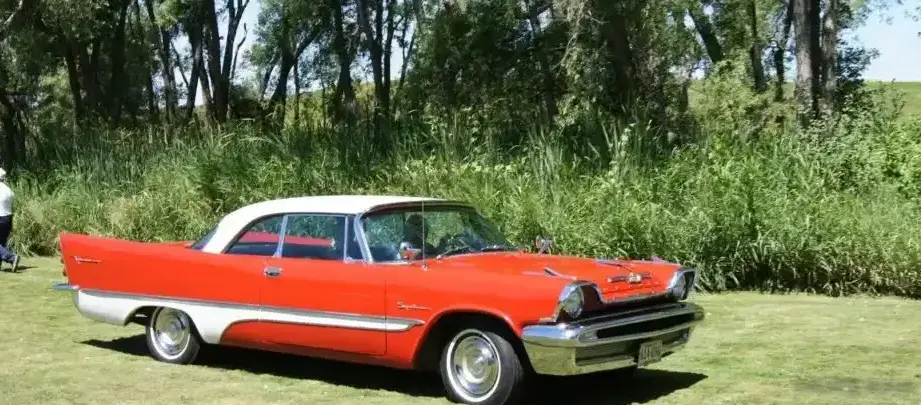
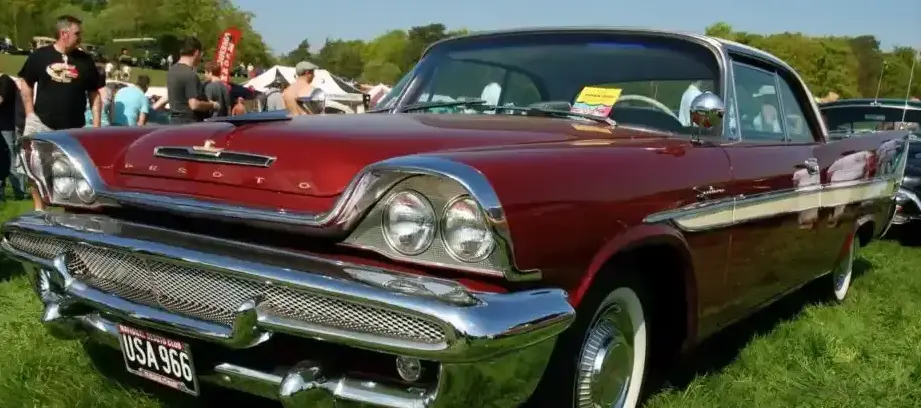
The DeSoto Firesweep I Station Wagon, particularly the 1958 facelifted model equipped with the PowerPack 5.7 V8 engine and PowerFlite automatic transmission, represents a significant, though ultimately short-lived, chapter in the American automotive landscape. Produced from 1957 to 1958, this variant occupied a middle ground within the Firesweep lineup, offering a blend of family practicality and respectable performance for the era. It was part of the first generation of the Firesweep, a full-size car positioned below the DeSoto Adventurer in terms of luxury and price. The Firesweep aimed to capture buyers seeking a stylish and spacious station wagon without the higher cost associated with more premium brands.
Technical Specifications
| Brand | DeSoto |
| Model | Firesweep |
| Generation | Firesweep I Station Wagon (facelift 1958) |
| Type (Engine) | PowerPack 5.7 V8 (295 Hp) PowerFlite |
| Start of production | 1957 |
| End of production | 1958 |
| Powertrain Architecture | Internal Combustion engine |
| Body type | Station wagon (estate) |
| Seats | 6 |
| Doors | 5 |
| Fuel Type | Petrol (Gasoline) |
| Power | 295 Hp @ 4600 rpm |
| Power per litre | 51.4 Hp/l |
| Torque | 522 Nm @ 2800 rpm / 385.01 lb.-ft. @ 2800 rpm |
| Engine displacement | 5735 cm3 / 349.97 cu. in. |
| Number of cylinders | 8 |
| Engine configuration | V-engine |
| Cylinder Bore | 103.12 mm / 4.06 in. |
| Piston Stroke | 85.85 mm / 3.38 in. |
| Compression ratio | 10:1 |
| Number of valves per cylinder | 2 |
| Fuel injection system | Carburettor |
| Engine aspiration | Naturally aspirated engine |
| Valvetrain | OHV |
| Engine oil capacity | 3.8 l / 4.02 US qt | 3.34 UK qt |
| Coolant | 16.1 l / 17.01 US qt | 14.17 UK qt |
| Fuel tank capacity | 87 l / 22.98 US gal | 19.14 UK gal |
| Length | 5540 mm / 218.11 in. |
| Width | 1989 mm / 78.31 in. |
| Height | 1450 mm / 57.09 in. |
| Wheelbase | 3099 mm / 122.01 in. |
| Front track | 1547 mm / 60.91 in. |
| Rear (Back) track | 1516 mm / 59.69 in. |
| Ride height (ground clearance) | 142 mm / 5.59 in. |
| Minimum turning circle (turning diameter) | 14.2 m / 46.59 ft. |
| Drivetrain Architecture | The Internal combustion engine (ICE) drives the rear wheels of the vehicle. |
| Drive wheel | Rear wheel drive |
| Number of gears and type of gearbox | 2 gears, automatic transmission PowerFlite |
| Front suspension | Independent coil spring |
| Rear suspension | Leaf spring |
| Front brakes | Drum, 279 mm |
| Rear brakes | Drum, 279 mm |
| Steering type | Worm-reduction unit |
Powertrain & Engine Architecture
The heart of this Firesweep variant was the DeSoto PowerPack 5.7 V8 engine. This engine, displacing 5735 cubic centimeters (349.97 cubic inches), was a robust and relatively modern design for its time. It featured a cast iron block and cylinder heads, with a 10:1 compression ratio. The engine utilized a carbureted fuel system, typical of American V8s of the late 1950s, and an overhead valve (OHV) valvetrain. The PowerPack designation indicated a slightly higher performance version of the standard DeSoto V8, achieving 295 horsepower at 4600 rpm and 522 Nm (385.01 lb.-ft.) of torque at 2800 rpm. This power was delivered to the rear wheels through the Chrysler Corporation’s PowerFlite two-speed automatic transmission. The PowerFlite, while not as sophisticated as some contemporary automatics, was known for its durability and smooth operation. It was a torque converter type transmission, providing relatively seamless shifts.
Driving Characteristics
The combination of the 295 hp V8 and the PowerFlite automatic transmission resulted in a driving experience that prioritized comfortable cruising over outright acceleration. While the engine produced ample torque, the two-speed automatic limited the vehicle’s ability to accelerate quickly. The PowerFlite’s gear ratios were optimized for highway driving, making the Firesweep a capable long-distance cruiser. Compared to Firesweeps equipped with a manual transmission, the automatic version felt less responsive, particularly during passing maneuvers. However, the automatic transmission appealed to a broader audience, especially families who valued ease of use over sporty performance. The large size and weight of the station wagon also contributed to a somewhat ponderous feel, especially around corners.
Equipment & Trim Levels
The 1958 Firesweep station wagon, with the PowerPack V8 and PowerFlite, was positioned as a mid-range offering within the Firesweep lineup. Standard features included a spacious interior with seating for six passengers, ample cargo space, and a relatively well-appointed dashboard. Interior upholstery typically consisted of durable cloth and vinyl materials. Options included power steering, power brakes, a radio, and whitewall tires. The exterior featured DeSoto’s signature styling cues of the era, including prominent tailfins and generous chrome trim. The station wagon body style added practicality with its large rear cargo area and fold-down rear seat.
Chassis & Braking
The Firesweep I Station Wagon utilized a traditional body-on-frame construction. The front suspension featured independent coil springs, providing a relatively comfortable ride. The rear suspension employed leaf springs, which were more robust and better suited for carrying heavy loads. Braking duties were handled by drum brakes on all four wheels, measuring 279 mm in diameter. While adequate for the time, the drum brakes lacked the stopping power of more modern disc brake systems. Steering was accomplished via a worm-reduction unit, which provided a somewhat indirect steering feel.
Market Reception & Comparison
The 1958 DeSoto Firesweep, including the PowerPack V8/PowerFlite variant, received mixed reviews from automotive critics. While the styling was generally praised, the performance was considered adequate but not exceptional. The PowerFlite automatic transmission was appreciated for its smoothness, but its limited number of gears was seen as a drawback. Compared to other station wagons of the era, such as those offered by Chevrolet and Ford, the Firesweep offered a similar level of comfort and practicality, but often at a slightly higher price point. Fuel economy, typical for a large American V8 of the 1950s, was relatively poor.
Legacy
The DeSoto Firesweep I Station Wagon, and the DeSoto brand as a whole, had a relatively short lifespan. Production ceased in 1961 due to declining sales and Chrysler’s decision to streamline its model lineup. Today, the 1958 Firesweep station wagon is a sought-after classic car, particularly among enthusiasts of 1950s American automobiles. The PowerPack 5.7 V8 engine, while not known for being particularly high-strung, is generally considered to be a reliable and durable powerplant. Parts availability can be a challenge, but a dedicated network of classic DeSoto owners and suppliers exists to support restoration and maintenance efforts. The Firesweep represents a unique and stylish chapter in American automotive history, embodying the optimism and design sensibilities of the late 1950s.