
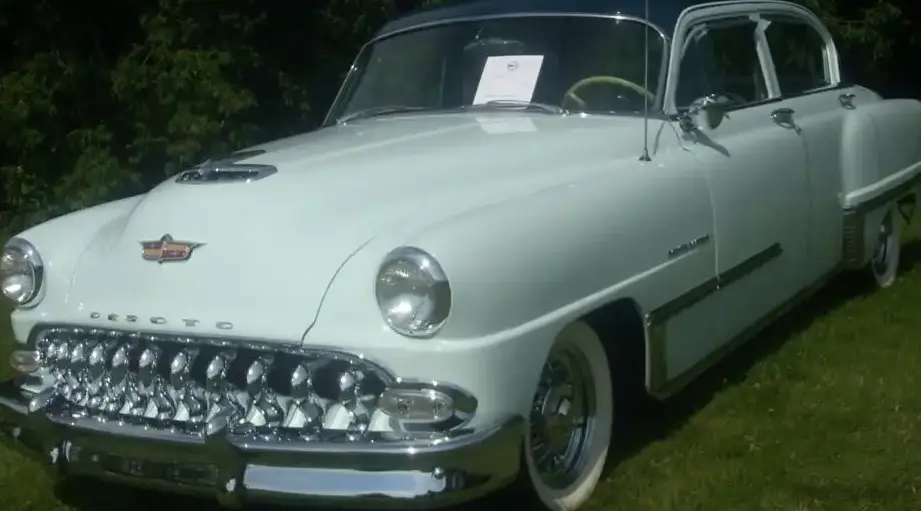
The DeSoto Powermaster Six 4-Door Sedan, powered by a 4.1-liter (250.56 cubic inch) inline-six engine producing 116 horsepower, represented a significant offering in the early 1950s American automotive landscape. Produced for the 1952 and 1953 model years, this vehicle occupied a middle ground within the DeSoto lineup, aiming to provide comfortable family transportation with a blend of style and affordability. It was part of the broader Powermaster series, which sought to deliver robust performance and durability, characteristics valued by American car buyers of the era.
Technical Specifications
| Brand | DeSoto |
| Model | Powermaster Six |
| Generation | Powermaster Six 4-Door Sedan |
| Type (Engine) | 4.1 (116 Hp) |
| Start of production | 1952 |
| End of production | 1953 |
| Powertrain Architecture | Internal Combustion engine |
| Body type | Sedan |
| Seats | 6 |
| Doors | 4 |
| Fuel Type | Petrol (Gasoline) |
| Power | 116 Hp @ 3600 rpm |
| Power per litre | 28.3 Hp/l |
| Torque | 282 Nm @ 1600 rpm |
| Torque (lb-ft) | 207.99 lb.-ft. @ 1600 rpm |
| Engine displacement | 4106 cm3 |
| Engine displacement (cu. in.) | 250.56 cu. in. |
| Number of cylinders | 6 |
| Engine configuration | Inline |
| Cylinder Bore | 87.31 mm (3.44 in.) |
| Piston Stroke | 114.3 mm (4.5 in.) |
| Compression ratio | 7:1 |
| Number of valves per cylinder | 2 |
| Fuel injection system | Carburettor |
| Engine aspiration | Naturally aspirated engine |
| Engine oil capacity | 4.7 l (4.97 US qt | 4.14 UK qt) |
| Coolant capacity | 15.1 l (15.96 US qt | 13.29 UK qt) |
| Fuel tank capacity | 64 l (16.91 US gal | 14.08 UK gal) |
| Length | 5420 mm (213.39 in.) |
| Width | 1963 mm (77.28 in.) |
| Height | 1588 mm (62.52 in.) |
| Wheelbase | 3188 mm (125.51 in.) |
| Front track | 1430 mm (56.3 in.) |
| Rear track | 1513 mm (59.57 in.) |
| Drag coefficient (Cd) | 0.6 |
| Minimum turning circle | 13 m (42.65 ft.) |
| Drivetrain Architecture | Rear wheel drive |
| Drive wheel | Rear wheel drive |
| Number of gears | 3 |
| Type of gearbox | Manual transmission |
| Front suspension | Independent coil spring |
| Rear suspension | Leaf spring |
| Front brakes | Drum, 305 mm |
| Rear brakes | Drum, 305 mm |
Powertrain & Engine Architecture
The heart of the Powermaster Six was DeSoto’s 4.1-liter inline-six engine. This engine, designated within the Chrysler corporation as part of their broad range of six-cylinder designs, featured a cast iron block and cylinder head. It utilized a single downdraft carburetor for fuel delivery, a common setup for the period. The engine employed a relatively low 7:1 compression ratio, a characteristic of the era’s gasoline formulations. The valvetrain consisted of two valves per cylinder, operated by a conventional pushrod system. The 116 horsepower output was achieved at 3600 rpm, while peak torque of 282 Nm (207.99 lb-ft) arrived at a relatively low 1600 rpm, suggesting a focus on usable low-end power for everyday driving. The engine was mated to a three-speed manual transmission as standard, delivering power to the rear wheels.
Driving Characteristics
The 1952-1953 DeSoto Powermaster Six with the 4.1-liter engine and manual transmission offered a driving experience typical of full-size American cars of the time. Acceleration was adequate for the period, but not particularly sporty. The low-end torque provided reasonable responsiveness in city driving, while highway cruising was possible, though requiring downshifts for passing maneuvers. The three-speed manual transmission, while offering driver control, lacked the convenience of later automatic options. The suspension, featuring independent coil springs in the front and leaf springs in the rear, provided a comfortable ride, absorbing bumps and imperfections in the road. However, handling was not a strong point, with noticeable body roll in corners. Compared to potential upgrades within the Powermaster line, such as the V8 options, the six-cylinder model prioritized fuel economy and affordability over outright performance.
Equipment & Trim Levels
The Powermaster Six 4-Door Sedan was positioned as a practical and reasonably well-equipped family car. Standard features included a spacious interior with seating for six passengers, upholstered in durable cloth or vinyl. The dashboard featured a straightforward layout with basic instrumentation, including a speedometer, fuel gauge, and temperature gauge. Exterior styling was typical of the early 1950s, with chrome trim, wraparound windshields, and generous use of brightwork. Optional extras included a radio, heater, whitewall tires, and upgraded interior trim. The trim level was generally consistent across the Powermaster Six range, with variations primarily relating to exterior paint colors and interior upholstery choices.
Chassis & Braking
The Powermaster Six utilized a traditional body-on-frame construction, common for American cars of the era. The chassis was robust and designed to withstand the rigors of everyday use. The front suspension employed independent coil springs, providing a more comfortable ride compared to solid axles. The rear suspension utilized leaf springs, a cost-effective and durable design. Braking was accomplished via drum brakes on all four wheels, measuring 305 mm in diameter. While adequate for the time, the drum brakes lacked the stopping power and fade resistance of later disc brake systems. Steering was accomplished via a conventional steering box, providing a somewhat indirect feel.
Market Reception & Comparison
The DeSoto Powermaster Six was generally well-received by the motoring press as a solid and reliable family car. Critics praised its comfortable ride, spacious interior, and durable powertrain. However, it was often criticized for its somewhat bland styling and lack of sporting pretensions. Compared to other six-cylinder offerings from competitors like Ford and Chevrolet, the Powermaster Six was considered to be competitive in terms of price and features. The V8-powered DeSoto models offered significantly more performance, but at a higher cost. Fuel economy, while not a primary concern for most buyers at the time, was reasonable for a full-size car of the period. Reliability was generally good, although maintenance requirements were typical for a 1950s vehicle.
Legacy
The DeSoto Powermaster Six, while not a particularly rare or collectible car today, represents an important chapter in American automotive history. The 4.1-liter inline-six engine proved to be a durable and reliable powerplant, and many examples remain on the road today. The Powermaster Six’s legacy lies in its embodiment of the post-war American dream – a comfortable, spacious, and affordable family car. In the used car market, these DeSotos are appreciated by enthusiasts for their classic styling, simple mechanicals, and relatively low cost of ownership. Parts availability can be a challenge, but a dedicated network of DeSoto owners and suppliers helps to keep these vehicles running for generations to come.

