
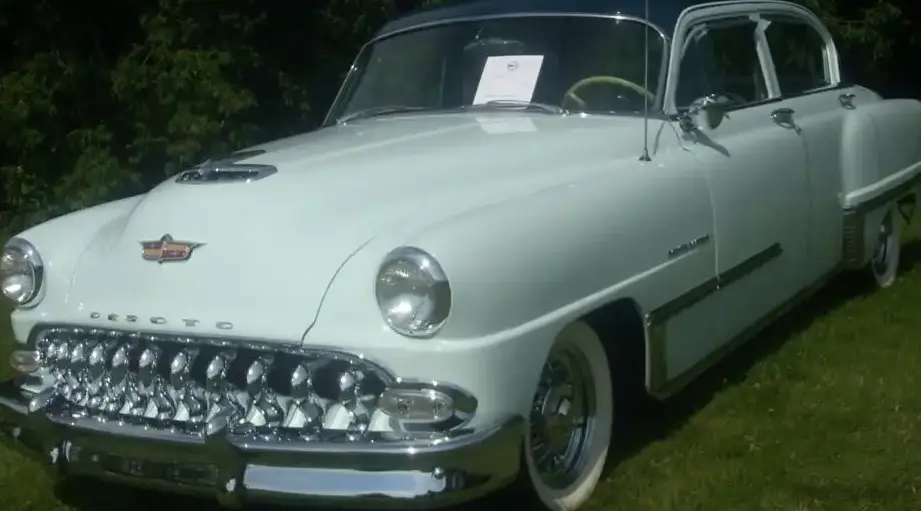
The DeSoto Powermaster Six 4-Door Sedan, equipped with a 4.1-liter engine producing 116 horsepower and paired with a PowerFlite automatic transmission, represented a significant offering in the early 1950s American automotive landscape. Produced for the 1953 and 1954 model years, this variant occupied a middle ground within the Powermaster lineup, aiming to balance affordability with the styling and comfort expected of a full-size American car. It was part of the broader effort by DeSoto to establish itself as a premium, yet accessible, brand within the Chrysler Corporation.
Technical Specifications
| Brand | DeSoto |
| Model | Powermaster Six |
| Generation | Powermaster Six 4-Door Sedan |
| Type (Engine) | 4.1 (116 Hp) PowerFlite |
| Start of production | 1953 |
| End of production | 1954 |
| Powertrain Architecture | Internal Combustion engine |
| Body type | Sedan |
| Seats | 6 |
| Doors | 4 |
| Fuel Type | Petrol (Gasoline) |
| Power | 116 Hp @ 3600 rpm |
| Power per litre | 28.3 Hp/l |
| Torque | 282 Nm @ 1600 rpm / 207.99 lb.-ft. @ 1600 rpm |
| Engine displacement | 4105 cm3 / 250.5 cu. in. |
| Number of cylinders | 6 |
| Engine configuration | Inline |
| Cylinder Bore | 87.31 mm / 3.44 in. |
| Piston Stroke | 114.3 mm / 4.5 in. |
| Compression ratio | 7:1 |
| Number of valves per cylinder | 2 |
| Fuel injection system | Carburettor |
| Engine aspiration | Naturally aspirated engine |
| Engine oil capacity | 4.7 l / 4.97 US qt | 4.14 UK qt |
| Coolant | 15.1 l / 15.96 US qt | 13.29 UK qt |
| Fuel tank capacity | 64 l / 16.91 US gal | 14.08 UK gal |
| Length | 5448 mm / 214.49 in. |
| Width | 1969 mm / 77.52 in. |
| Height | 1632 mm / 64.25 in. |
| Wheelbase | 3188 mm / 125.51 in. |
| Front track | 1403 mm / 55.24 in. |
| Rear (Back) track | 1438 mm / 56.61 in. |
| Front overhang | 940 mm / 37.01 in. |
| Rear overhang | 1321 mm / 52.01 in. |
| Ride height (ground clearance) | 178 mm / 7.01 in. |
| Drag coefficient (Cd) | 0.6 |
| Minimum turning circle (turning diameter) | 12.8 m / 41.99 ft. |
| Approach angle | 23° |
| Departure angle | 17° |
| Ramp-over (brakeover) angle | 15° |
| Drivetrain Architecture | The Internal combustion engine (ICE) drives the rear wheels of the vehicle. |
| Drive wheel | Rear wheel drive |
| Number of gears and type of gearbox | 2 gears, automatic transmission PowerFlite |
| Front suspension | Independent coil spring |
| Rear suspension | Leaf spring |
| Front brakes | Drum, 305 mm |
| Rear brakes | Drum, 305 mm |
Powertrain & Engine Architecture
The heart of the Powermaster Six was DeSoto’s 4.1-liter (250.5 cubic inch) inline-six cylinder engine. This engine, designated within Chrysler as the A-series, was a robust and relatively simple design. It featured a cast iron block and cylinder head, with two valves per cylinder operated by a single overhead camshaft. Fuel delivery was managed by a Carter carburetor, typical for the era. The 7:1 compression ratio was a compromise between performance and the fuel quality available at the time. The engine produced 116 horsepower at 3600 rpm and 282 Nm (207.99 lb-ft) of torque at 1600 rpm. This torque figure was particularly important for a large, heavy car like the Powermaster.
The PowerFlite automatic transmission, introduced by Chrysler in 1953, was a two-speed unit. It was a significant step forward in automatic transmission technology, offering smoother shifts than earlier designs. However, it lacked the multiple gears found in later automatics, and its operation relied heavily on hydraulic pressure and a torque converter. The PowerFlite was designed for durability and ease of maintenance, but its limited gear selection meant that the engine often operated at higher RPMs, potentially impacting fuel economy.
Driving Characteristics
The 116-horsepower Powermaster Six Automatic offered adequate, but not exhilarating, performance. Acceleration was leisurely by modern standards, and the two-speed PowerFlite transmission meant that the engine had to work harder to maintain speed, especially when climbing hills or passing other vehicles. Compared to the higher-output V8 engines offered in other DeSoto models, the Six felt noticeably less powerful. However, the PowerFlite transmission provided a level of convenience that appealed to many buyers, particularly those who preferred a relaxed driving experience. The gear ratios were optimized for cruising, making the Powermaster Six a comfortable highway car, but it lacked the responsiveness of manual transmission versions or those equipped with more powerful engines.
Equipment & Trim Levels
The Powermaster Six 4-Door Sedan was generally well-equipped for its time, though it wasn’t as lavishly appointed as the top-of-the-line DeSoto models. Standard features included a spacious interior with comfortable bench seats, a heater, and a basic instrument panel. Upholstery was typically cloth, though optional upgrades to vinyl were available. The dashboard featured a straightforward layout with clearly marked gauges. Optional extras included a radio, whitewall tires, and various trim enhancements. The Powermaster Six aimed to provide a good balance of features and affordability, making it an attractive option for families and those seeking a comfortable and reliable full-size car.
Chassis & Braking
The Powermaster Six utilized a traditional body-on-frame construction, common for American cars of the era. The front suspension featured independent coil springs, providing a relatively comfortable ride. The rear suspension employed leaf springs, which were robust and capable of handling the car’s weight. Braking was accomplished by drum brakes on all four wheels, measuring 305mm in diameter. While adequate for the time, the drum brakes lacked the stopping power and fade resistance of later disc brake systems. Steering was provided by a recirculating ball system, which offered reasonable precision but required considerable effort at low speeds.
Market Reception & Comparison
The DeSoto Powermaster Six Automatic received mixed reviews from automotive critics. While praised for its comfortable ride and spacious interior, it was often criticized for its lack of power and the limitations of the two-speed PowerFlite transmission. Compared to other six-cylinder offerings from competitors like Ford and Chevrolet, the Powermaster Six was generally considered to be on par in terms of performance and features. However, it often carried a slightly higher price tag. Fuel economy was typical for a full-size American car of the 1950s, averaging around 14-16 miles per gallon. Reliability was generally good, though the PowerFlite transmission could be prone to issues if not properly maintained.
Legacy
The DeSoto Powermaster Six 4-Door Sedan, particularly the 4.1-liter/PowerFlite combination, represents a snapshot of early 1950s American automotive engineering. While not a high-performance machine, it offered a comfortable and reliable transportation option for families. Today, these cars are sought after by collectors and enthusiasts, particularly those interested in preserving a piece of automotive history. The inline-six engine and PowerFlite transmission, while relatively simple designs, are known for their durability and ease of repair. However, finding parts can be challenging, and proper maintenance is essential to keep these classic cars running smoothly. The Powermaster Six remains a testament to the design philosophies and engineering practices of a bygone era.

