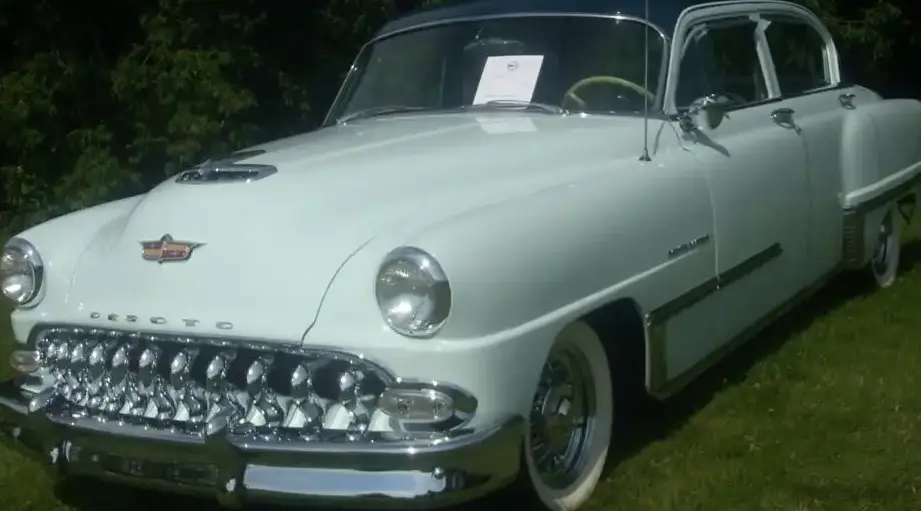
The DeSoto Powermaster Six All-Steel Station Wagon, as presented in its 1954 facelift, represented a significant offering from the DeSoto division of Chrysler Corporation during the early 1950s. Produced for the 1953 and 1954 model years, this station wagon was built upon the robust foundation of the Powermaster line, aiming to provide American families with a spacious and comfortable vehicle for both daily transportation and leisure activities. This particular variant featured a 4.1-liter (250.5 cubic inch) inline-six engine paired with a two-speed PowerFlite automatic transmission, positioning it as a mid-range option within the Powermaster lineup. The all-steel construction was a modern feature for the time, offering improved durability and safety compared to earlier body-on-wood designs.
Technical Specifications
| Brand | DeSoto |
| Model | Powermaster Six |
| Generation | Powermaster Six All-Steel Station Wagon (facelift 1954) |
| Type (Engine) | 4.1 (116 Hp) PowerFlite |
| Start of production | 1953 |
| End of production | 1954 |
| Powertrain Architecture | Internal Combustion engine |
| Body type | Station wagon (estate) |
| Seats | 6 |
| Doors | 5 |
| Fuel Type | Petrol (Gasoline) |
| Power | 116 Hp @ 3600 rpm |
| Power per litre | 28.3 Hp/l |
| Torque | 282 Nm @ 1600 rpm |
| Torque (lb-ft) | 207.99 lb.-ft. @ 1600 rpm |
| Engine displacement | 4105 cm3 |
| Engine displacement (cu. in.) | 250.5 cu. in. |
| Number of cylinders | 6 |
| Engine configuration | Inline |
| Cylinder Bore | 87.31 mm |
| Cylinder Bore (in.) | 3.44 in. |
| Piston Stroke | 114.3 mm |
| Piston Stroke (in.) | 4.5 in. |
| Compression ratio | 7:1 |
| Number of valves per cylinder | 2 |
| Fuel injection system | Carburettor |
| Engine aspiration | Naturally aspirated engine |
| Engine oil capacity | 4.7 l |
| Engine oil capacity (US qt) | 4.97 US qt |
| Engine oil capacity (UK qt) | 4.14 UK qt |
| Coolant capacity | 15.1 l |
| Coolant capacity (US qt) | 15.96 US qt |
| Coolant capacity (UK qt) | 13.29 UK qt |
| Length | 5439 mm |
| Length (in.) | 214.13 in. |
| Width | 1972 mm |
| Width (in.) | 77.64 in. |
| Height | 1632 mm |
| Height (in.) | 64.25 in. |
| Wheelbase | 3188 mm |
| Wheelbase (in.) | 125.51 in. |
| Front track | 1403 mm |
| Front track (in.) | 55.24 in. |
| Rear track | 1514 mm |
| Rear track (in.) | 59.61 in. |
| Drag coefficient (Cd) | 0.6 |
| Minimum turning circle | 13.1 m |
| Minimum turning circle (ft) | 42.98 ft. |
| Drivetrain Architecture | Rear wheel drive |
| Number of gears | 2 |
| Gearbox type | automatic transmission PowerFlite |
| Front suspension | Independent coil spring |
| Rear suspension | Leaf spring |
| Front brakes | Drum, 305 mm |
| Rear brakes | Drum, 305 mm |
| Steering type | Worm-reduction unit |
| Power steering | Hydraulic Steering |
Powertrain & Engine Architecture
The heart of the 1954 DeSoto Powermaster Six Station Wagon was its 4.1-liter inline-six cylinder engine. Designated with various codes depending on specific configurations, this engine was a robust and relatively simple design. It featured a cast iron block and cylinder head, with a two-barrel carburetor managing fuel delivery. The engine utilized a 7:1 compression ratio and a two-valve-per-cylinder configuration. The PowerFlite automatic transmission, introduced by Chrysler in 1953, was a two-speed unit. While not as sophisticated as some contemporary automatics, it provided smoother operation than manual transmissions, appealing to a broader range of drivers. The PowerFlite was known for its relatively simple design and durability, though it wasn’t particularly fuel-efficient by modern standards.
Driving Characteristics
The combination of the 116 horsepower engine and the two-speed PowerFlite transmission resulted in a driving experience geared towards comfortable cruising rather than spirited performance. Acceleration was adequate for the time, but the Powermaster Six Station Wagon was not designed for rapid acceleration. The PowerFlite transmission’s limited number of gears meant that the engine often operated at higher RPMs during highway driving, contributing to a noticeable level of engine noise. Compared to the higher-output V8 engines offered in other DeSoto models, the six-cylinder version provided a more economical option, but at the expense of outright power. The two-speed automatic did offer a simpler driving experience than the available three-speed manual transmission.
Equipment & Trim Levels
The Powermaster Six Station Wagon, even in its base configuration, offered a reasonable level of standard equipment for the early 1950s. Standard features typically included a spacious interior with cloth upholstery, a heater, and a basic AM radio. The station wagon body style itself was considered a premium offering, providing ample cargo space for families. Optional extras included power steering (a notable feature for the time), whitewall tires, and upgraded interior trim. The dashboard layout was typical of American cars of the era, featuring a large speedometer and various indicator lights. The interior trim was generally conservative, reflecting the Powermaster’s positioning as a practical family vehicle.
Chassis & Braking
The DeSoto Powermaster Six Station Wagon utilized a body-on-frame construction, common for American cars of the period. The chassis featured an independent coil spring suspension in the front, providing a relatively comfortable ride. The rear suspension employed a traditional leaf spring setup, which was robust but less refined than the front suspension. Braking was accomplished via drum brakes on all four wheels, measuring 305mm in diameter. While adequate for the vehicle’s weight and performance, the drum brakes lacked the stopping power of later disc brake systems. Steering was handled by a worm-reduction unit, and power steering was available as an option, making maneuvering the large station wagon easier.
Market Reception & Comparison
The DeSoto Powermaster Six Station Wagon was generally well-received by the American public, particularly families seeking a spacious and practical vehicle. Critics praised the all-steel construction and the comfortable ride. However, the six-cylinder engine and two-speed automatic transmission were sometimes criticized for their lack of performance compared to V8-powered competitors. Fuel economy, while not a primary concern for most buyers at the time, was also not a strong point of the Powermaster Six. Compared to other station wagons of the era, such as those offered by Ford and Chevrolet, the DeSoto Powermaster Six occupied a middle ground in terms of price, performance, and features.
Legacy
The 1953-1954 DeSoto Powermaster Six Station Wagon, while not a particularly rare or highly sought-after classic today, represents a significant piece of American automotive history. The powertrain, while relatively simple, proved to be reasonably durable, and many examples remain on the road today. The PowerFlite automatic transmission, while not known for its efficiency, was a pioneering design that helped to popularize automatic transmissions in American cars. In the used car market, these station wagons are often appreciated for their spaciousness, classic styling, and relative affordability. They represent a nostalgic reminder of a bygone era of American automotive design and engineering.