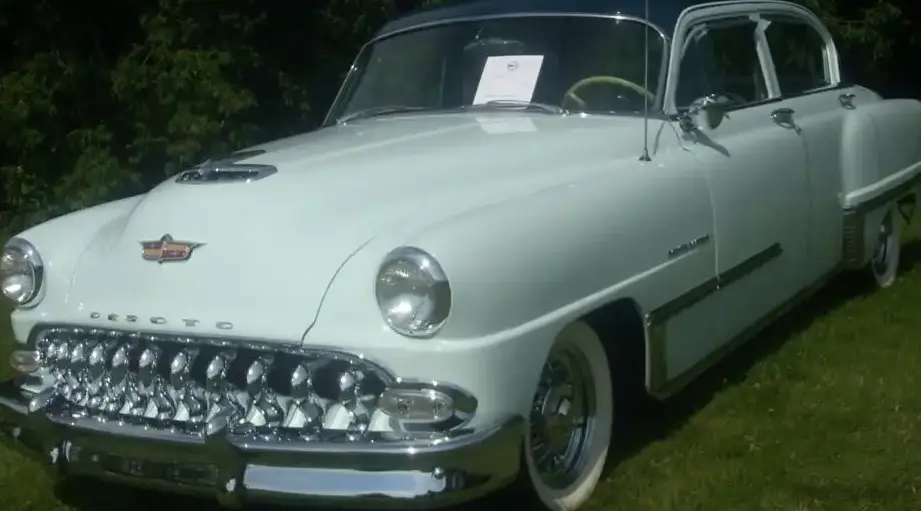
The DeSoto Powermaster Six Club Coupe, specifically the 4.1-liter (250.56 cubic inch) 116 horsepower variant, represented a significant offering in the early 1950s American automotive landscape. Produced for the 1952 and 1953 model years, this iteration of the Powermaster Six occupied a middle ground within the DeSoto lineup, aiming to provide a balance of style, comfort, and affordability. It was part of the broader Powermaster series, which served as DeSoto’s full-size offering during this period, positioned above the entry-level DeLuxe models. The Club Coupe body style, a two-door configuration with seating for six, was a popular choice for families and those seeking a stylish yet practical vehicle.
Technical Specifications
| Brand | DeSoto |
| Model | Powermaster Six |
| Generation | Powermaster Six Club Coupe |
| Type (Engine) | 4.1 (116 Hp) |
| Start of production | 1952 |
| End of production | 1953 |
| Powertrain Architecture | Internal Combustion engine |
| Body type | Coupe |
| Seats | 6 |
| Doors | 2 |
| Fuel Type | Petrol (Gasoline) |
| Power | 116 Hp @ 3600 rpm |
| Power per litre | 28.3 Hp/l |
| Torque | 282 Nm @ 1600 rpm |
| Torque (lb.-ft.) | 207.99 lb.-ft. @ 1600 rpm |
| Engine displacement | 4106 cm3 |
| Engine displacement (cu. in.) | 250.56 cu. in. |
| Number of cylinders | 6 |
| Engine configuration | Inline |
| Cylinder Bore | 87.31 mm (3.44 in.) |
| Piston Stroke | 114.3 mm (4.5 in.) |
| Compression ratio | 7:1 |
| Number of valves per cylinder | 2 |
| Fuel injection system | Carburettor |
| Engine aspiration | Naturally aspirated engine |
| Engine oil capacity | 4.7 l (4.97 US qt | 4.14 UK qt) |
| Coolant capacity | 15.1 l (15.96 US qt | 13.29 UK qt) |
| Fuel tank capacity | 64 l (16.91 US gal | 14.08 UK gal) |
| Length | 5420 mm (213.39 in.) |
| Width | 1963 mm (77.28 in.) |
| Height | 1588 mm (62.52 in.) |
| Wheelbase | 3188 mm (125.51 in.) |
| Front track | 1430 mm (56.3 in.) |
| Rear track | 1513 mm (59.57 in.) |
| Drag coefficient (Cd) | 0.6 |
| Minimum turning circle | 13 m (42.65 ft.) |
| Drivetrain Architecture | Rear wheel drive |
| Number of gears | 3 |
| Type of gearbox | Manual transmission |
| Front suspension | Independent coil spring |
| Rear suspension | Leaf spring |
| Front brakes | Drum, 305 mm |
| Rear brakes | Drum, 305 mm |
Powertrain & Engine Architecture
The heart of the 1952-1953 DeSoto Powermaster Six Club Coupe was its 4.1-liter inline-six cylinder engine. This engine, internally designated with various codes depending on specific production runs, was a robust and relatively simple design. It featured a cast iron block and cylinder head, with a two-barrel carburetor managing fuel delivery. The 7:1 compression ratio was typical for the era, balancing performance with the availability of regular gasoline. The engine utilized a conventional pushrod valvetrain with two valves per cylinder. The 116 horsepower output at 3600 rpm, while not groundbreaking, provided adequate power for comfortable cruising and everyday driving. Torque peaked at 282 Nm (207.99 lb.-ft.) at 1600 rpm, offering reasonable pulling power for its time. The engine was paired with a standard three-speed manual transmission, delivering power to the rear wheels.
Driving Characteristics
The Powermaster Six Club Coupe, equipped with the 4.1-liter engine and manual transmission, offered a driving experience characteristic of large American cars of the early 1950s. Acceleration was adequate but not sporty, with the focus being on smooth, comfortable cruising. The three-speed manual transmission required deliberate shifting, and the gear ratios were optimized for relaxed highway travel rather than quick acceleration. The relatively high weight of the vehicle (approximately 1,670 kg or 3,680 lbs) contributed to a feeling of substantiality and stability on the road. Compared to potential upgrades like the V8 engines offered in other DeSoto models, the six-cylinder version prioritized fuel economy and lower maintenance costs. The manual transmission provided a more engaging driving experience than an automatic, allowing the driver to better control the engine’s power band.
Equipment & Trim Levels
The Club Coupe trim level for the Powermaster Six offered a respectable level of standard equipment for the period. The interior typically featured cloth upholstery, though optional upgrades to leather were available. A full-width bench seat provided seating for three passengers in the front and three in the rear. The dashboard was relatively simple, featuring a speedometer, fuel gauge, and ammeter. Optional extras included a radio, heater, whitewall tires, and various trim enhancements. The exterior styling was typical of the era, with generous chrome accents, a prominent grille, and flowing lines. The two-door coupe body style offered a more sporty appearance than the four-door sedan.
Chassis & Braking
The DeSoto Powermaster Six Club Coupe utilized a body-on-frame construction, common for American cars of the time. The front suspension employed independent coil springs, providing a relatively comfortable ride. The rear suspension featured leaf springs, which were robust and capable of handling the vehicle’s weight. Braking was accomplished via drum brakes on all four wheels, measuring 305 mm in diameter. While adequate for the time, the drum brakes lacked the stopping power of modern disc brake systems. Steering was accomplished via a conventional steering box, providing a somewhat indirect but manageable steering feel.
Market Reception & Comparison
The DeSoto Powermaster Six Club Coupe was generally well-received by contemporary automotive critics. It was praised for its comfortable ride, spacious interior, and stylish design. However, some critics noted that the six-cylinder engine lacked the performance of the V8 engines offered by competitors. Compared to other DeSoto models, the Powermaster Six represented a more affordable option, appealing to buyers who prioritized value and practicality. Fuel economy, while not a primary concern for most buyers in the 1950s, was reasonably good for a full-size car of its era. Reliability was generally considered to be good, although maintenance requirements were higher than those of more modern vehicles.
Legacy
Today, the 1952-1953 DeSoto Powermaster Six Club Coupe is considered a classic American automobile. While not as highly sought after as some of its more powerful V8-equipped siblings, the six-cylinder version remains a popular choice among collectors and enthusiasts. The 4.1-liter inline-six engine is known for its durability and relative simplicity, making it a relatively easy engine to maintain and repair. Parts availability can be a challenge, but a dedicated network of DeSoto enthusiasts and parts suppliers exists. The Powermaster Six Club Coupe represents a significant chapter in American automotive history, embodying the style and optimism of the early 1950s.