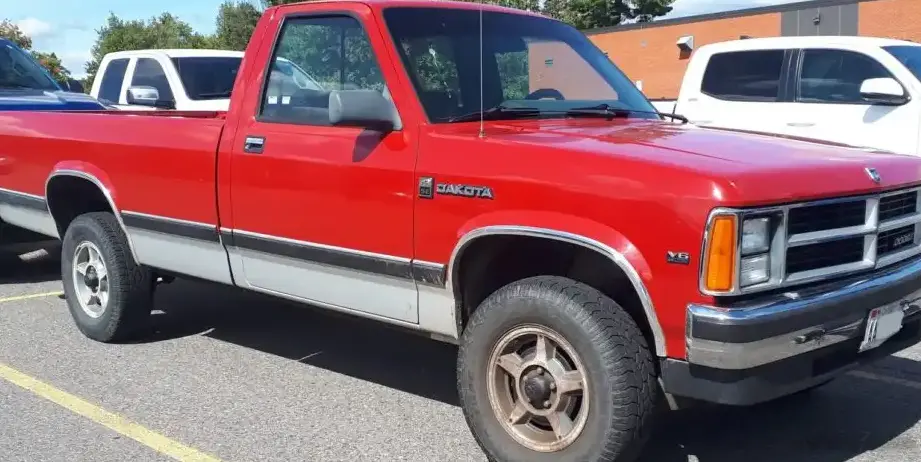
The Dodge Dakota III, specifically the facelifted version produced from 2007 to 2011, represented Dodge’s mid-size pickup truck offering in the North American market. This generation, built on the Dakota TX platform, aimed to provide a versatile and capable truck for both personal and commercial use. The 3.7-liter V6 engine paired with a four-speed automatic transmission and four-wheel drive (4×4) configuration was a popular choice, positioned as a balance between affordability, capability, and fuel efficiency within the Dakota lineup. It served as the entry-level engine option for those requiring four-wheel drive, slotting below the more powerful 4.7-liter V8 and the optional manual transmission variants.
Technical Specifications
| Brand | Dodge |
| Model | Dakota |
| Generation | Dakota III (facelift 2007) |
| Type (Engine) | 3.7 V6 (214 Hp) 4×4 Automatic |
| Start of production | 2007 |
| End of production | 2011 |
| Powertrain Architecture | Internal Combustion engine |
| Body type | Pick-up |
| Seats | 5 |
| Doors | 4 |
| Fuel consumption (urban) | 16.8 l/100 km (14 US mpg, 16.8 UK mpg, 6 km/l) |
| Fuel consumption (extra urban) | 13.1 l/100 km (18 US mpg, 21.6 UK mpg, 7.6 km/l) |
| Fuel consumption (combined) | 15.7 l/100 km (15 US mpg, 18 UK mpg, 6.4 km/l) |
| Fuel Type | Petrol (Gasoline) |
| Maximum speed | 180 km/h (111.85 mph) |
| Power | 214 Hp @ 5200 rpm |
| Power per litre | 57.8 Hp/l |
| Torque | 319 Nm @ 4000 rpm (235.28 lb.-ft. @ 4000 rpm) |
| Engine layout | Front, Longitudinal |
| Engine Model/Code | EKG |
| Engine displacement | 3701 cm3 (225.85 cu. in.) |
| Number of cylinders | 6 |
| Engine configuration | V-engine |
| Cylinder Bore | 93 mm (3.66 in.) |
| Piston Stroke | 90.8 mm (3.57 in.) |
| Compression ratio | 9.3:1 |
| Number of valves per cylinder | 2 |
| Fuel injection system | Multi-port manifold injection |
| Engine aspiration | Naturally aspirated engine |
| Engine oil capacity | 4.7 l (4.97 US qt | 4.14 UK qt) |
| Coolant capacity | 12.5 l (13.21 US qt | 11 UK qt) |
| Fuel tank capacity | 83 l (21.93 US gal | 18.26 UK gal) |
| Length | 5550 mm (218.5 in.) |
| Width | 1930 mm (75.98 in.) |
| Height | 1730 mm (68.11 in.) |
| Wheelbase | 3335 mm (131.3 in.) |
| Front track | 1595 mm (62.8 in.) |
| Rear track | 1598 mm (62.91 in.) |
| Drive wheel | All wheel drive (4×4) |
| Number of gears and type of gearbox | 5 gears, automatic transmission |
| Front suspension | Independent torsion bar, double wishbone |
| Rear suspension | Dependent suspension of two longitudinal semi-elliptic leaf springs |
| Front brakes | Ventilated discs |
| Rear brakes | Disc |
| Assisting systems | ABS (Anti-lock braking system) |
| Tires size | 245/70 R16 |
| Wheel rims size | 7J x 16 |
Powertrain & Engine Architecture
The heart of this Dakota variant is the 3.7-liter EKG V6 engine. This engine, part of Chrysler’s then-new Global Engine Manufacturing Alliance (GEMA) partnership with Hyundai, was designed to offer a modern, efficient alternative to older Chrysler V6 designs. It features a 60-degree V-angle, a cast iron block with aluminum cylinder heads, and dual overhead camshafts (DOHC) with two valves per cylinder. The multi-port fuel injection system delivers fuel directly to each intake port, optimizing combustion. The 42RLE four-speed automatic transmission was the standard pairing for this engine. While not known for its cutting-edge technology, the 42RLE was a reliable unit, providing smooth shifts and adequate performance for everyday driving. The transmission’s gear ratios were tuned for a balance of acceleration and fuel economy, prioritizing usability over outright performance.
Driving Characteristics
The 3.7L V6 and automatic transmission combination in the Dakota 4×4 delivered adequate, but not exhilarating, performance. With 214 horsepower and 235 lb-ft of torque, acceleration was sufficient for typical pickup truck duties, such as hauling moderate loads and navigating city streets. However, compared to the available 4.7-liter V8, the 3.7L felt noticeably less powerful, especially when fully loaded or climbing steep inclines. The automatic transmission, while smooth, lacked the responsiveness of a manual gearbox. The 4×4 system provided enhanced traction in slippery conditions, making it suitable for light off-road use and inclement weather. The overall driving experience was comfortable and predictable, prioritizing practicality over sporty handling.
Equipment & Trim Levels
The 3.7L 4×4 Dakota typically came standard with features like air conditioning, power windows and locks, a basic audio system, and cloth upholstery. Higher trim levels, such as the SLT, added features like alloy wheels, upgraded audio systems, keyless entry, and premium cloth or leather upholstery. Optional extras included a towing package, a sunroof, and a navigation system. The interior design was functional and durable, reflecting the truck’s work-oriented nature. The dashboard layout was straightforward, with easy-to-read gauges and logically placed controls.
Chassis & Braking
The Dakota III utilized a body-on-frame construction, providing a robust and durable platform. The front suspension featured an independent torsion bar setup with a double wishbone design, offering a comfortable ride and decent handling. The rear suspension employed a traditional leaf spring setup, which was well-suited for carrying loads. Braking duties were handled by ventilated discs up front and solid discs in the rear. Anti-lock brakes (ABS) were standard, enhancing safety and control during emergency braking situations. The 4×4 system employed a part-time transfer case, allowing the driver to switch between two-wheel drive and four-wheel drive as needed.
Market Reception & Comparison
The 3.7L Dakota 4×4 was generally well-received as a value-oriented pickup truck. Critics praised its affordability, comfortable ride, and decent fuel economy for a mid-size truck. However, some reviewers noted its lack of power compared to V8-powered competitors and the somewhat dated interior design. Compared to the 4.7L V8 Dakota, the 3.7L offered significantly better fuel economy but at the expense of performance. The 3.7L also proved to be more reliable than some of the earlier Dakota models, with fewer reports of major mechanical issues.
Legacy
The 3.7L V6-powered Dakota 4×4 has become a relatively affordable and dependable used pickup truck. The EKG engine, while not known for being particularly exciting, has proven to be reasonably durable with proper maintenance. Common issues include oil leaks and occasional sensor failures, but these are generally inexpensive to repair. Today, these Dakotas are often sought after by those needing a capable and reliable truck for light-duty work or as a daily driver. The combination of four-wheel drive, a comfortable interior, and a reasonable price point makes it a compelling option in the used truck market.