Technical Specifications
| Brand | Dodge |
| Model | Durango |
| Generation | Durango III (WD, facelift 2021) |
| Type (Engine) | 3.6 PENTASTAR V6 (293 Hp) AWD TORQUEFLITE |
| Start of production | 2021 |
| Powertrain Architecture | Internal Combustion engine |
| Body type | SUV, MPV |
| Seats | 5 |
| Doors | 5 |
| Fuel consumption (urban) | 13.1 l/100 km (18 US mpg, 21.6 UK mpg, 7.6 km/l) |
| Fuel consumption (extra urban) | 9.4 l/100 km (25 US mpg, 30.1 UK mpg, 10.6 km/l) |
| Fuel consumption (combined) | 11.2 l/100 km (21 US mpg, 25.2 UK mpg, 8.9 km/l) |
| Fuel Type | Petrol (Gasoline) |
| Weight-to-power ratio | 7.5 kg/Hp, 133.9 Hp/tonne |
| Weight-to-torque ratio | 6.2 kg/Nm, 161.3 Nm/tonne |
| Power | 293 Hp @ 6400 rpm |
| Power per litre | 81.3 Hp/l |
| Torque | 353 Nm @ 4000 rpm (260.36 lb.-ft. @ 4000 rpm) |
| Maximum engine speed | 6400 rpm |
| Engine layout | Front, Longitudinal |
| Engine Model/Code | Pentastar |
| Engine displacement | 3604 cm3 (219.93 cu. in.) |
| Number of cylinders | 6 |
| Engine configuration | V-engine |
| Cylinder Bore | 96 mm (3.78 in.) |
| Piston Stroke | 83 mm (3.27 in.) |
| Compression ratio | 10.2:1 |
| Number of valves per cylinder | 4 |
| Fuel injection system | Multi-port manifold injection |
| Engine aspiration | Naturally aspirated engine |
| Valvetrain | DOHC |
| Engine oil capacity | 5.7 l (6.02 US qt | 5.02 UK qt) |
| Coolant capacity | 9.9 l (10.46 US qt | 8.71 UK qt) |
| Kerb Weight | 2189 kg (4825.92 lbs.) |
| Max. weight | 2948 kg (6499.23 lbs.) |
| Max load | 759 kg (1673.31 lbs.) |
| Trunk (boot) space – minimum | 487 l (17.2 cu. ft.) |
| Trunk (boot) space – maximum | 2410 l (85.11 cu. ft.) |
| Fuel tank capacity | 93.1 l (24.59 US gal | 20.48 UK gal) |
| Permitted trailer load with brakes (12%) | 2812 kg (6199.4 lbs.) |
| Length | 5101 mm (200.83 in.) |
| Width | 1924 mm (75.75 in.) |
| Width including mirrors | 2172 mm (85.51 in.) |
| Height | 1851 mm (72.87 in.) |
| Wheelbase | 3042 mm (119.76 in.) |
| Front track | 1623 mm (63.9 in.) |
| Rear (Back) track | 1637 mm (64.45 in.) |
| Drag coefficient (Cd) | 0.37 |
| Minimum turning circle (turning diameter) | 12.5 m (41.01 ft.) |
| Approach angle | 20° |
| Departure angle | 21.5° |
| Ramp-over (brakeover) angle | 18.1° |
| Drivetrain Architecture | ICE drives all four wheels permanently |
| Drive wheel | All wheel drive (4×4) |
| Number of gears and type of gearbox | 8 gears, automatic transmission |
| Front suspension | Double wishbone, Transverse stabilizer |
| Rear suspension | Independent multi-link suspension |
| Front brakes | Ventilated discs, 350×32 mm |
| Rear brakes | Ventilated discs, 330×22 mm |
| Assisting systems | ABS (Anti-lock braking system) |
| Steering type | Steering rack and pinion |
| Power steering | Electric Steering |
| Tires size | 265/60 R18; 265/50 R20 |
| Wheel rims size | 8J x 18; 8J x 20 |
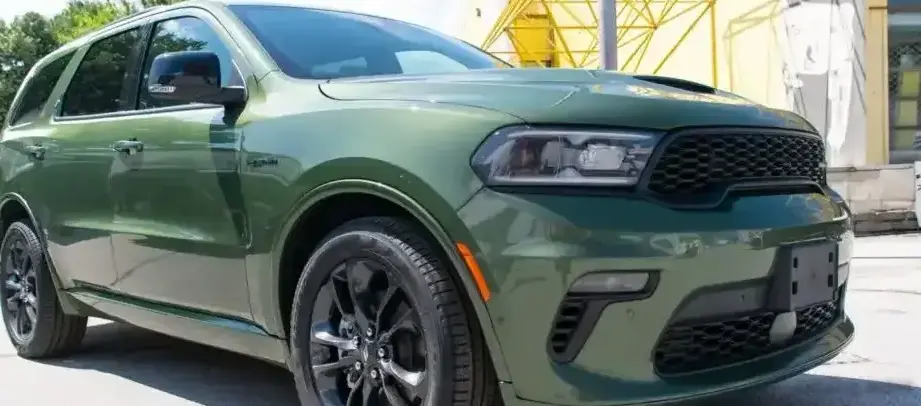
The Dodge Durango III, specifically the facelifted model introduced in 2021 with the 3.6-liter Pentastar V6 engine paired with an eight-speed TorqueFlite automatic transmission and all-wheel drive (AWD), represents a significant iteration of Dodge’s full-size SUV. Positioned as a mid-range offering within the Durango lineup, this variant aimed to balance performance, fuel efficiency, and capability for families and those needing a versatile vehicle. Production of this configuration began in 2021 and continues through subsequent model years as part of the WD generation Durango. It builds upon the foundation of the Durango III (introduced in 2011), offering updated styling, technology, and refinements to the powertrain.
Powertrain & Engine Architecture
The heart of this Durango variant is the 3.6-liter Pentastar V6 engine. This engine, a mainstay of Chrysler/Dodge/Jeep vehicles for over a decade, is known for its robust design and relatively smooth operation. The engine code is generally identified as the Pentastar, with variations depending on the specific year and calibration. It utilizes a 60-degree V-angle, contributing to its balance and reduced vibrations. The Pentastar employs multi-port fuel injection (MPI) and a double overhead camshaft (DOHC) valvetrain with four valves per cylinder. This configuration optimizes airflow for improved power and efficiency. The 8-speed TorqueFlite 8HP70 automatic transmission is a crucial component, offering a wide gear ratio spread for both acceleration and fuel economy. This transmission is known for its smooth shifts and responsiveness. The AWD system is typically an on-demand system, primarily operating in rear-wheel drive but automatically engaging the front axle when wheel slip is detected.
Driving Characteristics
The 3.6L V6 Durango offers a comfortable and capable driving experience, though it doesn’t deliver the outright performance of the higher-output V8 models. With 293 horsepower and 260 lb-ft of torque, acceleration is adequate for everyday driving and highway merging. The eight-speed automatic transmission helps to keep the engine in its optimal power band. Compared to a manual transmission equipped Durango (which wasn’t widely offered with this engine), the automatic prioritizes convenience and ease of use over driver engagement. The AWD system provides enhanced traction in inclement weather and on loose surfaces, making it a suitable choice for drivers in regions with challenging road conditions. The gear ratios are tuned for a balance between acceleration and fuel efficiency, with lower gears providing quick off-the-line response and higher gears optimizing fuel economy at cruising speeds.
Equipment & Trim Levels
The 3.6L Pentastar V6 AWD Durango typically served as the entry-level or mid-range trim. Standard equipment generally included features like three-zone automatic climate control, a touchscreen infotainment system with Apple CarPlay and Android Auto compatibility, keyless entry, and a suite of safety features such as blind-spot monitoring and rear cross-traffic alert. Interior upholstery was typically cloth, with options for leather upgrades on higher sub-trims. Optional extras included a premium sound system, a sunroof, and advanced driver-assistance systems like adaptive cruise control and lane departure warning.
Chassis & Braking
The Durango III utilizes a robust chassis with a fully independent suspension. The front suspension features a double wishbone design with a transverse stabilizer bar, while the rear suspension employs an independent multi-link setup. This configuration provides a comfortable ride and good handling characteristics. Braking duties are handled by ventilated disc brakes on all four wheels, providing ample stopping power. The size of the front discs is 350x32mm, and the rear discs are 330x22mm. An Anti-lock Braking System (ABS) is standard, enhancing safety and control during emergency braking situations.
Market Reception & Comparison
The 3.6L V6 Durango was generally well-received by critics as a practical and versatile SUV. It offered a good balance of performance, fuel economy, and capability at a more accessible price point than the V8-powered models. Fuel economy was a key selling point, with combined MPG figures around 21, making it more efficient than many of its V8 competitors. Reliability was generally considered good, with the Pentastar V6 engine having a proven track record. Compared to the Durango R/T (with the 5.7L Hemi V8), the V6 model offered less raw power but significantly better fuel economy. Compared to the SRT model (with the 6.4L Hemi V8), the difference in performance was even more pronounced, but the V6 offered a more affordable entry point into the Durango lineup.
Legacy
The 3.6L Pentastar V6-powered Durango has proven to be a reliable and durable vehicle. In the used car market, these models represent a good value proposition for buyers seeking a spacious and capable SUV. The Pentastar engine is known for its longevity, and with proper maintenance, it can provide many years of reliable service. While not as sought-after as the higher-performance V8 models, the 3.6L Durango remains a popular choice for families and those needing a versatile vehicle with all-weather capability.