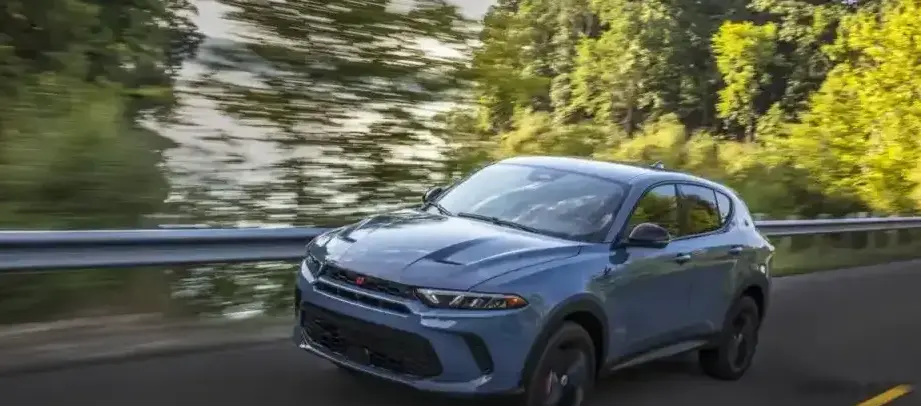
The Dodge Hornet R/T 1.3 Turbo eAWD Plug-in Hybrid Automatic, introduced for the 2023 model year, represents Dodge’s entry into the increasingly competitive compact CUV segment with a focus on performance and efficiency. Positioned as the top-tier trim of the Hornet lineup, the R/T distinguishes itself through its plug-in hybrid powertrain, delivering a combined system output of 288 horsepower and all-wheel drive capability. The Hornet itself is a significant model for Dodge, marking a return to the compact crossover market and leveraging the shared platform with the Alfa Romeo Tonale. This variant aims to appeal to buyers seeking a sporty driving experience combined with the benefits of electric propulsion.
Technical Specifications
| Brand | Dodge |
| Model | Hornet |
| Type | R/T 1.3 Turbo (288 Hp) eAWD Plug-in Hybrid Automatic |
| Start of production | 2023 |
| Powertrain Architecture | PHEV (Plug-in Hybrid Electric Vehicle) |
| Body type | CUV |
| Seats | 5 |
| Doors | 5 |
| Fuel Type | Petrol / electricity |
| Acceleration 0 – 60 mph | 5.6 sec |
| Maximum speed | 206 km/h (128 mph) |
| Weight-to-power ratio | 6.5 kg/Hp, 153.6 Hp/tonne |
| Weight-to-torque ratio | 3.6 kg/Nm, 276.8 Nm/tonne |
| Gross battery capacity | 15.5 kWh |
| Battery voltage | 306 V |
| Battery technology | Lithium nickel manganese cobalt oxides (Li-NMC) |
| Battery weight | 125 kg (275.58 lbs) |
| Battery location | In the central tunnel |
| All-electric range | 48.3 km (30.01 mi) |
| Electric motor power (Front) | 44 Hp |
| Electric motor location (Front) | Front, Transverse |
| Electric motor power (Rear) | 121 Hp |
| Electric motor Torque | 250 Nm (184.39 lb.-ft.) |
| Electric motor location (Rear) | Rear axle, Transverse |
| System power | 288 Hp |
| System torque | 519 Nm (382.79 lb.-ft.) |
| Internal combustion engine Power | 175 Hp |
| Power per litre | 131.4 Hp/l |
| Torque | 270 Nm (199.14 lb.-ft.) |
| Engine layout | Front, Transverse |
| Engine displacement | 1332 cm3 (81.28 cu. in.) |
| Number of cylinders | 4 |
| Engine configuration | Inline |
| Fuel injection system | Direct injection |
| Engine aspiration | Turbocharger, Intercooler |
| Engine systems | Start & Stop System |
| Kerb Weight | 1875 kg (4133.67 lbs) |
| Max. weight | 2417 kg (5328.57 lbs) |
| Max load | 542 kg (1194.91 lbs) |
| Trunk (boot) space – minimum | 650 l (22.95 cu. ft.) |
| Trunk (boot) space – maximum | 1430 l (50.5 cu. ft.) |
| Fuel tank capacity | 42 l (11.1 US gal | 9.24 UK gal) |
| Length | 4528 mm (178.27 in.) |
| Width including mirrors | 2082 mm (81.97 in.) |
| Height | 1601 mm (63.03 in.) |
| Wheelbase | 2636 mm (103.78 in.) |
| Front overhang | 951 mm (37.44 in.) |
| Rear overhang | 941 mm (37.05 in.) |
| Ride height (ground clearance) | 155 mm (6.1 in.) |
| Minimum turning circle (turning diameter) | 11.54 m (37.86 ft.) |
| Drivetrain Architecture | ICE drives front wheels, electric motors drive front and rear wheels. Full electric or mixed mode operation. |
| Drive wheel | All wheel drive (4×4) |
| Number of gears and type of gearbox | 6 gears, automatic transmission |
| Front suspension | Independent type McPherson |
| Rear suspension | Independent coil spring |
| Front brakes | Disc, 345 mm |
| Rear brakes | Disc, 305 mm |
| Assisting systems | ABS (Anti-lock braking system) |
| Steering type | Steering rack and pinion |
| Power steering | Electric Steering |
| Tires size | 225/55 R18; 235/40 R20 |
| Wheel rims size | 7.5J x 18; 8J x 20 |
Powertrain & Engine Architecture
The heart of the Hornet R/T is its sophisticated plug-in hybrid powertrain. It combines a 1.3-liter turbocharged inline-four cylinder engine (code: Firefly) with two electric motors and a 15.5 kWh battery pack. The internal combustion engine produces 175 horsepower and 199 lb-ft of torque, featuring direct fuel injection and a turbocharger for enhanced responsiveness. The primary electric motor, located at the front axle, delivers 44 horsepower, while a more powerful 121 horsepower electric motor powers the rear wheels. This dual-motor setup enables true all-wheel drive capability and allows for operation in full electric mode for up to 30 miles. The six-speed automatic transmission efficiently manages power delivery, optimized for both fuel economy and performance. The battery pack, utilizing Lithium Nickel Manganese Cobalt (Li-NMC) chemistry, is positioned in the central tunnel to optimize weight distribution.
Driving Characteristics
The Hornet R/T offers a distinct driving experience compared to lower trims. The combined 288 horsepower and 383 lb-ft of torque result in a 0-60 mph time of just 5.6 seconds. The electric motors provide instant torque, contributing to brisk acceleration, particularly in the initial stages. The automatic transmission is well-tuned, offering smooth shifts and responsive downshifts. In hybrid mode, the system seamlessly transitions between electric and gasoline power, prioritizing efficiency. The all-wheel drive system enhances traction and stability, especially in inclement weather. Compared to a hypothetical Hornet with solely the 1.3L engine, the R/T provides a significantly more engaging and powerful driving experience. While not as overtly sporty as some competitors, the R/T strikes a good balance between performance and everyday usability.
Equipment & Trim Levels
As the top-of-the-line trim, the Hornet R/T comes standard with a comprehensive suite of features. Interior appointments include premium cloth and leather upholstery, heated front seats, and a large touchscreen infotainment system with Apple CarPlay and Android Auto compatibility. Standard safety features include advanced driver-assistance systems (ADAS) such as adaptive cruise control, lane-keeping assist, and automatic emergency braking. Optional extras include a panoramic sunroof, premium audio system, and various cosmetic enhancements. The R/T trim also features unique exterior styling cues, including distinctive badging and a sportier front fascia.
Chassis & Braking
The Hornet R/T utilizes an independent suspension system at all four corners, featuring McPherson struts in the front and a multi-link setup in the rear. This configuration provides a comfortable ride while maintaining good handling characteristics. The R/T is equipped with disc brakes on all four wheels, measuring 345mm in the front and 305mm in the rear, providing ample stopping power. An anti-lock braking system (ABS) is standard, along with electronic stability control. The steering system is an electric power-assisted rack and pinion setup, offering precise and responsive steering feel.
Market Reception & Comparison
Initial reviews of the Dodge Hornet R/T have been generally positive, with critics praising its performance, fuel efficiency, and technology. The plug-in hybrid powertrain is seen as a significant advantage, offering a competitive all-electric range and reduced emissions. Compared to other compact CUVs in its class, such as the Toyota RAV4 Prime and Mitsubishi Outlander PHEV, the Hornet R/T offers a more engaging driving experience and a more premium interior. However, some reviewers have noted that the infotainment system can be complex to navigate. Fuel economy is rated at 77 MPGe combined, and 29 MPG when operating as a hybrid.
Legacy
The Dodge Hornet R/T represents a pivotal moment for Dodge, signaling the brand’s commitment to electrification and its entry into a growing segment of the automotive market. The long-term reliability of the plug-in hybrid powertrain remains to be seen, but the components are sourced from established suppliers. On the used car market, the Hornet R/T is expected to hold its value well due to its unique combination of performance, efficiency, and technology. The success of the Hornet R/T will likely influence Dodge’s future product strategy and its overall transition towards an electric future.