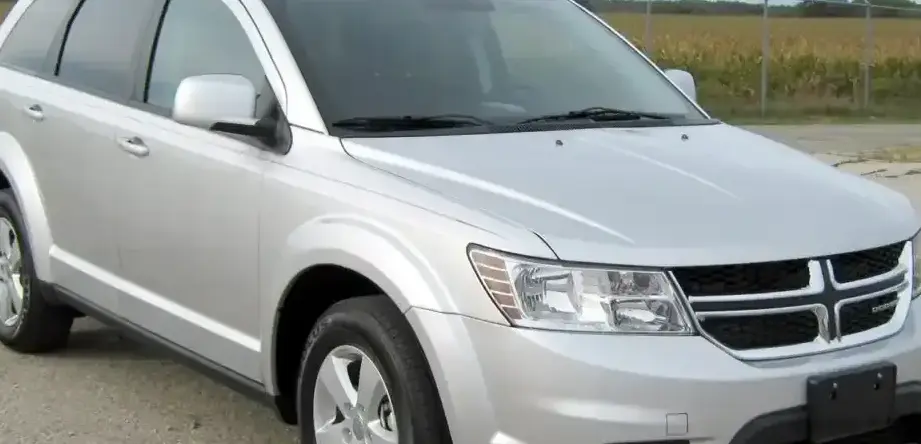
The Dodge Journey 3.5 V6 Automatic, produced from 2009 to 2010, represented a significant offering in Dodge’s crossover utility vehicle (CUV) lineup. Positioned as a mid-range to upper-mid-range trim, it aimed to provide a balance of power, space, and family-friendly features. The Journey, built on the JC49 platform, was Dodge’s attempt to enter the growing market segment of affordable, seven-passenger vehicles. This particular variant, equipped with the 3.5-liter V6 engine and a six-speed automatic transmission, was designed to appeal to buyers needing more than the base four-cylinder model could offer, but who didn’t necessarily require the performance of a higher-spec trim.
Technical Specifications
| Brand | Dodge |
| Model | Journey |
| Generation | Journey |
| Type (Engine) | 3.5 V6 (235 Hp) Automatic |
| Start of production | 2009 |
| End of production | 2010 |
| Powertrain Architecture | Internal Combustion engine |
| Body type | CUV |
| Seats | 7 |
| Doors | 5 |
| Fuel consumption (urban) | 14.7 l/100 km (16 US mpg, 19.2 UK mpg, 6.8 km/l) |
| Fuel consumption (extra urban) | 9.8 l/100 km (24 US mpg, 28.8 UK mpg, 10.2 km/l) |
| Fuel Type | Petrol (Gasoline) |
| Weight-to-power ratio | 7.7 kg/Hp, 129.5 Hp/tonne |
| Weight-to-torque ratio | 5.8 kg/Nm, 173.6 Nm/tonne |
| Power | 235 Hp @ 6400 rpm |
| Power per litre | 66.8 Hp/l |
| Torque | 315 Nm @ 4000 rpm (232.33 lb.-ft. @ 4000 rpm) |
| Maximum engine speed | 6800 rpm |
| Engine layout | Front, Transverse |
| Engine displacement | 3518 cm3 (214.68 cu. in.) |
| Engine configuration | V-engine |
| Cylinder Bore | 96 mm (3.78 in.) |
| Piston Stroke | 81 mm (3.19 in.) |
| Compression ratio | 10:1 |
| Number of valves per cylinder | 4 |
| Fuel injection system | Multi-port manifold injection |
| Engine aspiration | Naturally aspirated engine |
| Valvetrain | SOHC |
| Engine oil capacity | 5.2 l (5.49 US qt | 4.58 UK qt) |
| Coolant | 9.3 l (9.83 US qt | 8.18 UK qt) |
| Kerb Weight | 1814-1843 kg (3999.19 – 4063.12 lbs.) |
| Max. weight | 2472 kg (5449.83 lbs.) |
| Max load | 629-658 kg (1386.71 – 1450.64 lbs.) |
| Trunk (boot) space – minimum | 303 l (10.7 cu. ft.) |
| Trunk (boot) space – maximum | 1915 l (67.63 cu. ft.) |
| Fuel tank capacity | 78 l (20.61 US gal | 17.16 UK gal) |
| Permitted trailer load with brakes (12%) | 1600 kg (3527.4 lbs.) |
| Length | 4888 mm (192.44 in.) |
| Width | 1835 mm (72.24 in.) |
| Width including mirrors | 2127 mm (83.74 in.) |
| Height | 1765 mm (69.49 in.) |
| Wheelbase | 2890 mm (113.78 in.) |
| Front track | 1571 mm (61.85 in.) |
| Rear (Back) track | 1582 mm (62.28 in.) |
| Front overhang | 989 mm (38.94 in.) |
| Rear overhang | 1009 mm (39.72 in.) |
| Drag coefficient (Cd) | 0.37 |
| Minimum turning circle (turning diameter) | 11.7 m (38.39 ft.) |
| Drivetrain Architecture | The Internal combustion engine (ICE) drives the front wheels of the vehicle. |
| Drive wheel | Front wheel drive |
| Number of gears and type of gearbox | 6 gears, automatic transmission |
| Front suspension | Independent, type McPherson with coil spring and anti-roll bar |
| Rear suspension | Independent multi-link spring suspension with stabilizer |
| Front brakes | Ventilated discs, 302×28 mm |
| Rear brakes | Disc, 305×12 mm |
| Assisting systems | ABS (Anti-lock braking system) |
| Steering type | Steering rack and pinion |
| Tires size | 225/65 R17 |
| Wheel rims size | 6.5J x 17 |
Powertrain & Engine Architecture
The heart of this Journey variant is the 3.5-liter V6 engine, internally designated as the EDZ. This engine is a 60-degree V-engine featuring a single overhead camshaft (SOHC) design per cylinder bank. It utilizes multi-port fuel injection to deliver fuel directly into the intake ports, optimizing combustion. The engine produces 235 horsepower at 6400 rpm and 315 Nm (232 lb-ft) of torque at 4000 rpm. The six-speed automatic transmission, a Chrysler-sourced unit (62TE), was chosen for its smooth operation and ability to handle the engine’s output. This transmission featured a torque converter for smooth launches and a wide range of gear ratios to balance acceleration and fuel efficiency. The transmission was programmed for a balance between comfort and responsiveness, prioritizing smooth shifts over aggressive downshifts.
Driving Characteristics
The 3.5L V6 Automatic Journey offered a noticeable improvement in performance compared to the base 2.7-liter four-cylinder model. Acceleration was brisk, allowing for confident merging and overtaking maneuvers. While not a sports car, the V6 provided sufficient power for everyday driving and even towing light trailers. The automatic transmission, while generally smooth, could sometimes feel hesitant during quick acceleration. The gear ratios were tuned for fuel economy, meaning the engine occasionally felt strained when climbing hills or carrying a full load of passengers. Compared to the manual transmission versions, the automatic offered less driver engagement but greater convenience, particularly in urban traffic. The front-wheel-drive configuration provided adequate traction in most conditions, but all-wheel-drive was available on higher trims for improved stability in inclement weather.
Equipment & Trim Levels
The 3.5 V6 Automatic Journey typically came standard with features such as air conditioning, power windows and locks, a CD player with auxiliary input, and keyless entry. Higher trim levels added features like leather upholstery, heated front seats, a sunroof, and a premium sound system. The interior was designed with family use in mind, offering ample space for passengers and cargo. The second-row seats could be configured for either passenger comfort or increased cargo capacity. Optional extras included a rear-seat entertainment system, navigation system, and upgraded alloy wheels.
Chassis & Braking
The Journey’s chassis featured an independent McPherson strut suspension in the front and an independent multi-link suspension in the rear. This setup provided a comfortable ride quality, absorbing bumps and irregularities in the road surface effectively. Stabilizer bars were included at both ends to reduce body roll during cornering. The braking system consisted of ventilated discs in the front and solid discs in the rear. Anti-lock brakes (ABS) were standard, enhancing safety by preventing wheel lockup during hard braking. The steering was rack-and-pinion, providing precise and responsive handling.
Market Reception & Comparison
The Dodge Journey 3.5 V6 Automatic received mixed reviews from automotive critics. While praised for its spacious interior and comfortable ride, some reviewers criticized its fuel economy and somewhat uninspired handling. Compared to competitors like the Honda Pilot and Toyota Highlander, the Journey offered a more affordable price point but lacked the refinement and fuel efficiency of those models. The 3.5L V6 offered a significant performance upgrade over the base 2.7L four-cylinder, but the fuel economy penalty was noticeable. The 1.9L turbo diesel available in Europe was not offered in the US market.
Legacy
The Dodge Journey, while not a runaway success, remained in production for over a decade, undergoing several updates and revisions. The 3.5L V6 powertrain proved to be relatively reliable, although regular maintenance was crucial to prevent issues such as oil leaks and timing chain wear. In the used car market, the 2009-2010 Journey 3.5 V6 Automatic represents an affordable option for families needing a spacious and versatile vehicle. However, potential buyers should be aware of the potential for higher fuel costs and the importance of a thorough pre-purchase inspection.