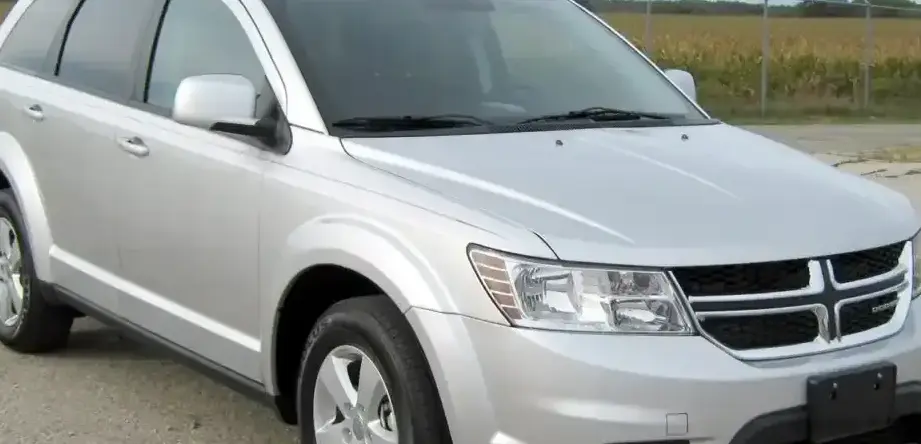
Technical Specifications
| Brand | Dodge |
| Model | Journey |
| Generation | Journey (facelift 2010) |
| Type (Engine) | 2.4 (173 Hp) Automatic |
| Start of production | 2010 |
| End of production | 2020 |
| Powertrain Architecture | Internal Combustion engine |
| Body type | CUV |
| Seats | 5-7 |
| Doors | 5 |
| Fuel consumption (economy) – urban (EPA) | 12.4 l/100 km (19 US mpg, 22.8 UK mpg, 8.1 km/l) |
| Fuel consumption (economy) – extra urban (EPA) | 9.4 l/100 km (25 US mpg, 30.1 UK mpg, 10.6 km/l) |
| Fuel consumption (economy) – combined (EPA) | 11.2 l/100 km (21 US mpg, 25.2 UK mpg, 8.9 km/l) |
| Fuel Type | Petrol (Gasoline) |
| Weight-to-power ratio | 10 kg/Hp, 99.7 Hp/tonne |
| Weight-to-torque ratio | 7.7 kg/Nm, 129.7 Nm/tonne |
| Power | 173 Hp @ 6000 rpm |
| Power per litre | 73.3 Hp/l |
| Torque | 225 Nm @ 4000 rpm (165.95 lb.-ft. @ 4000 rpm) |
| Maximum engine speed | 6500 rpm |
| Engine layout | Front, Transverse |
| Engine Model/Code | ED3 |
| Engine displacement | 2360 cm3 (144.02 cu. in.) |
| Number of cylinders | 4 |
| Engine configuration | Inline |
| Cylinder Bore | 88 mm (3.46 in.) |
| Piston Stroke | 97 mm (3.82 in.) |
| Compression ratio | 10.5:1 |
| Number of valves per cylinder | 4 |
| Fuel injection system | Multi-port manifold injection |
| Engine aspiration | Naturally aspirated engine |
| Valvetrain | DOHC, VVT |
| Engine oil capacity | 4.26 l (4.5 US qt | 3.75 UK qt) |
| Coolant | 7.5 l (7.93 US qt | 6.6 UK qt) |
| Kerb Weight | 1735 kg (3825.02 lbs.) |
| Max. weight | 2270-2381 kg (5004.49 – 5249.21 lbs.) |
| Max load | 535-646 kg (1179.47 – 1424.19 lbs.) |
| Trunk (boot) space – minimum | 300 l (10.59 cu. ft.) |
| Trunk (boot) space – maximum | 1915 l (67.63 cu. ft.) |
| Fuel tank capacity | 77.6 l (20.5 US gal | 17.07 UK gal) |
| Permitted trailer load with brakes (12%) | 450 kg (992.08 lbs.) |
| Length | 4887 mm (192.4 in.) |
| Width | 1834 mm (72.2 in.) |
| Width including mirrors | 2127 mm (83.74 in.) |
| Height | 1692 mm (66.61 in.) |
| Wheelbase | 2890 mm (113.78 in.) |
| Front track | 1570 mm (61.81 in.) |
| Rear (Back) track | 1582 mm (62.28 in.) |
| Front overhang | 989 mm (38.94 in.) |
| Rear overhang | 1008 mm (39.69 in.) |
| Drag coefficient (Cd) | 0.368 |
| Minimum turning circle (turning diameter) | 11.7 m (38.39 ft.) |
| Drivetrain Architecture | The Internal combustion engine (ICE) drives the front wheels of the vehicle. |
| Drive wheel | Front wheel drive |
| Number of gears and type of gearbox | 4 gears, automatic transmission |
| Front suspension | Independent, type McPherson with coil spring and anti-roll bar |
| Rear suspension | Independent multi-link spring suspension with stabilizer |
| Front brakes | Ventilated discs, 330×28 mm |
| Rear brakes | Disc, 328×12 mm |
| Assisting systems | ABS (Anti-lock braking system) |
| Steering type | Steering rack and pinion |
| Power steering | Hydraulic Steering |
| Tires size | 225/65 R17; 225/55 R19 |
| Wheel rims size | 6.5J x 17; 7J x 19 |
The Dodge Journey (facelift, produced from 2010-2020) 2.4L variant, equipped with a 173 horsepower engine and an automatic transmission, represented a key offering in Dodge’s crossover utility vehicle (CUV) lineup. Introduced as part of a mid-cycle refresh, this version aimed to provide a balance of affordability, practicality, and fuel efficiency within the Journey range. Positioned as a mid-range trim, it slotted between the base 2.5L four-cylinder model and the more powerful 3.6L V6 options. The Journey, initially launched in 2008, was Dodge’s attempt to enter the growing family crossover market, offering available seating for up to seven passengers and a focus on versatility.
Powertrain & Engine Architecture
The 2010-2020 Dodge Journey 2.4L Automatic was powered by the ED3 engine, a 2.4-liter inline four-cylinder gasoline engine. This engine utilized a multi-port fuel injection system, delivering fuel directly into the intake ports. The engine featured a double overhead camshaft (DOHC) valvetrain with variable valve timing (VVT) on the intake camshaft, optimizing performance and fuel efficiency across a wider range of engine speeds. The engine produced 173 horsepower at 6000 rpm and 225 Nm (165.95 lb.-ft.) of torque at 4000 rpm. The engine’s 10.5:1 compression ratio was a standard figure for naturally aspirated engines of this era. Paired with the engine was a four-speed automatic transmission, a relatively conventional choice for the time. While not offering the efficiency of more modern transmissions with higher gear counts, it provided smooth and predictable shifts for everyday driving.
Driving Characteristics
The 2.4L engine and four-speed automatic combination in the Dodge Journey delivered adequate, but not particularly exhilarating, performance. Acceleration was sufficient for typical commuting and highway merging, but the vehicle felt noticeably slower when fully loaded with passengers and cargo. The automatic transmission’s gear ratios were tuned for fuel economy and comfort rather than outright speed. Compared to the available 3.6L V6, the 2.4L offered significantly less power and a more relaxed driving experience. Manual transmission versions, while less common, provided a more engaging driving experience and slightly improved fuel economy. The front-wheel-drive configuration contributed to predictable handling, but lacked the enhanced traction of all-wheel-drive models.
Equipment & Trim Levels
The 2.4L Journey typically came standard with features such as air conditioning, power windows and locks, a basic audio system, and cloth upholstery. Higher trim levels, often denoted by names like SXT or Limited, added features like alloy wheels, upgraded audio systems, leather upholstery, a sunroof, and advanced safety features. Optional extras included a rear entertainment system, navigation, and a premium sound system. The interior design was functional and family-oriented, with ample storage compartments and a relatively spacious cabin.
Chassis & Braking
The Dodge Journey featured an independent McPherson strut front suspension and an independent multi-link rear suspension. This setup provided a comfortable ride quality, absorbing bumps and irregularities in the road surface effectively. Stabilizer bars were included at both ends to reduce body roll during cornering. The braking system consisted of ventilated discs at the front and solid discs at the rear. Anti-lock braking system (ABS) was standard. The steering was rack-and-pinion with hydraulic power assist, providing a reasonably responsive feel.
Market Reception & Comparison
The Dodge Journey 2.4L Automatic was generally well-received as a practical and affordable family vehicle. Critics praised its spacious interior, comfortable ride, and available features. However, the 2.4L engine was often criticized for being underpowered, particularly when the vehicle was fully loaded. Fuel economy was considered average for its class. Compared to competitors like the Honda CR-V and Toyota RAV4, the Journey offered a more aggressive styling and a lower starting price, but lacked the same level of refinement and fuel efficiency. The V6 models were often preferred by those seeking more performance.
Legacy
The Dodge Journey, including the 2.4L variant, enjoyed a long production run, remaining in production until 2020. While not known for exceptional reliability, the ED3 engine proved to be reasonably durable with proper maintenance. Common issues included occasional oil leaks and sensor failures. On the used car market, the 2.4L Journey represents an affordable option for buyers seeking a spacious and versatile crossover. However, potential buyers should be aware of the engine’s limitations and the potential for age-related maintenance issues. The Journey’s legacy lies in its role as a mainstream family vehicle that offered a compelling combination of space, features, and value.