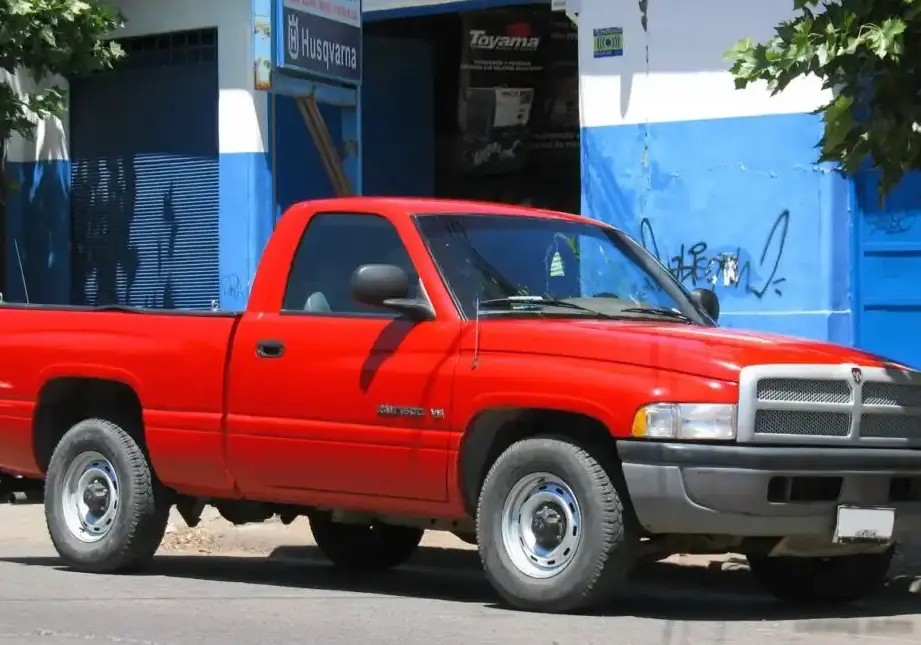
The Dodge Ram 1500 Regular Cab Short Bed (BR/BE) with the 5.9 V8 engine and four-speed automatic transmission was a mainstay of Dodge’s full-size pickup truck lineup from 1994 through 1998. Representing the second generation of the Ram, these trucks (designated BR and BE internally) offered a blend of traditional American truck values – ruggedness, capability, and a powerful V8 – with a growing emphasis on comfort and convenience. This particular configuration, with its 230 horsepower engine and four-wheel drive, occupied a sweet spot in the lineup, appealing to buyers who needed a capable work truck but also desired a more refined driving experience than the base models offered.
Technical Specifications
| Brand | Dodge |
| Model | RAM |
| Generation | Ram 1500 Regular Cab Short Bed (BR/BE) |
| Type (Engine) | 5.9 V8 (230 Hp) 4×4 Automatic |
| Start of production | 1994 |
| End of production | 1998 |
| Powertrain Architecture | Internal Combustion engine |
| Body type | Pick-up |
| Seats | 3 |
| Doors | 2 |
| Fuel Type | Petrol (Gasoline) |
| Power | 230 Hp @ 4000 rpm |
| Power per litre | 39 Hp/l |
| Torque | 447 Nm @ 3200 rpm / 329.69 lb.-ft. @ 3200 rpm |
| Engine layout | Front, Longitudinal |
| Engine Model/Code | 360 Magnum |
| Engine displacement | 5899 cm3 / 359.98 cu. in. |
| Number of cylinders | 8 |
| Engine configuration | V-engine |
| Cylinder Bore | 101.6 mm / 4 in. |
| Piston Stroke | 90.93 mm / 3.58 in. |
| Compression ratio | 9.1:1 |
| Number of valves per cylinder | 2 |
| Fuel injection system | Multi-port manifold injection |
| Engine aspiration | Naturally aspirated engine |
| Valvetrain | OHV |
| Engine oil capacity | 4.7 l / 4.97 US qt | 4.14 UK qt |
| Coolant | 19 l / 20.08 US qt | 16.72 UK qt |
| Max. weight | 2903 kg / 6400.02 lbs. |
| Fuel tank capacity | 98 l / 25.89 US gal | 21.56 UK gal |
| Permitted trailer load with brakes (12%) | 3493 kg / 7700.75 lbs. |
| Length | 5077 mm / 199.88 in. |
| Width | 2017 mm / 79.41 in. |
| Height | 1897 mm / 74.69 in. |
| Wheelbase | 3023 mm / 119.02 in. |
| Minimum turning circle (turning diameter) | 12.4 m / 40.68 ft. |
| Approach angle | 30.4° |
| Departure angle | 27.2° |
| Ramp-over (brakeover) angle | 20.8° |
| Drivetrain Architecture | The Internal combustion engine (ICE) drives the rear wheels permanently, and the front wheels are driven through an electrically or mechanically operated clutch if necessary. |
| Drive wheel | All wheel drive (4×4) |
| Number of gears and type of gearbox | 4 gears, automatic transmission |
| Front suspension | Dependent spring suspension with anti-roll bar, Trailing arm |
| Rear suspension | Leaf spring |
| Front brakes | Disc |
| Rear brakes | Drum |
| Assisting systems | ABS (Anti-lock braking system) |
| Steering type | Steering rack and pinion |
| Power steering | Hydraulic Steering |
| Tires size | 225/75 R16 |
| Wheel rims size | 7J x 16 |
Powertrain & Engine Architecture
The heart of this Ram 1500 was the 360 Magnum 5.9-liter V8 engine. This engine, a descendant of Chrysler’s long-running small-block V8 family, was known for its robust construction and ample low-end torque. The “Magnum” designation signified upgrades including improved cylinder heads, a revised intake manifold, and higher-flow exhaust, all aimed at boosting performance. The engine utilized a multi-port fuel injection system, delivering fuel directly to each cylinder for improved efficiency and responsiveness. The overhead valve (OHV) valvetrain, while traditional, was reliable and relatively simple to maintain. Paired with the 360 Magnum was a four-speed automatic transmission (typically the A727 or A518, depending on specific build dates and options). This transmission was a workhorse, known for its durability, but lacked the sophistication of more modern automatics. It featured a torque converter lockup to improve fuel economy at highway speeds.
Driving Characteristics
The 5.9L V8 with the four-speed automatic provided a comfortable balance of power and usability. While not a performance-oriented setup, the 230 horsepower and 329 lb-ft of torque were sufficient for hauling and towing. Acceleration was adequate, but the automatic transmission’s relatively wide gear ratios meant it wasn’t as quick off the line as a manual transmission equipped model. The automatic did, however, make the truck more accessible to a wider range of drivers. In 4×4 configuration, the Ram 1500 offered good traction in various conditions, making it a capable choice for those living in areas with inclement weather or needing off-road capability. The ride quality, while typical of a body-on-frame truck, was reasonably comfortable, especially compared to earlier generations.
Equipment & Trim Levels
The Ram 1500 Regular Cab Short Bed with the 5.9 V8 and automatic transmission typically fell into the mid-range of Dodge’s trim levels. Standard features generally included air conditioning, a basic AM/FM radio, and cloth upholstery. Optional extras included power windows and locks, a tilt steering wheel, cruise control, and upgraded sound systems. Interior trim levels varied, with some models offering more luxurious cloth or even leather upholstery. The short bed configuration provided a good compromise between cargo space and maneuverability.
Chassis & Braking
The Ram 1500 utilized a traditional body-on-frame construction, providing a robust and durable platform. The front suspension consisted of a dependent spring setup with an anti-roll bar, while the rear suspension employed leaf springs. This configuration was designed for load-carrying capacity and durability. Braking duties were handled by disc brakes up front and drum brakes in the rear. An anti-lock braking system (ABS) was often included, enhancing safety. The steering system was a hydraulic power rack-and-pinion setup, providing reasonable steering feel and ease of use.
Market Reception & Comparison
The 1994-1998 Dodge Ram 1500 was generally well-received by critics and consumers. The 5.9 V8 automatic combination was praised for its reliability and usability. Compared to the base 3.9L V6 models, the 5.9 offered a significant performance upgrade, making it a popular choice for those who needed to tow or haul heavy loads. Compared to the higher-output 5.9L Magnum with a manual transmission, the automatic version sacrificed some performance but gained convenience. Fuel economy was typical for a full-size truck of the era, averaging around 14-16 mpg in mixed driving. The Ram 1500 competed directly with the Ford F-150, Chevrolet Silverado, and GMC Sierra, offering a compelling alternative with its distinctive styling and robust powertrain.
Legacy
The 1994-1998 Dodge Ram 1500, particularly the 5.9 V8 automatic configuration, has developed a loyal following among truck enthusiasts. The 360 Magnum engine is known for its durability and relative simplicity, making it a popular choice for restoration projects and modifications. While not the most fuel-efficient or technologically advanced truck of its time, it represents a classic era of American truck design – a rugged, capable, and reliable workhorse. Today, well-maintained examples command reasonable prices in the used car market, appealing to those seeking a classic truck with a proven track record. The four-speed automatic, while not known for its efficiency, has proven to be a durable unit, and with proper maintenance, can provide many years of service.