
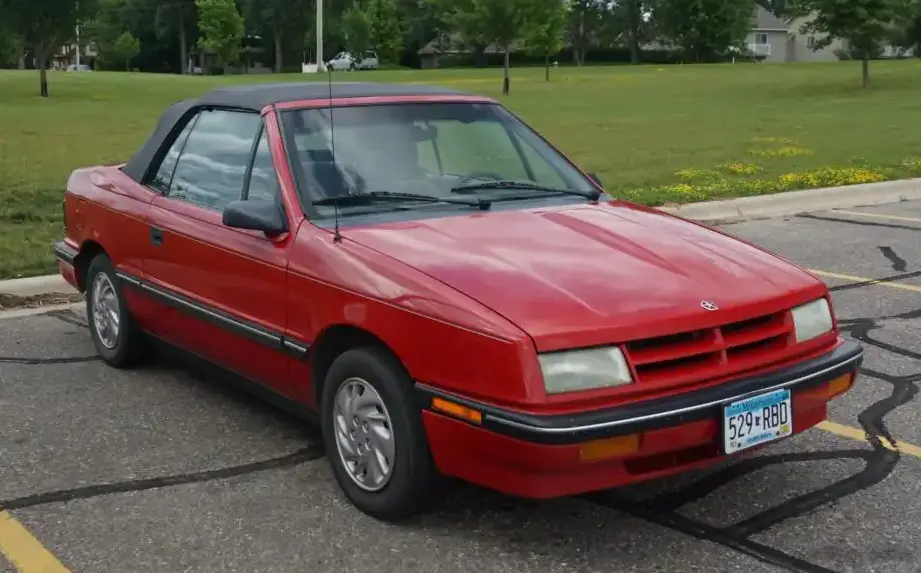
The Dodge Shadow Convertible 2.5i Turbo, produced between 1990 and 1995, represented a unique offering in the American compact car market. Falling within the second generation of the Dodge Shadow (1990-1994), the convertible variant aimed to capitalize on the growing popularity of open-top motoring while offering a performance edge with its turbocharged engine. Positioned as a more upscale and sporty trim within the Shadow lineup, it provided an alternative to the base models and competed with other affordable convertibles of the era, such as the Mazda Miata and Chevrolet Cavalier Z24. The 2.5i Turbo was a relatively short-lived model, discontinued as consumer preferences shifted and emissions regulations tightened.
Technical Specifications
| Brand | Dodge |
| Model | Shadow |
| Generation | Shadow Convertible |
| Type (Engine) | 2.5 i Turbo (152 Hp) |
| Start of production | 1990 |
| End of production | 1995 |
| Powertrain Architecture | Internal Combustion engine |
| Body type | Cabriolet |
| Seats | 5 |
| Doors | 2 |
| Fuel consumption (urban) | 16 l/100 km (14.7 US mpg, 17.7 UK mpg, 6.3 km/l) |
| Fuel consumption (extra urban) | 9 l/100 km (26.1 US mpg, 31.4 UK mpg, 11.1 km/l) |
| Fuel Type | Petrol (Gasoline) |
| Maximum speed | 200 km/h (124.27 mph) |
| Weight-to-power ratio | 8.1 kg/Hp, 123.6 Hp/tonne |
| Weight-to-torque ratio | 5 kg/Nm, 198.4 Nm/tonne |
| Power | 152 Hp @ 4800 rpm |
| Power per litre | 60.8 Hp/l |
| Torque | 244 Nm @ 2000 rpm (179.97 lb.-ft. @ 2000 rpm) |
| Engine layout | Front, Transverse |
| Engine displacement | 2501 cm3 (152.62 cu. in.) |
| Number of cylinders | 4 |
| Engine configuration | Inline |
| Cylinder Bore | 87.5 mm (3.44 in.) |
| Piston Stroke | 104 mm (4.09 in.) |
| Compression ratio | 7.8:1 |
| Number of valves per cylinder | 2 |
| Fuel injection system | Multi-port manifold injection |
| Engine aspiration | Turbocharger |
| Engine oil capacity | 4.3 l (4.54 US qt | 3.78 UK qt) |
| Coolant | 8.5 l (8.98 US qt | 7.48 UK qt) |
| Kerb Weight | 1230 kg (2711.69 lbs.) |
| Fuel tank capacity | 53 l (14 US gal | 11.66 UK gal) |
| Length | 4360 mm (171.65 in.) |
| Width | 1710 mm (67.32 in.) |
| Height | 1370 mm (53.94 in.) |
| Wheelbase | 2470 mm (97.24 in.) |
| Front track | 1460 mm (57.48 in.) |
| Rear track | 1455 mm (57.28 in.) |
| Drivetrain Architecture | Front wheel drive |
| Number of gears and type of gearbox | 5 gears, manual transmission |
| Front suspension | Coil spring |
| Rear suspension | Coil spring |
| Front brakes | Ventilated discs |
| Rear brakes | Drum |
| Assisting systems | ABS (Anti-lock braking system), Hydraulic Power Steering |
| Tires size | 185/70 R14 |
Powertrain & Engine Architecture
The heart of the Shadow Convertible 2.5i Turbo was the 2.5-liter inline-four cylinder engine, designated as the 525 engine family. This engine featured a cast iron block and an aluminum cylinder head. The key differentiating factor was the addition of a Garrett T25 turbocharger and an intercooler, boosting power output to 152 horsepower at 4800 rpm and 244 Nm (179.97 lb-ft) of torque at 2000 rpm. Fuel delivery was managed by a multi-port fuel injection system. The engine utilized a 7.8:1 compression ratio. The standard transmission was a 5-speed manual, providing drivers with direct control over the engine’s power. While an automatic transmission was offered on other Shadow models, it was not available with the turbocharged engine. This deliberate pairing aimed to maximize the performance potential of the turbocharger, as the automatic transmissions of the era weren’t designed to handle the increased torque efficiently.
Driving Characteristics
The 2.5i Turbo offered a noticeable performance upgrade over the naturally aspirated Shadow models. The turbocharger provided a surge of power in the mid-range, making it more responsive for highway passing and merging. The 5-speed manual transmission allowed drivers to keep the engine in its optimal power band. While not a sports car, the turbocharged Shadow Convertible offered a spirited driving experience for its class. The front-wheel-drive configuration, while common for the time, could exhibit some torque steer under hard acceleration. The suspension, tuned for comfort, provided a reasonably smooth ride, but handling was not as sharp as some of its European competitors. The gear ratios were fairly standard for a front-wheel-drive vehicle of this era, prioritizing acceleration over top-end speed. The turbo lag was noticeable, but once the turbo spooled up, the power delivery was quite strong for a compact car.
Equipment & Trim Levels
The Shadow Convertible 2.5i Turbo was generally well-equipped for its price point. Standard features included power steering, anti-lock brakes (ABS), and a basic sound system. The convertible top was manually operated. Interior appointments typically featured cloth upholstery, although leather was available as an option. Other optional extras included upgraded sound systems, cruise control, and power windows and locks. The interior design was functional but lacked the refinement of more expensive convertibles. The trim level sat above the base Shadow convertible, offering a more sporty aesthetic with unique badging and available options like a sport steering wheel and upgraded interior trim. It was positioned below any potential higher-performance, limited-edition variants that were never produced.
Chassis & Braking
The Shadow Convertible utilized a relatively simple chassis design, featuring a coil spring suspension at all four wheels. The front suspension employed MacPherson struts, while the rear utilized a twist-beam axle. Braking duties were handled by ventilated discs at the front and drum brakes at the rear. The ABS system helped to improve braking performance and stability, particularly on slippery surfaces. The steering was hydraulic power-assisted, providing relatively light and easy steering effort. The rear drum brakes were a cost-saving measure, and while adequate for normal driving, they didn’t offer the same stopping power as rear disc brakes. The stabilizer bar thickness was typical for a vehicle in this class, providing a reasonable balance between comfort and handling.
Market Reception & Comparison
The Dodge Shadow Convertible 2.5i Turbo received mixed reviews from automotive critics. The turbocharged engine was generally praised for its performance, but some reviewers noted the engine could be somewhat noisy and rough. The convertible top mechanism was criticized for being cumbersome to operate. Compared to the base Shadow models, the 2.5i Turbo offered a significant performance boost, but it came at a higher price. Compared to competitors like the Mazda Miata, the Shadow Convertible was larger and heavier, offering more interior space but less sporty handling. The Miata focused on pure driving enjoyment, while the Shadow aimed for a more practical and affordable convertible experience. Fuel economy was reasonable for a turbocharged engine of the era, averaging around 16 l/100 km (14.7 US mpg) in urban driving and 9 l/100 km (26.1 US mpg) on the highway.
Legacy
The Dodge Shadow Convertible 2.5i Turbo, while not a long-lived model, holds a certain appeal for enthusiasts of 1990s American cars. The turbocharged engine provides a unique driving experience, and the convertible body style remains popular. The 2.5-liter turbo engine, while generally reliable, can be prone to issues with the turbocharger and fuel injectors as it ages. Parts availability is becoming increasingly limited, but many components are still available through aftermarket suppliers. Today, well-maintained examples of the Shadow Convertible 2.5i Turbo are becoming increasingly collectible, appealing to those seeking a nostalgic and affordable open-top driving experience. The car represents a brief but interesting chapter in Dodge’s history, showcasing a willingness to experiment with performance in an otherwise mainstream vehicle.
