
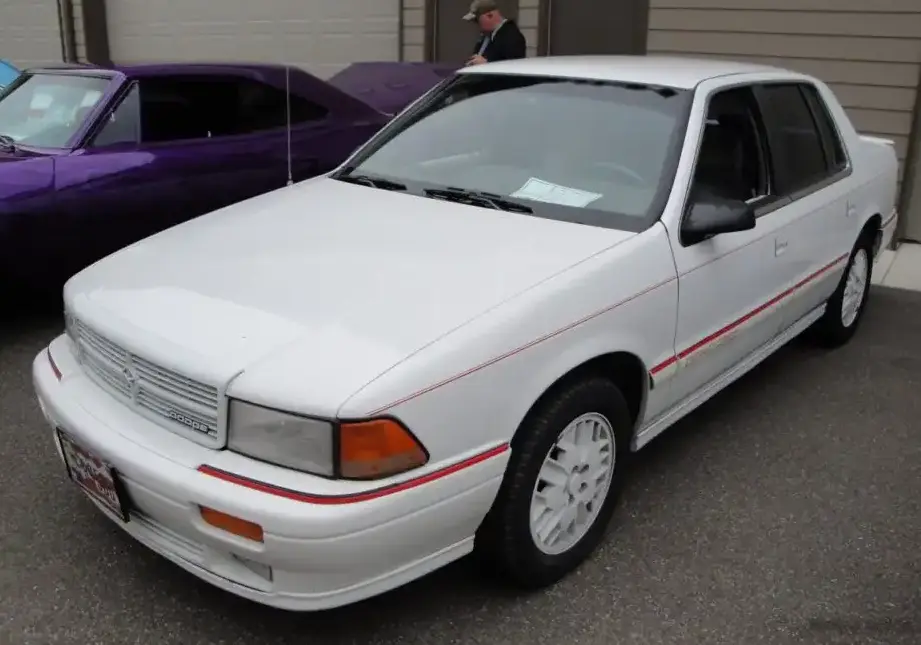
The Dodge Spirit 2.5, produced from 1988 to 1995, represented a significant offering in the mid-size American sedan market. Falling within the second generation of the Spirit (which spanned 1989-1995), the 2.5-liter variant was positioned as a mainstream, value-oriented choice within the lineup, slotting below the more performance-focused V6 models. The Spirit, along with its Chrysler siblings – the Plymouth Acclaim and Dodge Daytona – were built on the ‘A-body’ platform, a design that aimed to provide a more modern and efficient alternative to the older, rear-wheel-drive M-bodies. The 2.5L engine and 5-speed manual transmission combination was a popular choice for buyers prioritizing fuel economy and affordability.
Technical Specifications
| Brand | Dodge |
| Model | Spirit |
| Generation | Spirit |
| Type (Engine) | 2.5 (102 Hp) |
| Start of production | 1988 year |
| End of production | 1995 year |
| Powertrain Architecture | Internal Combustion engine |
| Body type | Sedan |
| Seats | 5 |
| Doors | 4 |
| Fuel consumption (urban) | 14 l/100 km (16.8 US mpg, 20.2 UK mpg, 7.1 km/l) |
| Fuel consumption (extra urban) | 8 l/100 km (29.4 US mpg, 35.3 UK mpg, 12.5 km/l) |
| Fuel Type | Petrol (Gasoline) |
| Maximum speed | 165 km/h (102.53 mph) |
| Weight-to-power ratio | 12.2 kg/Hp, 81.9 Hp/tonne |
| Weight-to-torque ratio | 6.8 kg/Nm, 147 Nm/tonne |
| Power | 102 Hp @ 4800 rpm |
| Power per litre | 40.8 Hp/l |
| Torque | 183 Nm @ 2800 rpm (134.97 lb.-ft. @ 2800 rpm) |
| Engine layout | Front, Transverse |
| Engine displacement | 2501 cm3 (152.62 cu. in.) |
| Number of cylinders | 4 |
| Engine configuration | Inline |
| Cylinder Bore | 87.5 mm (3.44 in.) |
| Piston Stroke | 104 mm (4.09 in.) |
| Compression ratio | 9:1 |
| Number of valves per cylinder | 2 |
| Fuel injection system | Multi-port manifold injection |
| Engine aspiration | Naturally aspirated engine |
| Valvetrain | OHC |
| Engine oil capacity | 4.3 l (4.54 US qt | 3.78 UK qt) |
| Coolant | 8.5 l (8.98 US qt | 7.48 UK qt) |
| Kerb Weight | 1245 kg (2744.76 lbs.) |
| Trunk (boot) space – minimum | 410 l (14.48 cu. ft.) |
| Fuel tank capacity | 61 l (16.11 US gal | 13.42 UK gal) |
| Length | 4602 mm (181.18 in.) |
| Width | 1731 mm (68.15 in.) |
| Height | 1358 mm (53.46 in.) |
| Wheelbase | 2629 mm (103.5 in.) |
| Front track | 1463 mm (57.6 in.) |
| Rear (Back) track | 1453 mm (57.2 in.) |
| Drivetrain Architecture | The Internal combustion engine (ICE) drives the front wheels of the vehicle. |
| Drive wheel | Front wheel drive |
| Number of gears and type of gearbox | 5 gears, manual transmission |
| Front suspension | Double wishbone |
| Rear suspension | Rigid axle suspension |
| Front brakes | Ventilated discs |
| Rear brakes | Drum |
| Assisting systems | ABS (Anti-lock braking system) |
| Power steering | Hydraulic Steering |
| Tires size | 185/70 R14 |
| Wheel rims size | 14 |
Powertrain & Engine Architecture
The heart of the Spirit 2.5 was the 2.5-liter inline-four cylinder engine. This engine, internally designated as the 525 engine family, was a relatively simple and robust design. It featured a single overhead camshaft (OHC) operating two valves per cylinder. Fuel delivery was handled by a multi-port fuel injection system, a significant upgrade over the carbureted engines of earlier generations. The 9:1 compression ratio was a compromise between performance and the fuel quality available in the US market. The engine produced 102 horsepower at 4800 rpm and 183 Nm (135 lb-ft) of torque at 2800 rpm. The five-speed manual transmission was a standard offering, providing a relatively direct connection between the engine and the front wheels. The transmission’s gear ratios were tuned for a balance of acceleration and fuel efficiency, with a slightly taller final drive compared to the V6 models.
Driving Characteristics
The Spirit 2.5 with the 5-speed manual offered adequate, though not exhilarating, performance. Acceleration from 0 to 60 mph was typically in the 10-11 second range. The engine felt reasonably responsive at lower RPMs, thanks to the decent low-end torque, making it suitable for everyday driving. However, it did lack the top-end power of the V6 variants. The manual transmission allowed drivers to keep the engine in its optimal power band, but the shift quality wasn’t particularly sporty. The front-wheel-drive configuration provided predictable handling, but the relatively soft suspension tuning prioritized ride comfort over sharp cornering. Compared to the automatic transmission equipped models, the manual offered a more engaging driving experience and slightly improved fuel economy.
Equipment & Trim Levels
The Spirit 2.5 typically came with a fairly basic level of standard equipment. This included features like cloth upholstery, a basic AM/FM radio, manual windows and locks, and a tilt steering wheel. Air conditioning was often an optional extra. Higher trim levels, such as the LE, added features like upgraded upholstery, power windows and locks, and a better sound system. The interior design was functional but lacked the sophistication of some of its Japanese competitors. The dashboard layout was straightforward, with easy-to-read gauges and well-placed controls.
Chassis & Braking
The Spirit 2.5 utilized a front-wheel-drive chassis with an independent double wishbone suspension at the front and a solid axle suspension at the rear. The front suspension provided a comfortable ride, while the rear suspension was more basic and focused on cost-effectiveness. Braking duties were handled by ventilated disc brakes at the front and drum brakes at the rear. Anti-lock brakes (ABS) were available as an option, enhancing safety. The steering was hydraulically assisted, providing relatively light and easy steering effort. The 185/70 R14 tires offered a good balance of ride comfort and grip.
Market Reception & Comparison
The Dodge Spirit 2.5 was generally well-received as an affordable and practical family sedan. Critics praised its spacious interior and comfortable ride. However, it was often criticized for its somewhat bland styling and lack of performance compared to some of its rivals. Compared to the Spirit R/T with its V6 engine, the 2.5-liter model offered significantly less power and acceleration. However, it also offered better fuel economy and a lower purchase price. The 2.5L engine was considered reliable, but the automatic transmission versions were sometimes prone to issues. The Spirit 2.5 competed with other mid-size sedans such as the Ford Taurus, Chevrolet Lumina, and Honda Accord.
Legacy
The Dodge Spirit 2.5, while not a particularly groundbreaking vehicle, played an important role in Dodge’s lineup during the 1990s. The 2.5-liter engine proved to be reasonably durable, and many examples are still on the road today. In the used car market, the Spirit 2.5 is often valued for its affordability and simplicity. Maintenance costs are generally low, and parts are readily available. While it may not offer the performance or features of more modern vehicles, the Spirit 2.5 remains a practical and reliable choice for budget-conscious buyers. The platform itself, while showing its age, provided a foundation for several Chrysler products and demonstrated the company’s shift towards front-wheel-drive technology.
