
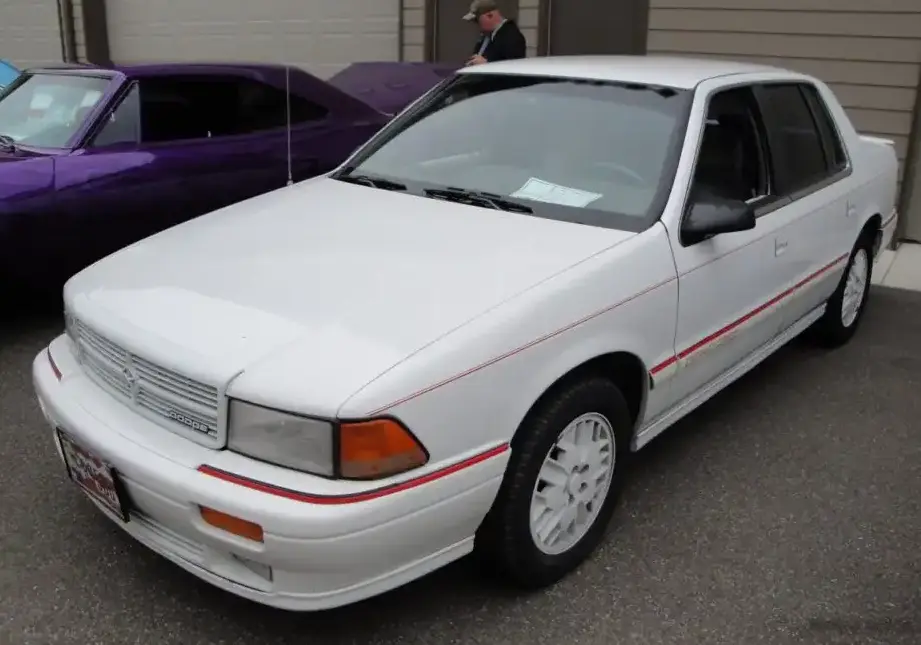
The Dodge Spirit 3.0, produced from 1988 to 1995, represented a significant offering in the mid-size American sedan market. Falling within the second generation of the Spirit (1989-1995), the 3.0-liter variant occupied a middle ground in the lineup, positioned above the base 2.5-liter models and below the performance-oriented RT trim. The Spirit, along with its Chrysler siblings – the Plymouth Acclaim and Dodge Daytona – were built on the Chrysler JH platform, a design intended to modernize the company’s offerings and compete with increasingly popular Japanese imports. The 3.0 model aimed to provide a balance of power, comfort, and affordability for family buyers.
Technical Specifications
| Brand | Dodge |
| Model | Spirit |
| Generation | Spirit |
| Type (Engine) | 3.0 (143 Hp) |
| Start of production | 1988 year |
| End of production | 1995 year |
| Powertrain Architecture | Internal Combustion engine |
| Body type | Sedan |
| Seats | 5 |
| Doors | 4 |
| Fuel consumption (urban) | 15 l/100 km (15.7 US mpg, 18.8 UK mpg, 6.7 km/l) |
| Fuel consumption (extra urban) | 9 l/100 km (26.1 US mpg, 31.4 UK mpg, 11.1 km/l) |
| Fuel Type | Petrol (Gasoline) |
| Maximum speed | 190 km/h (118.06 mph) |
| Weight-to-power ratio | 9 kg/Hp, 110.5 Hp/tonne |
| Weight-to-torque ratio | 5.6 kg/Nm, 179.3 Nm/tonne |
| Power | 143 Hp @ 5000 rpm |
| Power per litre | 48.1 Hp/l |
| Torque | 232 Nm @ 2400 rpm (171.11 lb.-ft. @ 2400 rpm) |
| Engine layout | Front, Transverse |
| Engine displacement | 2972 cm3 (181.36 cu. in.) |
| Number of cylinders | 6 |
| Engine configuration | V-engine |
| Cylinder Bore | 91.1 mm (3.59 in.) |
| Piston Stroke | 76 mm (2.99 in.) |
| Compression ratio | 8.9:1 |
| Number of valves per cylinder | 2 |
| Fuel injection system | Multi-port manifold injection |
| Engine aspiration | Naturally aspirated engine |
| Valvetrain | OHC |
| Engine oil capacity | 4.3 l (4.54 US qt | 3.78 UK qt) |
| Coolant | 9 l (9.51 US qt | 7.92 UK qt) |
| Kerb Weight | 1294 kg (2852.78 lbs.) |
| Trunk (boot) space – minimum | 408 l (14.41 cu. ft.) |
| Trunk (boot) space – maximum | 555 l (19.6 cu. ft.) |
| Fuel tank capacity | 61 l (16.11 US gal | 13.42 UK gal) |
| Length | 4602 mm (181.18 in.) |
| Width | 1731 mm (68.15 in.) |
| Height | 1358 mm (53.46 in.) |
| Wheelbase | 2629 mm (103.5 in.) |
| Front track | 1463 mm (57.6 in.) |
| Rear (Back) track | 1453 mm (57.2 in.) |
| Drivetrain Architecture | The Internal combustion engine (ICE) drives the front wheels of the vehicle. |
| Drive wheel | Front wheel drive |
| Number of gears and type of gearbox | 4 gears, automatic transmission |
| Front suspension | Wishbone |
| Rear suspension | Rigid axle suspension |
| Front brakes | Ventilated discs |
| Rear brakes | Drum |
| Assisting systems | ABS (Anti-lock braking system) |
| Power steering | Hydraulic Steering |
| Tires size | 205/60 R15 |
Powertrain & Engine Architecture
The heart of the Spirit 3.0 was the Chrysler 3.0-liter V6 engine, internally designated as the 3.0L. This engine was a 60-degree V6, utilizing an overhead camshaft (OHC) design with two valves per cylinder. The engine featured multi-port fuel injection, a significant upgrade over earlier carbureted designs, contributing to improved fuel efficiency and smoother operation. The 3.0L engine produced 143 horsepower at 5000 rpm and 171 lb-ft of torque at 2400 rpm. Paired with this engine was a four-speed automatic transmission, a Torqueflite A727 variant, known for its durability and relatively smooth shifts. This transmission was a common choice for Chrysler vehicles of the era, prioritizing reliability over outright performance. The engine’s transverse mounting within the front-wheel-drive configuration was a key element of the JH platform’s design, maximizing interior space.
Driving Characteristics
The Spirit 3.0 with the automatic transmission offered a comfortable, if not particularly sporty, driving experience. Acceleration was adequate for everyday driving, with the 3.0L V6 providing sufficient power for merging onto highways and passing slower traffic. However, the automatic transmission, while reliable, did detract from the engine’s potential. The gear ratios were tuned for fuel economy and smooth cruising rather than aggressive acceleration. Compared to the five-speed manual transmission available on some Spirit models, the automatic resulted in slightly slower 0-60 mph times. The suspension, tuned for comfort, provided a relatively soft ride, absorbing bumps and imperfections in the road well. Steering was hydraulically assisted, making maneuvering easy, but lacked the precision found in more performance-oriented vehicles.
Equipment & Trim Levels
The Spirit 3.0 typically came standard with features considered essential for a mid-size family sedan in the early 1990s. These included air conditioning, power steering, a basic AM/FM radio, cloth upholstery, and full wheel covers. Higher trim levels, often denoted by packages like the “LX” or “LE”, added features such as upgraded sound systems, power windows and locks, cruise control, and a more luxurious interior trim. Optional extras included a sunroof, leather upholstery, and alloy wheels. The interior design was functional and straightforward, prioritizing usability over stylistic flair. The dashboard layout was typical of American cars of the period, with clearly labeled controls and a relatively uncluttered appearance.
Chassis & Braking
The Spirit 3.0 utilized a front-wheel-drive chassis with an independent front suspension featuring wishbone components. The rear suspension employed a solid axle design, a cost-effective solution common in American cars of this era. Braking duties were handled by ventilated discs at the front and drum brakes at the rear. Anti-lock braking system (ABS) was available as an option, enhancing safety by preventing wheel lockup during hard braking. The tires were typically 205/60R15 size, providing a balance of ride comfort and handling. The chassis was designed to provide a comfortable ride and adequate handling for everyday driving, rather than being optimized for sporty performance.
Market Reception & Comparison
The Dodge Spirit 3.0 was generally well-received by critics as a practical and affordable family sedan. It offered a good value proposition, providing a spacious interior, a comfortable ride, and a reasonably powerful engine at a competitive price point. However, it was often criticized for its somewhat bland styling and lack of sporty handling. Compared to the 2.5-liter base models, the 3.0-liter offered a noticeable improvement in performance. Compared to the higher-performance RT trim, the 3.0-liter prioritized fuel economy and comfort over outright speed. Fuel economy figures averaged around 15 mpg in the city and 26 mpg on the highway, which were typical for V6-powered sedans of the time. Reliability was generally good, although some owners reported issues with the automatic transmission over the long term.
Legacy
The Dodge Spirit 3.0, while not a groundbreaking vehicle, played an important role in Chrysler’s efforts to modernize its lineup and compete in the mid-size sedan market. The 3.0L V6 engine proved to be a durable and reliable powerplant, and many examples remain on the road today. In the used car market, the Spirit 3.0 is often sought after by those looking for an affordable and practical classic American sedan. While not a collector’s item, well-maintained examples are appreciated for their simplicity, reliability, and nostalgic appeal. The Spirit’s legacy lies in its contribution to the evolution of the American family sedan, offering a blend of comfort, affordability, and practicality that resonated with buyers in the 1990s.
