
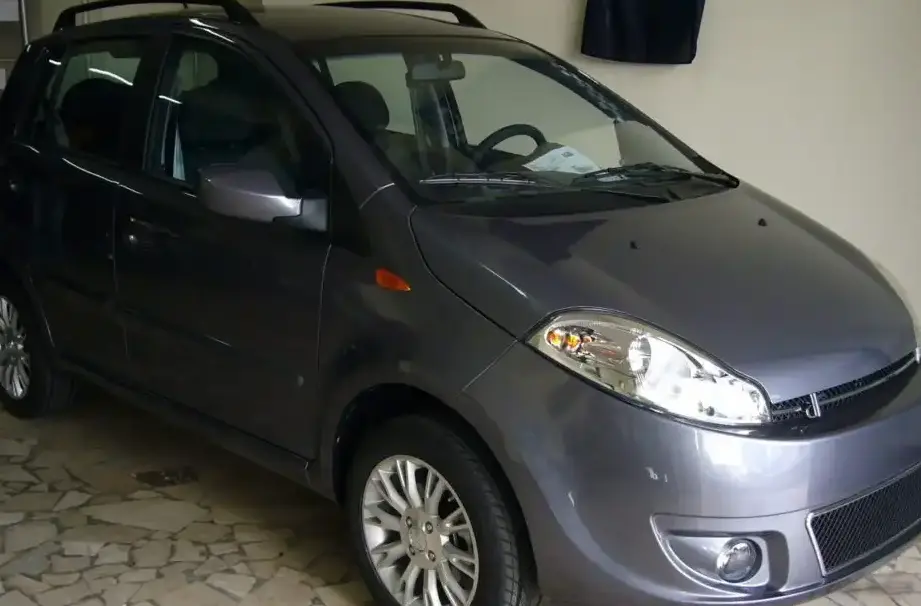
The DR 2 1.3, producing 83 horsepower, was a subcompact hatchback manufactured by the Italian automaker DR Motor Company between 2010 and 2014. Positioned as an entry-level offering within the DR 2 range, this variant aimed to provide affordable transportation with reasonable fuel efficiency. It was based heavily on the Chery Riich G3, a Chinese-market hatchback, reflecting DR Motor’s strategy of rebadging and adapting vehicles from other manufacturers for the European market. The 1.3-liter engine and five-speed manual transmission combination represented the base configuration for the DR 2, serving as the most accessible price point for potential buyers.
Technical Specifications
| Brand | DR |
| Model | 2 |
| Generation | 2 |
| Type (Engine) | 1.3 (83 Hp) |
| Start of production | 2010 |
| End of production | 2014 |
| Powertrain Architecture | Internal Combustion engine |
| Body type | Hatchback |
| Seats | 5 |
| Doors | 5 |
| Fuel consumption (urban) | 7.5 l/100 km (31.4 US mpg) |
| Fuel consumption (extra urban) | 4.5 l/100 km (52.3 US mpg) |
| Fuel consumption (combined) | 5.6 l/100 km (42 US mpg) |
| CO2 emissions | 129 g/km |
| Fuel Type | Petrol (Gasoline) |
| Acceleration 0 – 100 km/h | 12 sec |
| Acceleration 0 – 62 mph | 12 sec |
| Acceleration 0 – 60 mph | 11.4 sec |
| Maximum speed | 156 km/h (96.93 mph) |
| Emission standard | Euro 5 |
| Weight-to-power ratio | 11.7 kg/Hp |
| Weight-to-torque ratio | 8.5 kg/Nm |
| Power | 83 Hp @ 6000 rpm |
| Power per litre | 64 Hp/l |
| Torque | 114 Nm @ 3800-4500 rpm (84.08 lb.-ft.) |
| Engine layout | Front, Transverse |
| Engine displacement | 1297 cm3 (79.15 cu. in.) |
| Number of cylinders | 4 |
| Engine configuration | Inline |
| Compression ratio | 10.8:1 |
| Number of valves per cylinder | 4 |
| Fuel injection system | Multi-port manifold injection |
| Engine aspiration | Naturally aspirated |
| Valvetrain | DOHC |
| Kerb Weight | 970 kg (2138.48 lbs.) |
| Max. weight | 1420 kg (3130.56 lbs.) |
| Max load | 450 kg (992.08 lbs.) |
| Trunk (boot) space – minimum | 250 l (8.83 cu. ft.) |
| Trunk (boot) space – maximum | 650 l (22.95 cu. ft.) |
| Fuel tank capacity | 43 l (11.36 US gal) |
| Length | 3700 mm (145.67 in.) |
| Width | 1578 mm (62.13 in.) |
| Height | 1527 mm (60.12 in.) |
| Wheelbase | 2390 mm (94.09 in.) |
| Front track | 1370 mm (53.94 in.) |
| Rear track | 1355 mm (53.35 in.) |
| Minimum turning circle | 9.6 m (31.5 ft.) |
| Drivetrain | Front wheel drive |
| Number of gears | 5 |
| Gearbox type | Manual transmission |
| Front suspension | Independent, McPherson with coil spring and anti-roll bar |
| Rear suspension | Coil spring, Torsion |
| Front brakes | Disc |
| Rear brakes | Drum |
| Assisting systems | ABS (Anti-lock braking system) |
| Steering type | Steering rack and pinion |
| Tires size | 175/60 R14; 185/55 R15 |
| Wheel rims size | 14; 15 |
INTRODUCTION
The DR 2 1.3 (83 Hp) was a key model in DR Motor Company’s initial foray into the European automotive market. Introduced in 2010, it represented a budget-friendly hatchback option, primarily targeting buyers seeking a practical and economical vehicle for urban commuting. The DR 2, in general, was based on the Chery Riich G3 platform, a compact hatchback originally designed for the Chinese market. DR Motor Company acquired the rights to rebadge and sell the vehicle in Europe, adapting it to meet European safety and emissions standards. The 1.3-liter engine variant served as the entry point to the DR 2 lineup, offering a balance between affordability and acceptable performance for everyday driving.
Powertrain & Engine Architecture
The DR 2 1.3 was powered by a 1.3-liter, inline-four cylinder gasoline engine. This engine, derived from Chery designs, featured a double overhead camshaft (DOHC) valvetrain with four valves per cylinder. The engine utilized a multi-point fuel injection system, delivering fuel directly into the intake ports. With a compression ratio of 10.8:1, the engine produced 83 horsepower at 6000 rpm and 114 Nm (84.08 lb.-ft.) of torque between 3800 and 4500 rpm. The engine was transversely mounted in the front of the vehicle. The powertrain was paired with a five-speed manual transmission, which was the sole transmission option for this variant. This transmission was chosen for its simplicity and contribution to fuel efficiency. The engine’s architecture prioritized fuel economy over outright performance, making it suitable for city driving.
Driving Characteristics
The DR 2 1.3 with the five-speed manual transmission offered modest performance. Acceleration from 0 to 100 km/h (0-62 mph) took approximately 12 seconds, and the top speed was around 156 km/h (96.93 mph). The engine’s torque peak at 3800-4500 rpm meant that drivers needed to rev the engine to access usable power, particularly when overtaking or climbing hills. Compared to potential higher-output variants (which were not widely available in Europe), the 1.3-liter engine felt noticeably less responsive. The gear ratios in the five-speed manual transmission were geared towards fuel efficiency, resulting in a slightly less engaging driving experience than a sportier setup. However, the light weight of the vehicle (970 kg / 2138.48 lbs) helped to mitigate the engine’s power deficit to some extent.
Equipment & Trim Levels
The DR 2 1.3 typically came with a basic level of standard equipment. Interior features generally included cloth upholstery, a simple dashboard layout, and manual air conditioning. Power windows and central locking were often included, but features like alloy wheels, a more advanced audio system, or parking sensors were typically optional extras. The trim level for the 1.3-liter variant was generally the base trim, focusing on providing essential features at the lowest possible price point. Optional extras could be added to personalize the vehicle, but the emphasis remained on affordability. Safety features included ABS (Anti-lock Braking System) as standard, but airbags and other advanced safety systems were often limited.
Chassis & Braking
The DR 2 1.3 utilized a relatively simple chassis design. The front suspension consisted of independent McPherson struts with coil springs and an anti-roll bar, while the rear suspension employed a coil spring and torsion beam setup. This suspension configuration prioritized ride comfort over handling precision. The braking system featured disc brakes on the front wheels and drum brakes on the rear wheels. The drum brakes on the rear were a cost-saving measure common in entry-level vehicles of this class. The steering system was a rack and pinion type, providing adequate steering feel for everyday driving. Tire sizes typically ranged from 175/60 R14 to 185/55 R15, depending on the trim level and optional wheel upgrades.
Market Reception & Comparison
The DR 2 1.3 received mixed reviews from automotive critics. It was generally praised for its affordability and fuel efficiency, but criticized for its lack of refinement and relatively low performance. Compared to other subcompact hatchbacks available in Europe at the time, such as the Fiat Panda or the Renault Twingo, the DR 2 1.3 offered a lower price point but lacked the established brand reputation and overall sophistication of its competitors. Fuel economy was a strong point, with combined fuel consumption figures of around 5.6 l/100 km (42 US mpg). Reliability was also considered acceptable, although the long-term durability of the Chinese-sourced components remained a concern for some buyers.
Legacy
The DR 2 1.3, while not a groundbreaking vehicle, played a role in establishing DR Motor Company as a player in the European automotive market. The 1.3-liter engine and five-speed manual transmission combination proved to be a reasonably reliable powertrain, although finding replacement parts today can be challenging due to the limited production numbers and the brand’s relatively small presence. In the used car market, the DR 2 1.3 remains an affordable option for buyers seeking a basic and economical hatchback. However, potential buyers should be aware of the vehicle’s limited features and the potential for higher maintenance costs due to the sourcing of components. The DR 2 1.3 represents a unique chapter in the history of automotive rebadging and the increasing globalization of the automotive industry.
