
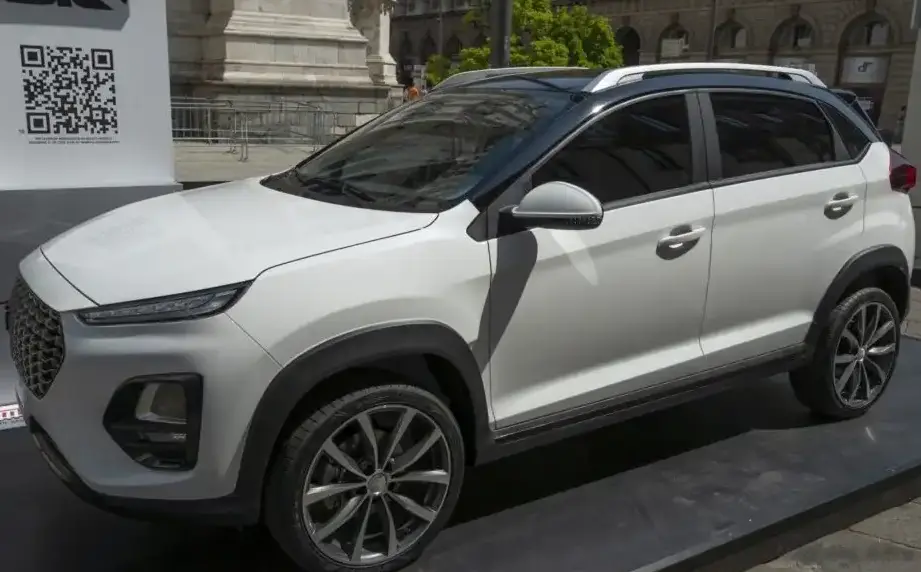
The DR 3.0 1.5 (116 Hp) CVT is a compact crossover SUV produced by the Italian automotive manufacturer DR Automobiles beginning in 2022. Positioned as an entry-level offering within the DR 3.0 range, this variant combines a naturally aspirated 1.5-liter gasoline engine with a continuously variable transmission (CVT). The DR 3.0, and this specific trim, represents DR’s attempt to offer affordable transportation in the European market, often utilizing platforms and technology sourced from established manufacturers. It is available in both Coupe and SUV body styles, offering five seats and five doors.
Technical Specifications
| Brand | DR |
| Model | 3.0 |
| Generation | 3.0 |
| Type (Engine) | 1.5 (116 Hp) CVT |
| Start of production | 2022 |
| Powertrain Architecture | Internal Combustion engine |
| Body type | Coupe, SUV |
| Seats | 5 |
| Doors | 5 |
| Combined fuel consumption (WLTP) | 6.5 l/100 km (36.2 US mpg, 43.5 UK mpg, 15.4 km/l) |
| CO2 emissions (WLTP) | 159 g/km |
| Fuel Type | Petrol (Gasoline) |
| Maximum speed | 175 km/h (108.74 mph) |
| Emission standard | Euro 6d-ISC-FCM |
| Weight-to-power ratio | 11.2 kg/Hp, 89.2 Hp/tonne |
| Weight-to-torque ratio | 9.6 kg/Nm, 103.8 Nm/tonne |
| Power | 116 Hp @ 6150 rpm |
| Power per litre | 77.4 Hp/l |
| Torque | 135 Nm @ 4700 rpm (99.57 lb.-ft. @ 4700 rpm) |
| Engine layout | Front, Transverse |
| Engine displacement | 1498 cm3 (91.41 cu. in.) |
| Number of cylinders | 4 |
| Engine configuration | Inline |
| Number of valves per cylinder | 4 |
| Fuel injection system | Multi-port manifold injection |
| Engine aspiration | Naturally aspirated engine |
| Valvetrain | DOHC |
| Engine systems | Start & Stop System |
| Kerb Weight | 1300 kg (2866.01 lbs.) |
| Max. weight | 1620 kg (3571.49 lbs.) |
| Max load | 320 kg (705.48 lbs.) |
| Trunk (boot) space – minimum | 420 l (14.83 cu. ft.) |
| Trunk (boot) space – maximum | 800 l (28.25 cu. ft.) |
| Fuel tank capacity | 50 l (13.21 US gal | 11 UK gal) |
| Length | 4170 mm (164.17 in.) |
| Width | 1760 mm (69.29 in.) |
| Height | 1570 mm (61.81 in.) |
| Wheelbase | 2555 mm (100.59 in.) |
| Front track | 1495 mm (58.86 in.) |
| Rear (Back) track | 1484 mm (58.43 in.) |
| Drivetrain Architecture | The Internal combustion engine (ICE) drives the front wheels of the vehicle. |
| Drive wheel | Front wheel drive |
| Number of gears and type of gearbox | automatic transmission CVT |
| Front suspension | Independent, type McPherson with coil spring and anti-roll bar |
| Rear suspension | Torsion |
| Front brakes | Ventilated discs |
| Rear brakes | Disc |
| Assisting systems | ABS (Anti-lock braking system) |
| Steering type | Steering rack and pinion |
| Power steering | Electric Steering |
| Tires size | 205/50 R17 |
| Wheel rims size | 17 |
Powertrain & Engine Architecture
The DR 3.0 1.5 CVT is powered by a 1.5-liter inline-four cylinder gasoline engine. This engine utilizes a multi-port fuel injection system and a double overhead camshaft (DOHC) valvetrain. The engine produces 116 horsepower at 6150 rpm and 135 Nm (99.57 lb-ft) of torque at 4700 rpm. The engine is transversely mounted at the front of the vehicle. The engine incorporates a Start & Stop system to improve fuel efficiency. The engine is paired with a continuously variable transmission (CVT), which is designed to provide smooth acceleration and optimized fuel economy. While the specific CVT used isn’t widely publicized, it’s likely a unit sourced from a larger supplier, prioritizing cost-effectiveness over outright performance.
Driving Characteristics
The 1.5-liter engine and CVT combination in the DR 3.0 delivers adequate, but not particularly spirited, performance. Acceleration is linear, thanks to the CVT, but the engine lacks the low-end torque found in turbocharged alternatives. The CVT is programmed for fuel efficiency, meaning it tends to hold lower engine speeds for longer, which can result in a somewhat droning engine note during acceleration. Compared to potential higher-output versions (if offered in the future), this variant prioritizes fuel economy and ease of driving over outright performance. The CVT’s continuously variable ratios aim to keep the engine in its optimal power band, but the overall experience is geared towards comfortable commuting rather than enthusiastic driving.
Equipment & Trim Levels
The DR 3.0 1.5 CVT typically comes standard with features such as air conditioning, power windows, central locking, and a basic audio system. Safety features generally include ABS, electronic stability control, and airbags. Interior upholstery is typically cloth, and the dashboard features a functional, if somewhat basic, design. Optional extras may include alloy wheels, a touchscreen infotainment system with Bluetooth connectivity, and parking sensors. The trim level for this variant is generally considered entry-level, focusing on providing essential features at an affordable price point.
Chassis & Braking
The DR 3.0 utilizes a McPherson strut suspension setup at the front, providing a comfortable ride quality. The rear suspension employs a torsion beam, a cost-effective solution commonly found in vehicles of this class. The braking system consists of ventilated discs at the front and solid discs at the rear. ABS (Anti-lock Braking System) is standard. The steering is rack and pinion with electric power assistance. The vehicle is equipped with 205/50 R17 tires mounted on 17-inch wheels.
Market Reception & Comparison
The DR 3.0 1.5 CVT has been positioned as a budget-friendly option in the European market. Critics have generally acknowledged its affordability but have noted its relatively modest performance and basic interior. Fuel economy is a strong point, with the WLTP combined cycle rating of 6.5 l/100 km (36.2 US mpg). Compared to other trims within the DR 3.0 range (if available), this variant offers the lowest price point but also the least amount of power. It competes with other entry-level compact crossovers, such as the Dacia Duster, offering a similar value proposition.
Legacy
As a relatively new model, the long-term reliability of the DR 3.0 1.5 CVT is still being established. The 1.5-liter engine, while not known for exceptional performance, is generally considered to be a reliable unit. The CVT, however, is a component that requires careful maintenance to ensure longevity. In the used car market, this variant is likely to appeal to buyers seeking an affordable and fuel-efficient crossover SUV. Its simplicity and relatively low running costs could make it a practical choice for those prioritizing value over performance.
