
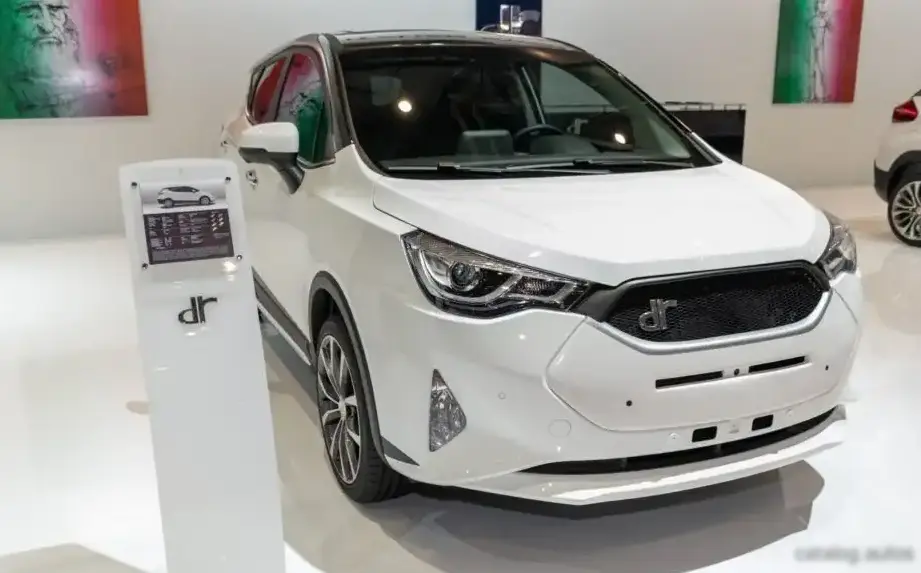
The DR 4 1.6 (114 Hp) is a compact SUV produced by the Italian manufacturer DR Automobiles between 2016 and 2020. Positioned as an entry-level offering within the DR 4 lineup, it represented an attempt to provide affordable SUV transportation in the European market. The DR 4 itself is heavily based on the first-generation Chery Tiggo 5, reflecting DR’s strategy of rebadging and modifying vehicles sourced primarily from China. This variant, equipped with the 1.6-liter engine and a six-speed manual transmission, aimed to balance fuel efficiency with acceptable performance for everyday driving.
Technical Specifications
| Brand | DR |
| Model | 4 |
| Generation | 4 |
| Type (Engine) | 1.6 (114 Hp) |
| Start of production | 2016 |
| End of production | 2020 |
| Powertrain Architecture | Internal Combustion engine |
| Body type | SUV |
| Seats | 5 |
| Doors | 5 |
| Fuel consumption (economy) – urban | 9.4 l/100 km (25 US mpg) |
| Fuel consumption (economy) – extra urban | 6.3 l/100 km (37.3 US mpg) |
| Fuel consumption (economy) – combined | 7.4 l/100 km (31.8 US mpg) |
| CO2 emissions | 174 g/km |
| Fuel Type | Petrol (Gasoline) |
| Acceleration 0 – 100 km/h | 10.5 sec |
| Acceleration 0 – 62 mph | 10.5 sec |
| Acceleration 0 – 60 mph | 10 sec |
| Maximum speed | 175 km/h (108.74 mph) |
| Emission standard | Euro 6 |
| Weight-to-power ratio | 11.1 kg/Hp |
| Weight-to-torque ratio | 8.1 kg/Nm |
| Power | 114 Hp @ 6300 rpm |
| Torque | 155 Nm @ 4000 rpm (114.32 lb.-ft. @ 4000 rpm) |
| Engine layout | Front, Transverse |
| Engine displacement | 1590 cm3 (97.03 cu. in.) |
| Number of cylinders | 4 |
| Engine configuration | Inline |
| Engine aspiration | Naturally aspirated engine |
| Kerb Weight | 1260 kg (2777.82 lbs.) |
| Max. weight | 1635 kg (3604.56 lbs.) |
| Max load | 375 kg (826.73 lbs.) |
| Trunk (boot) space – minimum | 600 l (21.19 cu. ft.) |
| Trunk (boot) space – maximum | 1200 l (42.38 cu. ft.) |
| Fuel tank capacity | 45 l (11.89 US gal | 9.9 UK gal) |
| Length | 4345 mm (171.06 in.) |
| Width | 1765 mm (69.49 in.) |
| Height | 1640 mm (64.57 in.) |
| Wheelbase | 2560 mm (100.79 in.) |
| Front track | 1480 mm (58.27 in.) |
| Rear (Back) track | 1475 mm (58.07 in.) |
| Drivetrain Architecture | The Internal combustion engine (ICE) drives the front wheels of the vehicle. |
| Drive wheel | Front wheel drive |
| Number of gears and type of gearbox | 6 gears, manual transmission |
| Front suspension | Independent type McPherson |
| Front brakes | Ventilated discs |
| Rear brakes | Disc |
| Assisting systems | ABS (Anti-lock braking system) |
| Steering type | Steering rack and pinion |
| Power steering | Electric Steering |
| Wheel rims size | 16; 17; 18 |
Powertrain & Engine Architecture
The DR 4 1.6 utilizes a 1.6-liter inline-four cylinder gasoline engine. This engine, sourced from Chery, is a naturally aspirated unit, meaning it does not employ turbocharging or supercharging. It produces 114 horsepower at 6,300 rpm and 155 Nm (114.32 lb-ft) of torque at 4,000 rpm. The engine features a multi-point fuel injection system and a double overhead camshaft (DOHC) valvetrain. The six-speed manual transmission was the sole gearbox option for this variant. The transmission’s gear ratios are tuned for fuel efficiency and everyday drivability rather than outright performance. The engine code is not widely publicized, but it is understood to be a derivative of Chery’s S16DR engine family.
Driving Characteristics
The DR 4 1.6 with the manual transmission offers a reasonably comfortable driving experience, though it’s not particularly sporty. Acceleration from 0 to 100 km/h (0-62 mph) takes approximately 10.5 seconds, which is typical for a vehicle in this class with this engine size. The engine feels adequate for city driving and highway cruising, but can feel strained when fully loaded or attempting quick overtaking maneuvers. The manual gearbox provides drivers with more control over the engine’s power delivery compared to an automatic, but the shift quality is often described as somewhat notchy. Compared to potential higher-output engine options (had they been available in the DR 4 range), this 1.6L version prioritizes fuel economy over performance.
Equipment & Trim Levels
The DR 4 1.6 typically came equipped with a basic level of standard features. These generally included air conditioning, power windows, central locking, and an audio system with USB connectivity. Safety features such as ABS and dual front airbags were also standard. Higher trim levels, if selected, could add features like alloy wheels, a more advanced audio system, rear parking sensors, and a leather-wrapped steering wheel. Interior upholstery was typically cloth, with a relatively simple dashboard layout. The overall interior design reflected the vehicle’s budget-oriented positioning.
Chassis & Braking
The DR 4 1.6 utilizes a front-wheel-drive layout with an independent McPherson strut suspension at the front and a semi-independent torsion beam suspension at the rear. The front brakes are ventilated discs, providing adequate stopping power, while the rear brakes are solid discs. The steering is rack and pinion with electric power assistance. The suspension setup is tuned for comfort rather than sporty handling, resulting in a relatively soft ride quality. Stabilizer bars are present at both the front and rear to reduce body roll during cornering, though their effectiveness is limited by the vehicle’s overall weight and suspension design.
Market Reception & Comparison
The DR 4 1.6 received mixed reviews from automotive critics. It was generally praised for its affordability and spacious interior, but criticized for its unremarkable performance, basic interior materials, and the perceived lack of brand recognition. Compared to other compact SUVs available in the European market at the time, such as the Dacia Duster or the Renault Captur, the DR 4 1.6 offered a competitive price point but lacked the refinement and established reputation of its rivals. Fuel economy was considered average for its class, and reliability reports were limited due to the relatively low sales volume of the vehicle.
Legacy
The DR 4 1.6, while not a major success in terms of sales volume, represents an interesting example of a Chinese-sourced vehicle being rebadged and marketed in Europe. The 1.6-liter engine and six-speed manual transmission combination proved to be reasonably reliable, though long-term durability data is scarce. On the used car market, the DR 4 1.6 is typically offered at very low prices, making it an attractive option for budget-conscious buyers. However, potential buyers should be aware of the vehicle’s limited brand recognition and the potential challenges of sourcing spare parts.
