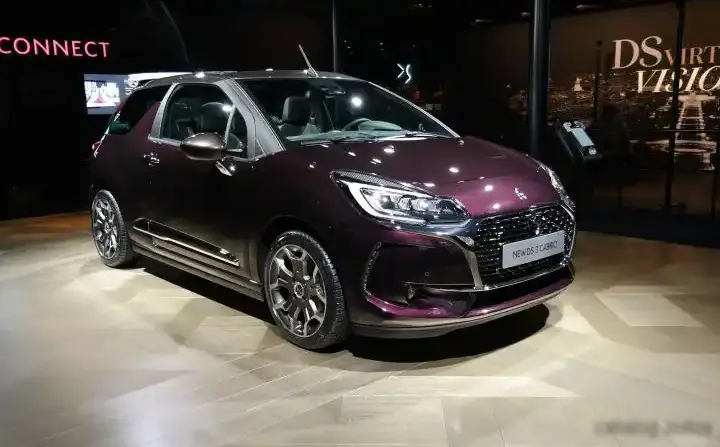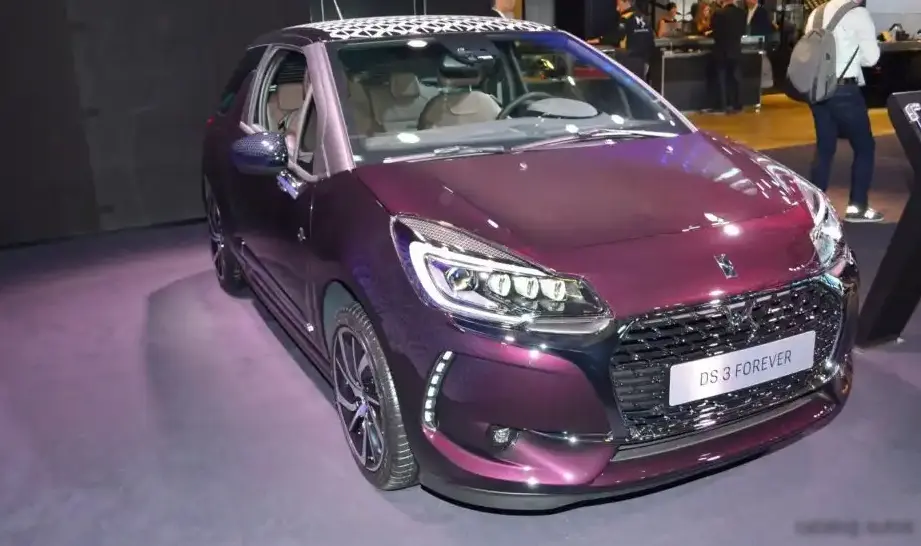
The DS 3 1.6 BlueHDi 99 Stop&Start, produced between 2016 and 2018, represents a key variant within the second generation of the DS 3 hatchback. Positioned as an entry-level diesel option, it aimed to deliver fuel efficiency and lower running costs to a broader customer base. This model falls within the broader PSA Peugeot Citroën B-segment platform, shared with vehicles like the Peugeot 208 and Citroën C3. The DS 3, as a premium subcompact, sought to offer a more sophisticated alternative to mainstream competitors, and the 1.6 BlueHDi 99 offered a balance between affordability and the brand’s aspirations for refinement.
Technical Specifications
| Brand | DS |
| Model | 3 |
| Generation | 2 |
| Type (Engine) | 1.6 BlueHDi (99 Hp) Stop&Start |
| Start of production | 2016 |
| End of production | 2018 |
| Powertrain Architecture | Internal Combustion engine |
| Body type | Hatchback |
| Seats | 5 |
| Doors | 3 |
| Fuel consumption (urban) | 3.8 l/100 km (61.9 US mpg, 74.3 UK mpg, 26.3 km/l) |
| Fuel consumption (extra urban) | 3.2 l/100 km (73.5 US mpg, 88.3 UK mpg, 31.3 km/l) |
| Fuel consumption (combined) | 3.4 l/100 km (69.2 US mpg, 83.1 UK mpg, 29.4 km/l) |
| CO2 emissions | 87 g/km |
| Fuel Type | Diesel |
| Acceleration 0 – 100 km/h | 10.8 sec |
| Acceleration 0 – 62 mph | 10.8 sec |
| Acceleration 0 – 60 mph | 10.3 sec |
| Maximum speed | 189 km/h (117.44 mph) |
| Emission standard | Euro 6 |
| Weight-to-power ratio | 11 kg/Hp, 91.2 Hp/tonne |
| Weight-to-torque ratio | 4.3 kg/Nm, 234.1 Nm/tonne |
| Power | 99 Hp @ 3750 rpm |
| Power per litre | 63.5 Hp/l |
| Torque | 254 Nm @ 1750 rpm (187.34 lb.-ft. @ 1750 rpm) |
| Engine layout | Front, Transverse |
| Engine Model/Code | BHY DV6FD |
| Engine displacement | 1560 cm3 (95.2 cu. in.) |
| Number of cylinders | 4 |
| Engine configuration | Inline |
| Cylinder Bore | 75 mm (2.95 in.) |
| Piston Stroke | 88.3 mm (3.48 in.) |
| Fuel injection system | Diesel Commonrail |
| Engine aspiration | Turbocharger, Intercooler |
| Engine oil capacity | 3.8 l (4.02 US qt | 3.34 UK qt) |
| Kerb Weight | 1085 kg (2392.02 lbs.) |
| Max. weight | 1633 kg (3600.15 lbs.) |
| Max load | 548 kg (1208.13 lbs.) |
| Trunk (boot) space – minimum | 285 l (10.06 cu. ft.) |
| Trunk (boot) space – maximum | 980 l (34.61 cu. ft.) |
| Fuel tank capacity | 45 l (11.89 US gal | 9.9 UK gal) |
| AdBlue tank | 17 l (4.49 US gal | 3.74 UK gal) |
| Max. roof load | 70 kg (154.32 lbs.) |
| Permitted trailer load with brakes (12%) | 775 kg (1708.58 lbs.) |
| Permitted trailer load without brakes | 450 kg (992.08 lbs.) |
| Permitted towbar download | 46 kg (101.41 lbs.) |
| Length | 3954 mm (155.67 in.) |
| Width | 1715 mm (67.52 in.) |
| Width including mirrors | 2004 mm (78.9 in.) |
| Height | 1458-1483 mm (57.4 – 58.39 in.) |
| Wheelbase | 2464 mm (97.01 in.) |
| Front track | 1465-1468 mm (57.68 – 57.8 in.) |
| Rear (Back) track | 1467-1471 mm (57.76 – 57.91 in.) |
| Front overhang | 830 mm (32.68 in.) |
| Rear overhang | 660 mm (25.98 in.) |
| Minimum turning circle (turning diameter) | 10.2 m (33.46 ft.) |
| Drivetrain Architecture | The Internal combustion engine (ICE) drives the front wheels of the vehicle. |
| Drive wheel | Front wheel drive |
| Number of gears and type of gearbox | 5 gears, manual transmission |
| Front suspension | Independent type McPherson |
| Rear suspension | Semi-independent, coil spring |
| Front brakes | Ventilated discs |
| Rear brakes | Disc |
| Assisting systems | ABS (Anti-lock braking system) |
| Steering type | Steering rack and pinion |
| Power steering | Electric Steering |
| Tires size | 195/55 R16; 205/45 R17 |
| Wheel rims size | 16; 17 |
INTRODUCTION
The DS 3 1.6 BlueHDi 99 Stop&Start, launched in 2016, was a crucial component of DS Automobiles’ strategy to establish itself as a distinct premium brand. Building upon the success of the original Citroën DS3, the DS 3 aimed for a more upscale experience. This particular variant, powered by the 1.6-liter BlueHDi diesel engine producing 99 horsepower, was designed to appeal to buyers prioritizing fuel economy and low emissions. The “Stop&Start” system further enhanced its efficiency by automatically shutting off the engine when the vehicle was stationary. It occupied the lower-mid range of the DS 3 lineup, offering a more accessible entry point compared to the higher-powered petrol and diesel options.
Powertrain & Engine Architecture
At the heart of the DS 3 1.6 BlueHDi 99 lies the PSA Group’s DV6 engine family, specifically the BHY DV6FD variant. This is a four-cylinder, inline diesel engine with a displacement of 1560cc. It utilizes a common-rail direct injection system, delivering fuel at extremely high pressure for optimized combustion. The engine is turbocharged and intercooled, enhancing power output and efficiency. The BHY engine is known for its relatively robust design, though early versions of the DV6 family did experience some issues with diesel particulate filter (DPF) clogging, which PSA addressed through software updates and improved DPF designs. The 99 horsepower output is achieved at 3750 rpm, while peak torque of 254 Nm (187 lb-ft) is available from 1750 rpm. The engine is paired with a five-speed manual transmission, chosen for its simplicity and cost-effectiveness. While an automatic transmission was available on other DS 3 models, it wasn’t offered with this specific engine/power combination.
Driving Characteristics
The DS 3 1.6 BlueHDi 99, with its 99 horsepower and 254 Nm of torque, provides adequate, though not exhilarating, performance. Acceleration from 0-60 mph takes around 10.3 seconds, and top speed is 117.44 mph. The engine feels most comfortable in the mid-range, offering sufficient power for everyday driving and overtaking maneuvers. The five-speed manual transmission is well-matched to the engine’s characteristics, with gear ratios optimized for fuel efficiency. Compared to the more powerful 1.6 BlueHDi 120 or the petrol-powered variants, the 99 hp version feels noticeably slower, particularly when fully loaded or climbing hills. However, the lower power output also contributes to improved fuel economy. The steering is light and precise, making the DS 3 easy to maneuver in urban environments. The suspension, while firm enough to provide decent handling, can feel a little harsh on rough road surfaces.
Equipment & Trim Levels
The DS 3 1.6 BlueHDi 99 typically came equipped with a reasonable level of standard features. These included air conditioning, a touchscreen infotainment system with Bluetooth connectivity, USB port, and steering wheel-mounted audio controls. Safety features such as ABS, ESP (Electronic Stability Program), and multiple airbags were also standard. Higher trim levels, such as Prestige or Performance, added features like automatic climate control, rear parking sensors, alloy wheels, and upgraded interior trim. Optional extras included a panoramic sunroof, leather upholstery, and a more advanced navigation system. Interior upholstery was typically cloth, though leather options were available. The dashboard design was modern and stylish, reflecting the DS brand’s emphasis on premium aesthetics.
Chassis & Braking
The DS 3 1.6 BlueHDi 99 utilizes a McPherson strut front suspension and a semi-independent coil spring rear suspension. This setup provides a good balance between ride comfort and handling. The front brakes are ventilated discs, while the rear brakes are solid discs. ABS (Anti-lock Braking System) and ESP (Electronic Stability Program) are standard, enhancing safety and stability. The chassis is relatively lightweight, contributing to the car’s fuel efficiency and agility. Stabilizer bars are fitted to both the front and rear axles to reduce body roll during cornering. The steering is electrically assisted, providing a light and responsive feel.
Market Reception & Comparison
The DS 3 1.6 BlueHDi 99 was generally well-received by critics for its fuel efficiency and low running costs. However, some reviewers noted that the engine lacked the punch of the more powerful alternatives. Compared to the 1.6 BlueHDi 120, the 99 hp version offered significantly lower performance but also a lower price point. Against petrol-powered rivals, the 1.6 BlueHDi 99 excelled in fuel economy, but the petrol engines often provided a more engaging driving experience. Reliability was generally good, although, as with many modern diesels, the DPF could be a potential source of issues if the vehicle was primarily used for short journeys. Fuel economy figures of around 69.2 US mpg combined were consistently reported, making it an attractive option for drivers covering high mileages.
Legacy
The DS 3 1.6 BlueHDi 99 remains a relatively common sight on the used car market. The BHY DV6FD engine, while not without its quirks, has proven to be reasonably durable when properly maintained. Regular servicing, including oil changes and DPF regeneration, is crucial for long-term reliability. The DS 3’s stylish design and comfortable interior continue to appeal to buyers looking for a small, premium hatchback. While newer models offer more advanced technology and improved performance, the 1.6 BlueHDi 99 represents a solid and economical choice for those seeking a practical and fuel-efficient city car.