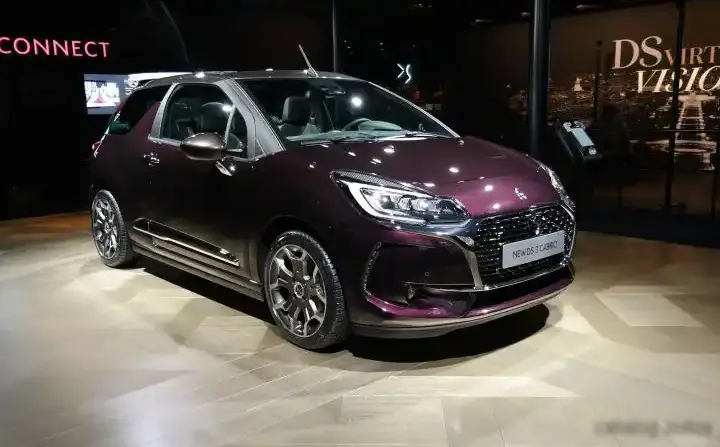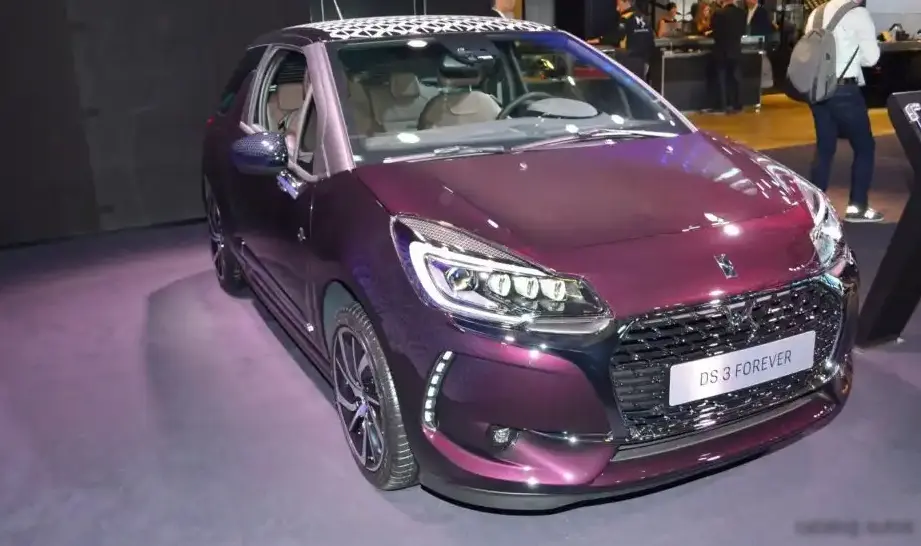
The DS 3 1.6 BlueHDi 99 Stop&Start, produced from 2016 to 2018, represents an entry-level diesel offering within the second generation DS 3 hatchback range (introduced in 2015). Positioned as a fuel-efficient option, it aimed to appeal to buyers prioritizing economy and lower running costs. This variant utilized a 1.6-liter turbocharged diesel engine paired with a five-speed manual transmission, forming a core part of the DS 3 lineup alongside petrol and higher-output diesel alternatives. The DS 3 itself was originally launched as a premium subcompact car, spun off from Citroën, and later becoming a standalone brand, DS Automobiles, aiming to compete with vehicles like the Audi A1 and Mini Cooper.
Technical Specifications
| Brand | DS |
| Model | 3 |
| Generation | 2 |
| Type (Engine) | 1.6 BlueHDi (99 Hp) Stop&Start Drive Efficiency |
| Start of production | 2016 |
| End of production | 2018 |
| Powertrain Architecture | Internal Combustion engine |
| Body type | Hatchback |
| Seats | 5 |
| Doors | 3 |
| Fuel consumption (urban) | 3.6 l/100 km (65.3 US mpg, 78.5 UK mpg, 27.8 km/l) |
| Fuel consumption (extra urban) | 2.7 l/100 km (87.1 US mpg, 104.6 UK mpg, 37 km/l) |
| Fuel consumption (combined) | 3 l/100 km (78.4 US mpg, 94.2 UK mpg, 33.3 km/l) |
| CO2 emissions | 79 g/km |
| Fuel Type | Diesel |
| Acceleration 0 – 100 km/h | 10.8 sec |
| Acceleration 0 – 62 mph | 10.8 sec |
| Acceleration 0 – 60 mph | 10.3 sec |
| Maximum speed | 189 km/h (117.44 mph) |
| Emission standard | Euro 6 |
| Weight-to-power ratio | 11 kg/Hp, 91.2 Hp/tonne |
| Weight-to-torque ratio | 4.3 kg/Nm, 234.1 Nm/tonne |
| Power | 99 Hp @ 3750 rpm |
| Power per litre | 63.5 Hp/l |
| Torque | 254 Nm @ 1750 rpm (187.34 lb.-ft. @ 1750 rpm) |
| Engine layout | Front, Transverse |
| Engine Model/Code | BHY DV6FD |
| Engine displacement | 1560 cm3 (95.2 cu. in.) |
| Number of cylinders | 4 |
| Engine configuration | Inline |
| Cylinder Bore | 75 mm (2.95 in.) |
| Piston Stroke | 88.3 mm (3.48 in.) |
| Fuel injection system | Diesel Commonrail |
| Engine aspiration | Turbocharger, Intercooler |
| Engine oil capacity | 3.8 l (4.02 US qt | 3.34 UK qt) |
| Kerb Weight | 1085 kg (2392.02 lbs.) |
| Max. weight | 1633 kg (3600.15 lbs.) |
| Max load | 548 kg (1208.13 lbs.) |
| Trunk (boot) space – minimum | 285 l (10.06 cu. ft.) |
| Trunk (boot) space – maximum | 980 l (34.61 cu. ft.) |
| Fuel tank capacity | 45 l (11.89 US gal | 9.9 UK gal) |
| AdBlue tank | 17 l (4.49 US gal | 3.74 UK gal) |
| Max. roof load | 70 kg (154.32 lbs.) |
| Permitted trailer load with brakes (12%) | 775 kg (1708.58 lbs.) |
| Permitted trailer load without brakes | 450 kg (992.08 lbs.) |
| Permitted towbar download | 46 kg (101.41 lbs.) |
| Length | 3954 mm (155.67 in.) |
| Width | 1715 mm (67.52 in.) |
| Width including mirrors | 2004 mm (78.9 in.) |
| Height | 1458-1483 mm (57.4 – 58.39 in.) |
| Wheelbase | 2464 mm (97.01 in.) |
| Front track | 1465-1468 mm (57.68 – 57.8 in.) |
| Rear (Back) track | 1467-1471 mm (57.76 – 57.91 in.) |
| Front overhang | 830 mm (32.68 in.) |
| Rear overhang | 660 mm (25.98 in.) |
| Minimum turning circle (turning diameter) | 10.2 m (33.46 ft.) |
| Drivetrain Architecture | The Internal combustion engine (ICE) drives the front wheels of the vehicle. |
| Drive wheel | Front wheel drive |
| Number of gears and type of gearbox | 5 gears, manual transmission |
| Front suspension | Independent type McPherson |
| Rear suspension | Semi-independent, coil spring |
| Front brakes | Ventilated discs |
| Rear brakes | Disc |
| Assisting systems | ABS (Anti-lock braking system) |
| Steering type | Steering rack and pinion |
| Power steering | Electric Steering |
| Tires size | 195/55 R16; 205/45 R17 |
| Wheel rims size | 16; 17 |
Powertrain & Engine Architecture
The DS 3 1.6 BlueHDi 99 Stop&Start utilizes the PSA Group’s DV6FD engine, specifically the BHY variant. This 1.6-liter inline-four diesel engine is a common unit found in various Peugeot, Citroën, and DS models. It features a turbocharger with an intercooler to boost power and efficiency. The engine employs a common-rail direct fuel injection system, delivering fuel at high pressure for optimized combustion. The engine’s Stop&Start system automatically shuts off the engine when the vehicle is stationary (at traffic lights, for example) to reduce fuel consumption and emissions. The five-speed manual transmission was the sole gearbox option for this specific configuration. The DV6 engine family is known for its relatively robust design, but requires regular maintenance, particularly regarding the diesel particulate filter (DPF).
Driving Characteristics
With 99 horsepower and 254 Nm (187 lb-ft) of torque, the DS 3 1.6 BlueHDi 99 offered adequate, though not exhilarating, performance. Acceleration from 0-60 mph took around 10.3 seconds, and top speed was 117 mph. The engine’s peak torque was available from 1750 rpm, providing reasonable responsiveness in everyday driving situations. Compared to the more powerful 120 hp BlueHDi variant, this version felt noticeably slower, particularly during overtaking maneuvers. The five-speed manual transmission was well-matched to the engine’s characteristics, offering a decent spread of gears. However, it lacked the refinement of six-speed gearboxes found in some competitors. The focus was clearly on fuel economy rather than outright performance.
Equipment & Trim Levels
The DS 3 1.6 BlueHDi 99 typically came equipped with a reasonable level of standard features. These included air conditioning, electric front windows, a USB audio connection, and a height-adjustable driver’s seat. Safety features such as ABS, ESP (Electronic Stability Program), and multiple airbags were also standard. Higher trim levels, such as Prestige or Performance, added features like automatic headlights and rain sensors, rear parking sensors, a touchscreen infotainment system, and alloy wheels. Interior upholstery was typically cloth, with options for leather upgrades. The dashboard design was modern and stylish, reflecting the DS brand’s emphasis on premium aesthetics.
Chassis & Braking
The DS 3 featured a McPherson strut front suspension and a semi-independent coil spring rear suspension. This setup provided a comfortable ride quality, although it wasn’t particularly sporty. The front brakes were ventilated discs, while the rear brakes were solid discs. ABS (Anti-lock Braking System) was standard, providing enhanced braking performance in emergency situations. The DS 3’s relatively lightweight construction (around 1085 kg or 2392 lbs) helped to contribute to its decent handling characteristics. Stabilizer bars were fitted to both the front and rear axles to reduce body roll during cornering.
Market Reception & Comparison
The DS 3 1.6 BlueHDi 99 was generally well-received by critics for its fuel efficiency and low running costs. However, some reviewers noted that the engine lacked the punch of its more powerful counterparts. Compared to the 120 hp BlueHDi version, the 99 hp model offered a lower price point but compromised on performance. Against competitors like the Audi A1 and Mini Cooper, the DS 3 offered a more affordable alternative, but lacked the brand prestige and driving dynamics of those vehicles. Fuel economy was a key selling point, with combined figures of around 78.4 US mpg being highly competitive.
Legacy
The 1.6 BlueHDi engine, in its various iterations, proved to be a reliable unit when properly maintained. However, the DPF (Diesel Particulate Filter) could be prone to clogging if the vehicle was primarily used for short journeys. The DS 3 1.6 BlueHDi 99 remains a relatively affordable option on the used car market. Its fuel efficiency and low running costs continue to appeal to budget-conscious buyers. While not the most exciting car to drive, it offers a practical and economical solution for urban commuting and everyday transportation. The DS 3, as a whole, helped establish DS Automobiles as a distinct brand, moving away from its Citroën roots and aiming for a more premium market position.