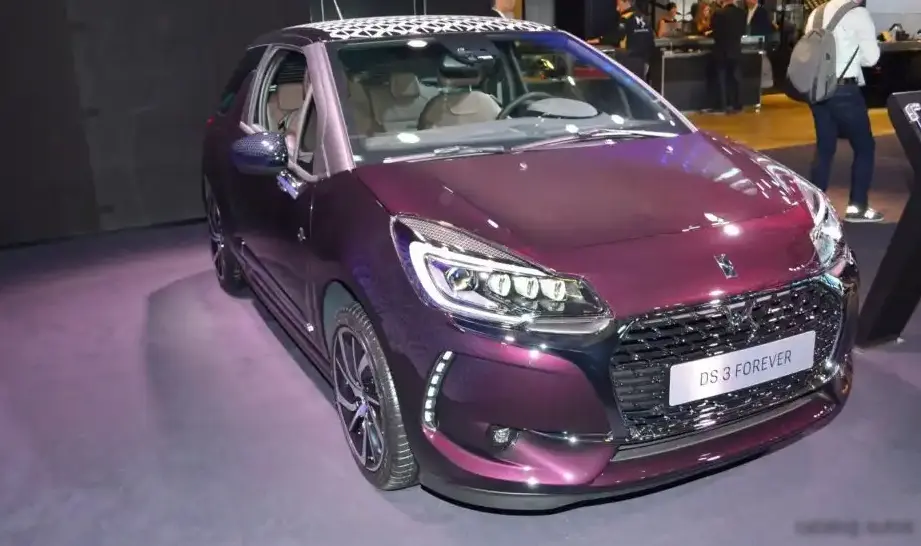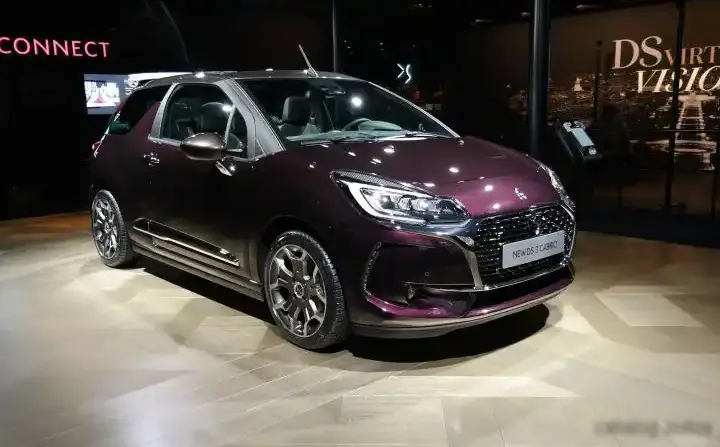
The DS 3 Cabrio 1.2 PureTech (110 hp) Stop&Start was a front-wheel-drive, four-seat convertible produced between 2016 and 2018. Positioned as a stylish and relatively economical entry point into the DS 3 Cabrio range, it offered open-top motoring with a focus on fuel efficiency and urban practicality. This variant occupied the lower-mid range of the DS 3 Cabrio lineup, sitting below the more powerful 1.6 THP models and offering a more accessible price point than the range-topping trims. It was part of the broader DS 3 family, which itself was based on the Peugeot 208 and Citroën DS3 platforms.
Technical Specifications
| Brand | DS |
| Model | 3 |
| Generation | 3 Cabrio |
| Type (Engine) | 1.2 PureTech (110 Hp) Stop&Start |
| Start of production | 2016 |
| End of production | 2018 |
| Powertrain Architecture | Internal Combustion engine |
| Body type | Cabriolet |
| Seats | 4 |
| Doors | 3 |
| Fuel consumption (urban) | 5.3 l/100 km (44.4 US mpg, 53.3 UK mpg, 18.9 km/l) |
| Fuel consumption (extra urban) | 3.8 l/100 km (61.9 US mpg, 74.3 UK mpg, 26.3 km/l) |
| Fuel consumption (combined) | 4.3 l/100 km (54.7 US mpg, 65.7 UK mpg, 23.3 km/l) |
| CO2 emissions | 100 g/km |
| Fuel Type | Petrol (Gasoline) |
| Acceleration 0 – 100 km/h | 10.7 sec |
| Acceleration 0 – 62 mph | 10.7 sec |
| Acceleration 0 – 60 mph | 10.2 sec |
| Maximum speed | 190 km/h (118.06 mph) |
| Emission standard | Euro 6 |
| Weight-to-power ratio | 9.9 kg/Hp, 100.9 Hp/tonne |
| Weight-to-torque ratio | 5.3 kg/Nm, 188.1 Nm/tonne |
| Power | 110 Hp @ 5500 rpm |
| Power per litre | 91.7 Hp/l |
| Torque | 205 Nm @ 1500 rpm (151.2 lb.-ft. @ 1500 rpm) |
| Engine layout | Front, Transverse |
| Engine Model/Code | HNZ EB2DT |
| Engine displacement | 1199 cm3 (73.17 cu. in.) |
| Number of cylinders | 3 |
| Engine configuration | Inline |
| Cylinder Bore | 75 mm (2.95 in.) |
| Piston Stroke | 90.5 mm (3.56 in.) |
| Number of valves per cylinder | 4 |
| Fuel injection system | Direct injection |
| Engine aspiration | Turbocharger, Intercooler |
| Engine oil capacity | 3.5 l (3.7 US qt | 3.08 UK qt) |
| Kerb Weight | 1090-1160 kg (2403.04 – 2557.36 lbs.) |
| Max. weight | 1598 kg (3522.99 lbs.) |
| Max load | 438-508 kg (965.62 – 1119.95 lbs.) |
| Trunk (boot) space – minimum | 245 l (8.65 cu. ft.) |
| Fuel tank capacity | 50 l (13.21 US gal | 11 UK gal) |
| Permitted trailer load with brakes (12%) | 1100 kg (2425.08 lbs.) |
| Permitted trailer load without brakes | 520 kg (1146.4 lbs.) |
| Permitted towbar download | 46 kg (101.41 lbs.) |
| Length | 3954 mm (155.67 in.) |
| Width with mirrors folded | 1715 mm (67.52 in.) |
| Width including mirrors | 2004 mm (78.9 in.) |
| Height | 1458-1483 mm (57.4 – 58.39 in.) |
| Wheelbase | 2464 mm (97.01 in.) |
| Front track | 1465-1469 mm (57.68 – 57.83 in.) |
| Rear (Back) track | 1467-1471 mm (57.76 – 57.91 in.) |
| Front overhang | 830 mm (32.68 in.) |
| Rear overhang | 660 mm (25.98 in.) |
| Minimum turning circle | 10.2 – 10.4 m (33.46 – 34.12 ft.) |
| Drivetrain Architecture | The Internal combustion engine (ICE) drives the front wheels of the vehicle. |
| Drive wheel | Front wheel drive |
| Number of gears and type of gearbox | 5 gears, manual transmission |
| Front suspension | Independent type McPherson |
| Rear suspension | Semi-independent, coil spring |
| Front brakes | Ventilated discs |
| Rear brakes | Disc |
| Assisting systems | ABS (Anti-lock braking system) |
| Steering type | Steering rack and pinion |
| Power steering | Electric Steering |
| Tires size | 195/55 R16; 205/45 R17 |
| Wheel rims size | 16; 17 |
Powertrain & Engine Architecture
The DS 3 Cabrio 1.2 PureTech (110 hp) Stop&Start was powered by the PSA-developed 1.2-liter three-cylinder turbocharged gasoline engine, internally designated HNZ EB2DT. This engine was part of the “PureTech” family, known for its efficiency and responsiveness. The engine featured direct fuel injection, a single-scroll turbocharger, and an intercooler to enhance performance. The Stop&Start system automatically shut off the engine when the vehicle came to a halt, improving fuel economy in urban driving conditions. The engine’s valvetrain employed four valves per cylinder, contributing to its breathing efficiency. The engine was transversely mounted at the front of the vehicle, driving the front wheels. The 5-speed manual transmission was the only transmission option available with this engine.
Driving Characteristics
The 110 hp 1.2 PureTech engine provided adequate performance for everyday driving, particularly in urban and suburban environments. Acceleration from 0-60 mph took around 10.2 seconds, and the top speed was 190 km/h (118 mph). While not a particularly sporty setup, the turbocharger provided a noticeable boost in power at higher engine speeds. The 5-speed manual transmission offered a reasonable spread of gears, but some drivers found it slightly notchy. Compared to the more powerful 1.6 THP variants, the 1.2 PureTech offered a more relaxed driving experience, prioritizing fuel economy over outright performance. The relatively low weight of the DS 3 Cabrio helped to mitigate the engine’s modest power output.
Equipment & Trim Levels
The DS 3 Cabrio 1.2 PureTech (110 hp) Stop&Start typically came equipped with features such as air conditioning, a touchscreen infotainment system with Bluetooth connectivity, alloy wheels, and electric front windows. Higher trim levels offered additional features like automatic headlights and rain-sensing wipers, rear parking sensors, and upgraded interior trim materials. Interior upholstery was typically cloth, with options for leather upgrades. The dashboard layout was similar to that of the standard DS 3, with a focus on a modern and stylish design. Optional extras included a panoramic sunroof, a premium sound system, and various styling packages.
Chassis & Braking
The DS 3 Cabrio utilized a McPherson strut front suspension and a semi-independent coil spring rear suspension. This setup provided a comfortable ride quality, although it wasn’t particularly sporty. The front brakes were ventilated discs, while the rear brakes were solid discs. ABS (Anti-lock Braking System) was standard. The steering was electric power-assisted, providing light and precise steering feel. The chassis was reinforced to compensate for the lack of a fixed roof, maintaining structural rigidity.
Market Reception & Comparison
The DS 3 Cabrio 1.2 PureTech (110 hp) Stop&Start was generally well-received by critics for its stylish design, fuel efficiency, and comfortable ride. However, some reviewers noted that the engine could feel strained when fully loaded or on steep inclines. Compared to the 1.6 THP variants, the 1.2 PureTech offered significantly better fuel economy, but at the expense of performance. It was positioned as a more affordable and practical alternative to the higher-powered models, appealing to buyers who prioritized economy and style over outright speed. The 1.2 PureTech engine was also praised for its refinement and low noise levels.
Legacy
The 1.2 PureTech engine has proven to be a relatively reliable powertrain, although some early models experienced issues with the timing chain. Regular maintenance, including oil changes and timing chain inspections, is crucial for ensuring long-term reliability. On the used car market, the DS 3 Cabrio 1.2 PureTech (110 hp) Stop&Start remains a popular choice for buyers seeking a stylish and affordable convertible. Its fuel efficiency and relatively low running costs make it an attractive option for urban commuters and weekend drivers. The DS 3 Cabrio, in general, helped establish DS as a distinct brand separate from Citroën, focusing on premium design and technology.