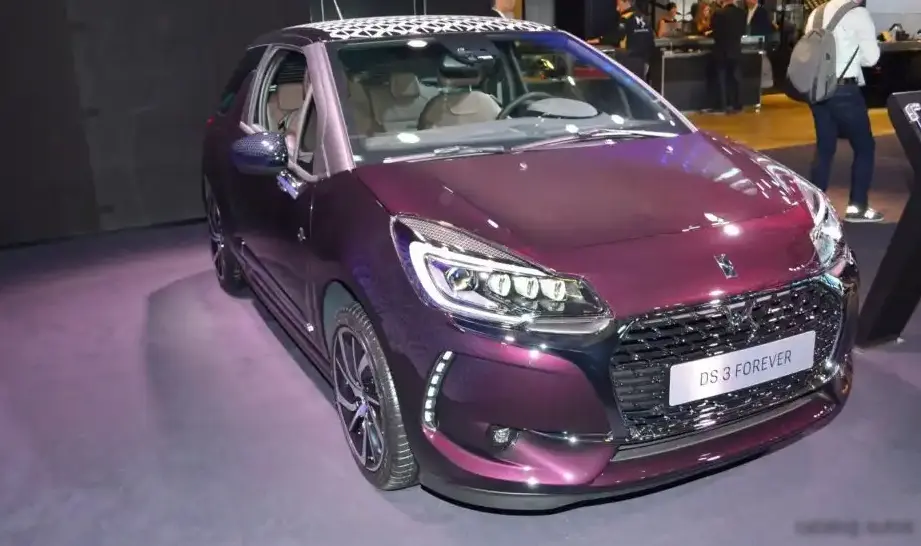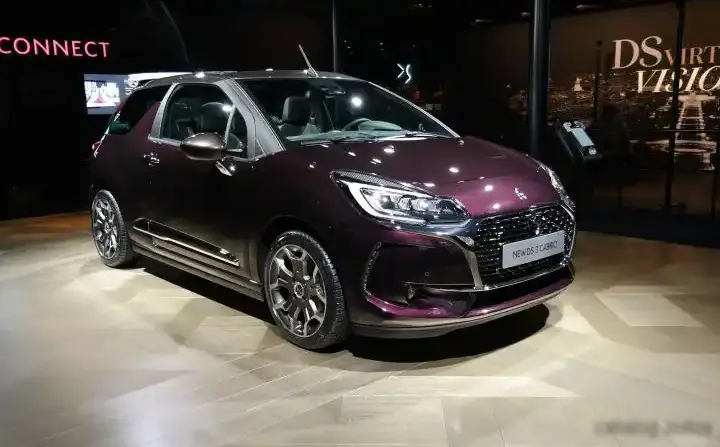
The DS 3 Cabrio Performance 1.6 THP, produced from 2016 to 2018, represented the high-performance variant of the DS 3 Cabriolet range. Positioned as the flagship model, it aimed to deliver a sporty open-top driving experience. The DS 3 Cabrio itself was a stylish and distinctive offering within the premium subcompact segment, building upon the success of the original Citroën DS 3, and later becoming a standalone brand under the DS Automobiles umbrella. This particular variant, with its 208 horsepower engine, was intended to appeal to drivers seeking a more engaging and dynamic driving experience than the standard models.
Technical Specifications
| Brand | DS |
| Model | 3 |
| Generation | 3 Cabrio |
| Type (Engine) | Performance 1.6 THP (208 Hp) Stop&Start |
| Start of production | 2016 |
| End of production | 2018 |
| Powertrain Architecture | Internal Combustion engine |
| Body type | Cabriolet |
| Seats | 4 |
| Doors | 3 |
| Fuel consumption (urban) | 6.9 l/100 km (34.1 US mpg, 40.9 UK mpg, 14.5 km/l) |
| Fuel consumption (extra urban) | 4.6 l/100 km (51.1 US mpg, 61.4 UK mpg, 21.7 km/l) |
| Fuel consumption (combined) | 5.4 l/100 km (43.6 US mpg, 52.3 UK mpg, 18.5 km/l) |
| CO2 emissions | 125 g/km |
| Fuel Type | Petrol (Gasoline) |
| Acceleration 0 – 100 km/h | 6.5 sec |
| Acceleration 0 – 62 mph | 6.5 sec |
| Acceleration 0 – 60 mph | 6.2 sec |
| Maximum speed | 230 km/h (142.92 mph) |
| Emission standard | Euro 6 |
| Weight-to-power ratio | 5.2 kg/Hp, 190.7 Hp/tonne |
| Weight-to-torque ratio | 3.6 kg/Nm, 275 Nm/tonne |
| Power | 208 Hp @ 6000 rpm |
| Power per litre | 130.2 Hp/l |
| Torque | 300 Nm @ 1700 rpm (221.27 lb.-ft. @ 1700 rpm) |
| Engine layout | Front, Transverse |
| Engine Model/Code | 5GR EP6FDTX |
| Engine displacement | 1598 cm3 (97.52 cu. in.) |
| Number of cylinders | 4 |
| Engine configuration | Inline |
| Cylinder Bore | 77 mm (3.03 in.) |
| Piston Stroke | 85.8 mm (3.38 in.) |
| Number of valves per cylinder | 4 |
| Fuel injection system | Direct injection |
| Engine aspiration | Turbocharger, Intercooler |
| Engine oil capacity | 4.3 l (4.54 US qt | 3.78 UK qt) |
| Kerb Weight | 1091 kg (2405.24 lbs.) |
| Max. weight | 1629 kg (3591.33 lbs.) |
| Max load | 538 kg (1186.09 lbs.) |
| Trunk (boot) space – minimum | 245 l (8.65 cu. ft.) |
| Fuel tank capacity | 50 l (13.21 US gal | 11 UK gal) |
| Length | 3968 mm (156.22 in.) |
| Width with mirrors folded | 1717 mm (67.6 in.) |
| Width including mirrors | 2004 mm (78.9 in.) |
| Height | 1443 mm (56.81 in.) |
| Wheelbase | 2464 mm (97.01 in.) |
| Front track | 1465-1488 mm (57.68 – 58.58 in.) |
| Rear (Back) track | 1467-1491 mm (57.76 – 58.7 in.) |
| Front overhang | 842 mm (33.15 in.) |
| Rear overhang | 662 mm (26.06 in.) |
| Minimum turning circle | 10.4 m (34.12 ft.) |
| Drivetrain Architecture | Front wheel drive |
| Drive wheel | Front wheel drive |
| Number of gears and type of gearbox | 6 gears, manual transmission |
| Front suspension | Independent type McPherson |
| Rear suspension | Semi-independent, coil spring |
| Front brakes | Ventilated discs |
| Rear brakes | Disc |
| Assisting systems | ABS (Anti-lock braking system) |
| Steering type | Steering rack and pinion |
| Power steering | Electric Steering |
| Tires size | 205/40 R18 |
| Wheel rims size | 18 |
Powertrain & Engine Architecture
The heart of the DS 3 Cabrio Performance is the 1.6-liter turbocharged four-cylinder engine, designated the 5GR EP6FDTX. This engine is part of the Prince engine family, a collaborative development between PSA Peugeot Citroën (now Stellantis) and BMW. It utilizes direct fuel injection, a technology that improves efficiency and power output by injecting fuel directly into the combustion chamber. The engine also features an intercooler to cool the intake air, further enhancing performance. The turbocharger provides a significant boost in power, allowing the relatively small displacement engine to produce 208 horsepower and 300 Nm (221 lb-ft) of torque. The engine’s Start & Stop system aimed to improve fuel economy in urban driving conditions by automatically shutting off the engine when the vehicle is stationary.
The engine is paired with a six-speed manual transmission, chosen for its sporty feel and driver engagement. Power is delivered exclusively to the front wheels. The manual transmission was a key element in the “Performance” designation, appealing to enthusiasts who preferred greater control over gear selection.
Driving Characteristics
The DS 3 Cabrio Performance offered a noticeably more spirited driving experience compared to the lower-powered versions of the DS 3 Cabrio. The 208 horsepower engine provided brisk acceleration, with a 0-60 mph time of around 6.2 seconds. The turbocharger delivers a surge of power from around 1700 rpm, providing strong mid-range acceleration. The six-speed manual transmission allowed drivers to keep the engine in its optimal power band. While the chassis was tuned for a balance between comfort and handling, the Performance model benefited from a slightly firmer suspension setup compared to standard models, reducing body roll during cornering. The open-top configuration added to the sense of driving enjoyment, but also introduced some wind noise at higher speeds.
Equipment & Trim Levels
The DS 3 Cabrio Performance came standard with a range of features designed to enhance both comfort and style. These typically included sport seats with unique upholstery, leather-wrapped steering wheel, automatic climate control, and a touchscreen infotainment system. Exterior styling cues included unique alloy wheels, a rear spoiler, and chrome exhaust outlets. Optional extras included navigation system, premium audio system, and various cosmetic enhancements.
Chassis & Braking
The DS 3 Cabrio Performance utilized a McPherson strut front suspension and a semi-independent coil spring rear suspension. The front brakes were ventilated discs, providing ample stopping power, while the rear brakes were solid discs. ABS (Anti-lock Braking System) was standard. The suspension was tuned to provide a balance between comfort and handling, with slightly stiffer springs and dampers compared to the standard DS 3 Cabrio.
Market Reception & Comparison
The DS 3 Cabrio Performance was generally well-received by automotive critics, who praised its sporty performance and stylish design. However, some reviewers noted that the interior space was limited, and the ride could be firm on rough roads. Compared to other hot hatchbacks of the time, the DS 3 Cabrio Performance offered a unique combination of open-top motoring and sporty performance. The 1.6 THP engine provided good fuel economy for its power output, but it was not as efficient as some of the diesel-powered alternatives. The manual transmission was a plus for driving enthusiasts, but it may not have appealed to all buyers.
Legacy
The 1.6 THP engine, while generally reliable, has been known to exhibit some issues with carbon buildup on the intake valves, particularly in vehicles that are primarily driven on short journeys. Regular servicing and the use of high-quality fuel can help to mitigate this risk. Today, the DS 3 Cabrio Performance remains a desirable used car, particularly for those seeking a stylish and engaging open-top driving experience. Its relatively low production numbers and unique character have contributed to its growing collector appeal. The engine’s performance and the overall package make it a standout in the subcompact convertible segment.