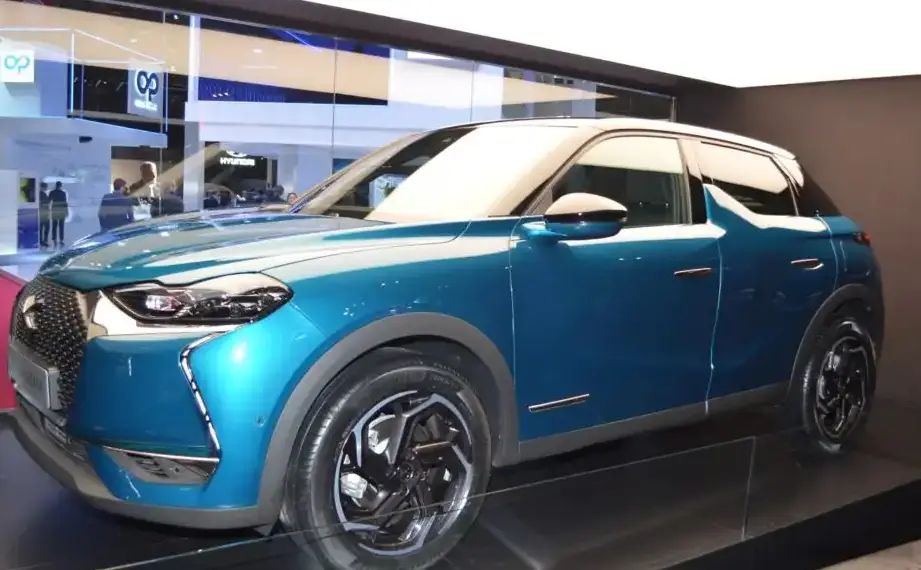
The DS 3 Crossback 1.5 BlueHDi (110 hp) was a front-wheel-drive subcompact crossover produced by the French manufacturer DS Automobiles between October 2020 and 2022. Positioned as a mid-range offering within the Crossback lineup, it aimed to provide a balance between fuel efficiency and acceptable performance for everyday driving. This variant utilized a diesel engine paired with a manual transmission, catering to European markets where diesel remained a popular choice. It was built on the Common Modular Platform (CMP) shared with other Stellantis vehicles like the Peugeot 208 and Opel/Vauxhall Corsa.
Technical Specifications
| Brand | DS |
| Model | 3 |
| Generation | 3 Crossback |
| Type (Engine) | 1.5 BlueHDi (110 Hp) |
| Start of production | October, 2020 |
| End of production | 2022 |
| Powertrain Architecture | Internal Combustion engine |
| Body type | Crossover |
| Seats | 5 |
| Doors | 5 |
| Fuel consumption at Low speed (WLTP) | 4.8 l/100 km (49 US mpg, 58.9 UK mpg, 20.8 km/l) |
| Fuel consumption at Medium speed (WLTP) | 4.1 l/100 km (57.4 US mpg, 68.9 UK mpg, 24.4 km/l) |
| Fuel consumption at high speed (WLTP) | 3.9-4.0 l/100 km (60.3 – 58.8 US mpg, 72.4 – 70.6 UK mpg, 25.6 – 25 km/l) |
| Fuel consumption at very high speed (WLTP) | 5.2 l/100 km (45.2 US mpg, 54.3 UK mpg, 19.2 km/l) |
| Combined fuel consumption (WLTP) | 4.5-4.6 l/100 km (52.3 – 51.1 US mpg, 62.8 – 61.4 UK mpg, 22.2 – 21.7 km/l) |
| CO2 emissions (WLTP) | 119-120 g/km |
| Fuel consumption (economy) – urban (NEDC, WLTP equivalent) | 4.4 l/100 km (53.5 US mpg, 64.2 UK mpg, 22.7 km/l) |
| Fuel consumption (economy) – extra urban (NEDC, WLTP equivalent) | 3.4 l/100 km (69.2 US mpg, 83.1 UK mpg, 29.4 km/l) |
| Fuel consumption (economy) – combined (NEDC, WLTP equivalent) | 3.8 l/100 km (61.9 US mpg, 74.3 UK mpg, 26.3 km/l) |
| CO2 emissions (NEDC, WLTP equivalent) | 99 g/km |
| Fuel Type | Diesel |
| Acceleration 0 – 100 km/h | 9.7 sec |
| Acceleration 0 – 62 mph | 9.7 sec |
| Acceleration 0 – 60 mph | 9.2 sec |
| Maximum speed | 194 km/h (120.55 mph) |
| Emission standard | Euro 6.3 |
| Weight-to-power ratio | 11 kg/Hp, 91.3 Hp/tonne |
| Weight-to-torque ratio | 4.8 kg/Nm, 207.5 Nm/tonne |
| Power | 110 Hp @ 3750 rpm |
| Power per litre | 73.4 Hp/l |
| Torque | 250 Nm @ 1750 rpm (184.39 lb.-ft. @ 1750 rpm) |
| Engine layout | Front, Transverse |
| Engine Model/Code | YHS DV5RC |
| Engine displacement | 1499 cm3 (91.47 cu. in.) |
| Number of cylinders | 4 |
| Engine configuration | Inline |
| Number of valves per cylinder | 4 |
| Fuel injection system | Diesel Commonrail |
| Engine aspiration | Turbocharger, Intercooler |
| Engine oil capacity | 3.5 l (3.7 US qt | 3.08 UK qt) |
| Kerb Weight | 1205 kg (2656.57 lbs.) |
| Max. weight | 1725 kg (3802.97 lbs.) |
| Max load | 520 kg (1146.4 lbs.) |
| Trunk (boot) space – minimum | 350 l (12.36 cu. ft.) |
| Trunk (boot) space – maximum | 1050 l (37.08 cu. ft.) |
| Fuel tank capacity | 41 l (10.83 US gal | 9.02 UK gal) |
| AdBlue tank | 15 l (3.96 US gal | 3.3 UK gal) |
| Permitted trailer load with brakes (12%) | 1200 kg (2645.55 lbs.) |
| Length | 4118 mm (162.13 in.) |
| Width | 1791 mm (70.51 in.) |
| Width with mirrors folded | 1802 mm (70.94 in.) |
| Width including mirrors | 1988 mm (78.27 in.) |
| Height | 1534 mm (60.39 in.) |
| Wheelbase | 2558 mm (100.71 in.) |
| Front track | 1548 mm (60.94 in.) |
| Rear (Back) track | 1557 mm (61.3 in.) |
| Front overhang | 860 mm (33.86 in.) |
| Rear overhang | 700 mm (27.56 in.) |
| Ride height (ground clearance) | 170 mm (6.69 in.) |
| Minimum turning circle (turning diameter) | 10.7 m (35.1 ft.) |
| Drivetrain Architecture | The Internal combustion engine (ICE) drives the front wheels of the vehicle. |
| Drive wheel | Front wheel drive |
| Number of gears and type of gearbox | 6 gears, manual transmission |
| Front suspension | Independent, type McPherson with coil spring and anti-roll bar |
| Rear suspension | Independent multi-link spring suspension with stabilizer |
| Front brakes | Ventilated discs, 283×26 mm |
| Rear brakes | Disc, 249×10 mm |
| Assisting systems | ABS (Anti-lock braking system) |
| Steering type | Steering rack and pinion |
| Power steering | Electric Steering |
| Tires size | 215/60 R17 H; 215/55 R18 V |
| Wheel rims size | 17; 18 |
Powertrain & Engine Architecture
The DS 3 Crossback 1.5 BlueHDi utilized the DV5RC engine, a 1.5-liter inline-four cylinder diesel engine. This engine is part of the PSA Group’s (now Stellantis) BlueHDi family, known for its focus on reducing particulate matter and NOx emissions. The engine employs a common-rail direct fuel injection system, delivering fuel at extremely high pressure for optimized combustion. A turbocharger with an intercooler is used to boost power output and improve efficiency. The engine features four valves per cylinder and a variable geometry turbocharger (VGT) to enhance responsiveness across the rev range. The 110 hp version of this engine is tuned for a balance of fuel economy and drivability. It was paired with a six-speed manual transmission, providing precise gear changes and driver control. The engine code ‘YHS’ often indicates specific calibration or emission control system variations.
Driving Characteristics
The 1.5 BlueHDi 110 hp engine in the DS 3 Crossback provided adequate, though not exhilarating, performance. Acceleration from 0-60 mph took approximately 9.2 seconds, and top speed was around 120.55 mph. The engine’s 250 Nm (184 lb-ft) of torque, available from 1750 rpm, provided sufficient pulling power for everyday driving and overtaking maneuvers. Compared to higher-output versions of the DS 3 Crossback, such as those with petrol engines, the diesel variant prioritized fuel efficiency over outright speed. The manual transmission allowed for greater driver engagement, but the gear ratios were tuned for economy rather than sporty performance. The engine felt relatively refined for a diesel, with minimal vibration and noise intrusion into the cabin.
Equipment & Trim Levels
The 1.5 BlueHDi 110 hp variant of the DS 3 Crossback typically came equipped with a reasonable level of standard features. These included air conditioning, a touchscreen infotainment system with Apple CarPlay and Android Auto compatibility, Bluetooth connectivity, and a suite of safety features such as automatic emergency braking, lane departure warning, and speed limit recognition. Interior upholstery was typically cloth, with options for leather upgrades available. Higher trim levels offered additional features such as a larger touchscreen, navigation system, parking sensors, a reversing camera, and premium audio systems. Exterior options included alloy wheels, panoramic sunroof, and various paint colors.
Chassis & Braking
The DS 3 Crossback featured a McPherson strut front suspension and a multi-link rear suspension, providing a comfortable and controlled ride. The suspension was tuned to balance ride comfort with handling agility. The front brakes were ventilated discs, while the rear brakes were solid discs. Anti-lock Braking System (ABS) was standard, along with Electronic Stability Control (ESC). The steering was electric power-assisted, providing light and precise steering feel. The vehicle’s relatively low weight (around 1205 kg / 2656 lbs) contributed to its nimble handling characteristics.
Market Reception & Comparison
The DS 3 Crossback 1.5 BlueHDi 110 hp was generally well-received by critics for its fuel efficiency and comfortable ride. However, some reviewers noted that the engine lacked the punch of its petrol counterparts. Compared to the petrol-powered versions, the diesel offered significantly better fuel economy, making it an attractive option for drivers covering long distances. The manual transmission was praised for its precise shift quality, but some drivers may have preferred an automatic option. In terms of reliability, the BlueHDi engine family had a generally good reputation, although diesel particulate filter (DPF) issues could occur with frequent short journeys.
Legacy
The DS 3 Crossback 1.5 BlueHDi (110 hp) represents a significant step in DS Automobiles’ attempt to establish itself as a premium brand. While diesel engines are becoming less common due to tightening emissions regulations, this variant remains a popular choice in the used car market, particularly for those seeking a fuel-efficient and comfortable subcompact crossover. The engine’s robust design and relatively simple technology contribute to its long-term reliability, making it a sensible option for budget-conscious buyers. The CMP platform it’s built on has proven to be versatile and reliable, underpinning several successful models across the Stellantis portfolio.