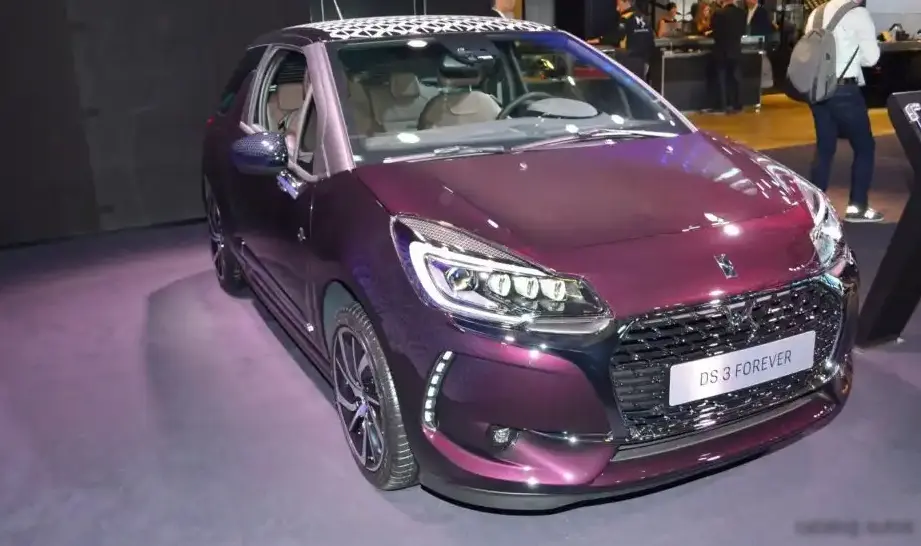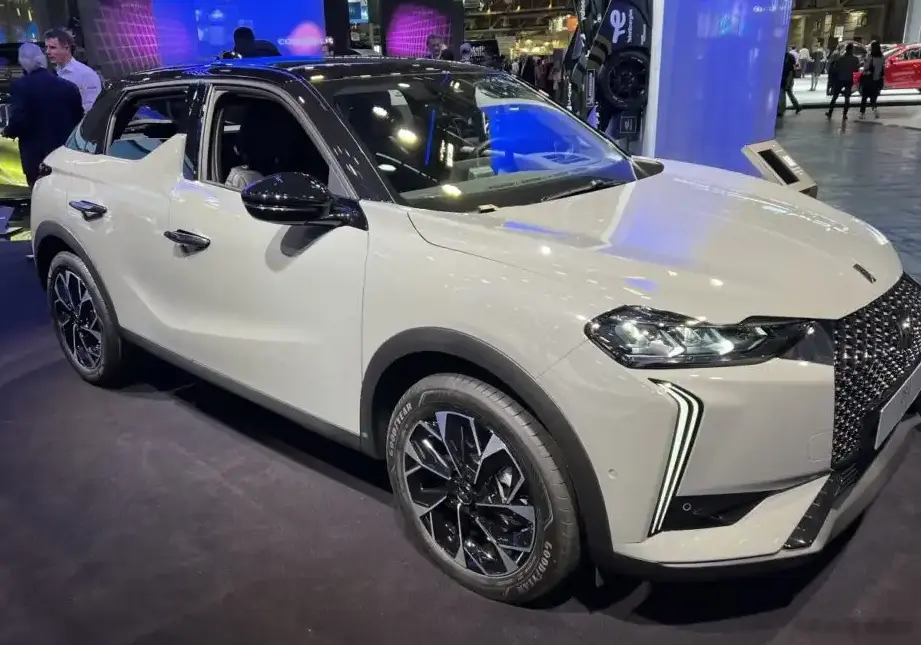
The DS 3 (facelift 2023) 1.2 (145 Hp) Hybrid eDCT represents a significant evolution in the DS Automobiles compact crossover lineup. Introduced with the 2023 facelift, and entering full production in March 2025, this variant blends a turbocharged three-cylinder gasoline engine with a 48-volt mild hybrid system, offering a balance of efficiency and performance. Positioned as a mid-range offering within the DS 3 range, it caters to buyers seeking a more refined and fuel-conscious alternative to the standard gasoline engines. The DS 3 itself is built upon the Stellantis CMP (Common Modular Platform) – previously known as the PF1 – shared with other Peugeot and Opel/Vauxhall models, but distinguished by its unique styling and premium interior appointments.
Technical Specifications
| Brand | DS |
| Model | 3 |
| Generation | 3 (facelift 2023) |
| Type (Engine) | 1.2 (145 Hp) Hybrid eDCT |
| Start of production | March, 2025 |
| Powertrain Architecture | MHEV (Mild Hybrid Electric Vehicle) |
| Body type | Crossover |
| Seats | 5 |
| Doors | 5 |
| Fuel consumption at Low speed (WLTP) | 3.8-3.9 l/100 km (61.9 – 60.3 US mpg) |
| Fuel consumption at Medium speed (WLTP) | 4.4 l/100 km (53.5 US mpg) |
| Fuel consumption at high speed (WLTP) | 4.4 l/100 km (53.5 US mpg) |
| Fuel consumption at very high speed (WLTP) | 6.1-6.2 l/100 km (38.6 – 37.9 US mpg) |
| Combined fuel consumption (WLTP) | 5 l/100 km (47 US mpg) |
| CO2 emissions (WLTP) | 112-113 g/km |
| Fuel Type | Petrol (Gasoline) |
| Acceleration 0 – 100 km/h | 9.2 sec |
| Acceleration 0 – 62 mph | 9.2 sec |
| Acceleration 0 – 60 mph | 8.7 sec |
| Maximum speed | 196 km/h (121.79 mph) |
| Emission standard | Euro 6d-ISC-FCM |
| Weight-to-power ratio | 8.6 kg/Hp |
| Weight-to-torque ratio | 5.4 kg/Nm |
| Gross battery capacity | 0.88 kWh |
| Battery voltage | 48 V |
| Battery technology | Lithium-ion (Li-Ion) |
| Electric motor power | 28 Hp |
| Electric motor Torque | 55 Nm (40.57 lb.-ft.) |
| System power | 145 Hp |
| Power | 136 Hp @ 5500 rpm |
| Torque | 230 Nm @ 1750 rpm (169.64 lb.-ft. @ 1750 rpm) |
| Engine displacement | 1199 cm3 (73.17 cu. in.) |
| Cylinder Bore | 75 mm (2.95 in.) |
| Piston Stroke | 90.5 mm (3.56 in.) |
| Kerb Weight | 1249 kg (2753.57 lbs.) |
| Max. weight | 1715 kg (3780.93 lbs.) |
| Trunk (boot) space – minimum | 350 l (12.36 cu. ft.) |
| Trunk (boot) space – maximum | 1050 l (37.08 cu. ft.) |
| Fuel tank capacity | 44 l (11.62 US gal) |
| Gears | 6 |
| Gearbox Type | Automatic e-DCT |
Powertrain & Engine Architecture
At the heart of the DS 3 1.2 Hybrid eDCT lies the HN09 engine, a 1.2-liter turbocharged three-cylinder gasoline engine. This engine, part of the PureTech family developed by Stellantis, utilizes direct fuel injection and an intercooled turbocharger to deliver 136 horsepower at 5500 rpm and 230 Nm (169.64 lb-ft) of torque at 1750 rpm. The “Hybrid” designation indicates the integration of a 48-volt mild hybrid system. This system comprises a small electric motor (28 hp and 55 Nm) and a lithium-ion battery with a gross capacity of 0.88 kWh, positioned under the front seats. The electric motor provides assistance during acceleration and allows for regenerative braking, contributing to improved fuel economy. The powertrain is coupled with a six-speed e-DCT (efficient Dual-Clutch Transmission) which provides quick and smooth gear changes. This transmission is crucial for maximizing the benefits of both the gasoline engine and the electric motor.
Driving Characteristics
The 145 hp combined output of the 1.2 Hybrid eDCT delivers a respectable driving experience. Acceleration from 0 to 100 km/h (0-62 mph) takes approximately 9.2 seconds, while 0-60 mph is achieved in around 8.7 seconds. While not a performance-oriented variant, the hybrid system provides a noticeable boost in responsiveness, particularly during initial acceleration. The e-DCT transmission contributes to a smooth and efficient power delivery. Compared to the standard 1.2 PureTech without hybrid assistance, the Hybrid eDCT offers improved fuel economy and a more refined driving experience. It doesn’t possess the outright punch of higher-spec DS 3 models, but it provides adequate power for everyday driving and highway cruising. The mild hybrid system isn’t capable of full electric driving, but it allows for extended periods of engine-off coasting, further enhancing fuel efficiency.
Equipment & Trim Levels
The DS 3 1.2 Hybrid eDCT typically comes well-equipped, reflecting the brand’s focus on premium features. Standard equipment often includes a touchscreen infotainment system with Apple CarPlay and Android Auto compatibility, automatic climate control, rear parking sensors, and a suite of advanced driver-assistance systems (ADAS) such as lane departure warning and automatic emergency braking. Interior upholstery is typically a combination of cloth and leather-effect materials, with options for full leather available. Higher trim levels add features like a larger touchscreen, premium audio system, panoramic sunroof, and adaptive cruise control. Exterior styling elements, such as unique alloy wheel designs and chrome accents, further differentiate this variant from lower-spec models.
Chassis & Braking
The DS 3 1.2 Hybrid eDCT utilizes a McPherson strut front suspension and a semi-independent coil spring rear suspension. This setup provides a comfortable ride quality while maintaining reasonable handling characteristics. The front brakes are ventilated discs, while the rear brakes are typically solid discs. ABS (Anti-lock Braking System) and electronic stability control are standard safety features. The steering is electric power-assisted, offering a light and precise feel. The weight distribution is generally well-balanced, contributing to predictable handling. Stabilizer bars are fitted to both the front and rear axles to reduce body roll during cornering.
Market Reception & Comparison
The DS 3 1.2 Hybrid eDCT has been generally well-received by automotive critics, praised for its fuel efficiency, refined driving experience, and stylish design. Compared to other DS 3 variants, the Hybrid eDCT offers a compelling balance between performance and economy. It provides better fuel economy than the standard 1.2 PureTech models, while offering a more engaging driving experience than the diesel options. However, it doesn’t quite match the performance of the more powerful gasoline engines. Reliability reports are still emerging, but the PureTech engine has had a mixed reputation in the past, with some reports of timing chain issues. The mild hybrid system is relatively simple and appears to be reliable.
Legacy
The DS 3 1.2 Hybrid eDCT represents a step towards electrification for the DS Automobiles brand. While it’s not a fully electric vehicle, it demonstrates the brand’s commitment to reducing emissions and improving fuel efficiency. The long-term reliability of this powertrain remains to be seen, but the combination of a turbocharged engine and a mild hybrid system is becoming increasingly common in the automotive industry. On the used car market, this variant is likely to appeal to buyers seeking a stylish, fuel-efficient, and well-equipped compact crossover. Its relatively low running costs and comfortable driving experience should ensure continued demand in the years to come.