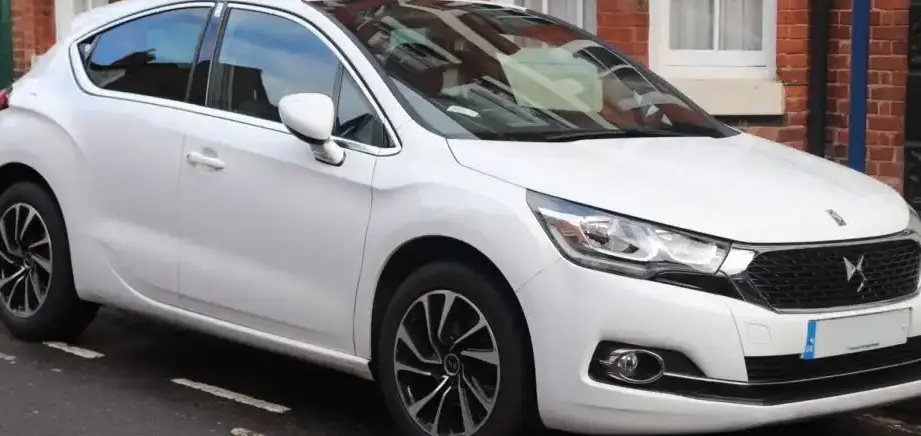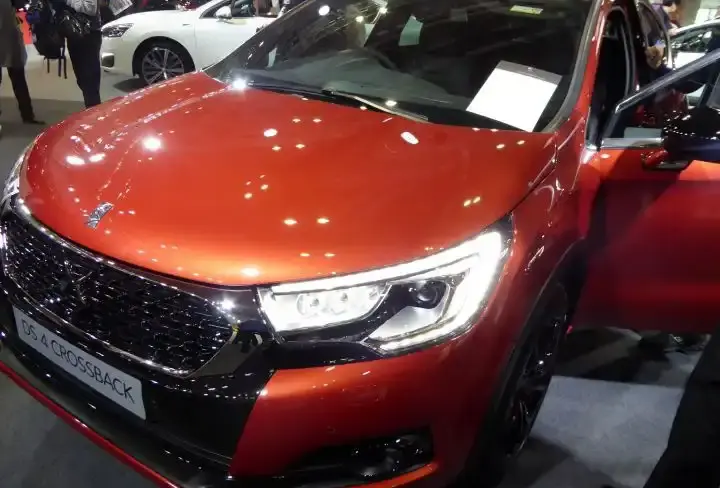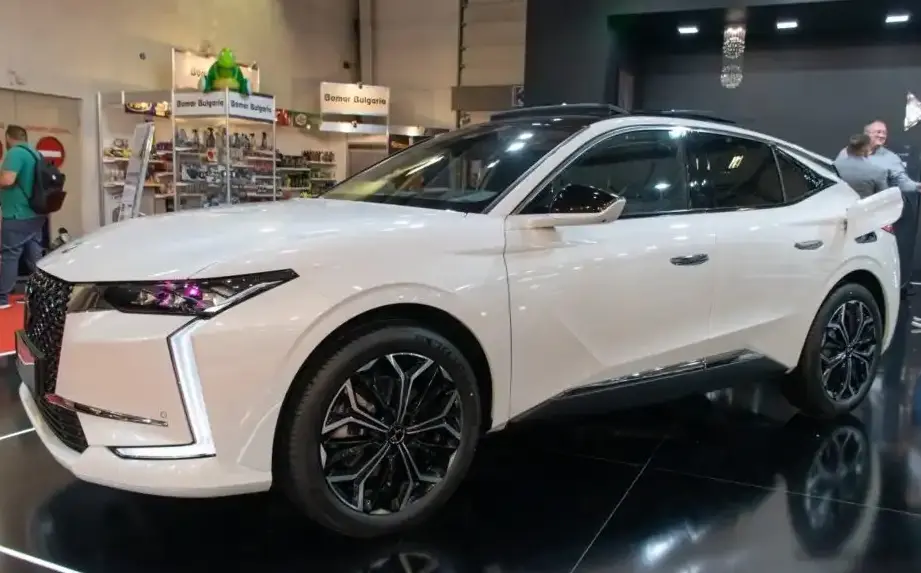
The DS 4 II 1.6 PureTech (225 Hp) E-TENSE Automatic is a plug-in hybrid electric vehicle (PHEV) produced by the French automaker DS Automobiles between May 2021 and June 2025. Positioned as a premium compact crossover, this variant represents a significant step in DS’s electrification strategy, offering a blend of petrol engine performance and electric-only driving capability. It’s built on the EMP2 platform, shared with other Stellantis group vehicles like the Peugeot 308 and Opel Astra. This model aimed to appeal to buyers seeking a sophisticated and efficient vehicle with a reduced environmental impact, while still providing a comfortable and engaging driving experience.
Technical Specifications
| Brand | DS |
| Model | 4 |
| Generation | 4 II |
| Type (Engine) | 1.6 PureTech (225 Hp) E-TENSE Automatic |
| Start of production | May, 2021 |
| End of production | June, 2025 |
| Powertrain Architecture | PHEV (Plug-in Hybrid Electric Vehicle) |
| Body type | Crossover |
| Seats | 5 |
| Doors | 5 |
| Fuel consumption at Low speed (WLTP) | 7.4-7.7 l/100 km (31.8 – 30.5 US mpg, 38.2 – 36.7 UK mpg, 13.5 – 13 km/l) |
| Fuel consumption at Medium speed (WLTP) | 6.1-6.4 l/100 km (38.6 – 36.8 US mpg, 46.3 – 44.1 UK mpg, 16.4 – 15.6 km/l) |
| Fuel consumption at high speed (WLTP) | 5.6-5.8 l/100 km (42 – 40.6 US mpg, 50.4 – 48.7 UK mpg, 17.9 – 17.2 km/l) |
| Fuel consumption at very high speed (WLTP) | 6.9-7.4 l/100 km (34.1 – 31.8 US mpg, 40.9 – 38.2 UK mpg, 14.5 – 13.5 km/l) |
| Combined fuel consumption (WLTP) | 1.3-1.4 l/100 km (180.9 – 168 US mpg, 217.3 – 201.8 UK mpg, 76.9 – 71.4 km/l) |
| CO2 emissions (WLTP) | 29-32 g/km |
| Fuel Type | Petrol / electricity |
| Acceleration 0 – 100 km/h | 7.7 sec |
| Acceleration 0 – 62 mph | 7.7 sec |
| Acceleration 0 – 60 mph | 7.3 sec |
| Maximum speed | 233 km/h (144.78 mph) |
| Emission standard | Euro 6.3 |
| Weight-to-power ratio | 7.3 kg/Hp, 136.1 Hp/tonne |
| Weight-to-torque ratio | 4.6 kg/Nm, 217.8 Nm/tonne |
| Gross battery capacity | 12.4 kWh |
| Battery technology | Lithium-ion (Li-Ion) |
| Battery location | Under the trunk |
| All-electric range (WLTP) | 52-55 km (32.31 – 34.18 mi) |
| Average Energy consumption (WLTP) | 14.6-15.2 kWh/100 km (23.5 – 24.46 kWh/100 mi, 143 – 138 MPGe, 6.8 – 6.6 km/kWh, 4.3 – 4.1 mi/kWh) |
| Max speed (electric) | 135 km/h (83.89 mph) |
| Electric motor power | 110 Hp @ 2500 rpm |
| Electric motor Torque | 320 Nm (236.02 lb.-ft.) |
| Electric motor location | Between the combustion engine and the transmission |
| System power | 225 Hp @ 6000 rpm |
| System torque | 360 Nm (265.52 lb.-ft.) |
| Power | 180 Hp @ 6000 rpm |
| Torque | 250 Nm @ 1750 rpm (184.39 lb.-ft. @ 1750 rpm) |
| Engine layout | Front, Transverse |
| Engine Model/Code | DGZ EP6FADTXHPD |
| Engine displacement | 1598 cm3 (97.52 cu. in.) |
| Number of cylinders | 4 |
| Engine configuration | Inline |
| Cylinder Bore | 77 mm (3.03 in.) |
| Piston Stroke | 86 mm (3.39 in.) |
| Compression ratio | 10.2:1 |
| Number of valves per cylinder | 4 |
| Fuel injection system | Direct injection |
| Engine aspiration | Turbocharger, Intercooler |
| Valvetrain | DOHC |
| Engine oil capacity | 4.25 l (4.49 US qt | 3.74 UK qt) |
| Kerb Weight | 1653 kg (3644.24 lbs.) |
| Max. weight | 2200 kg (4850.17 lbs.) |
| Max load | 547 kg (1205.93 lbs.) |
| Trunk (boot) space – minimum | 390 l (13.77 cu. ft.) |
| Trunk (boot) space – maximum | 1190 l (42.02 cu. ft.) |
| Fuel tank capacity | 40 l (10.57 US gal | 8.8 UK gal) |
| Permitted trailer load with brakes (12%) | 1400 kg (3086.47 lbs.) |
| Permitted trailer load without brakes | 750 kg (1653.47 lbs.) |
| Permitted towbar download | 70 kg (154.32 lbs.) |
| Length | 4400 mm (173.23 in.) |
| Width | 1866 mm (73.46 in.) |
| Width including mirrors | 2061 mm (81.14 in.) |
| Height | 1490 mm (58.66 in.) |
| Wheelbase | 2675 mm (105.31 in.) |
| Front track | 1600 mm (62.99 in.) |
| Rear (Back) track | 1605 mm (63.19 in.) |
| Front overhang | 925 mm (36.42 in.) |
| Rear overhang | 800 mm (31.5 in.) |
| Ride height (ground clearance) | 189 mm (7.44 in.) |
| Minimum turning circle (turning diameter) | 10.82 m (35.5 ft.) |
| Drivetrain Architecture | The Internal combustion engine (ICE) and electric motor drive the front wheels of the car with the ability to work in full electric or mixed mode. |
| Drive wheel | Front wheel drive |
| Number of gears and type of gearbox | 8 gears, automatic transmission |
| Front suspension | Independent, type McPherson with coil spring and anti-roll bar |
| Rear suspension | Coil spring, Torsion |
| Front brakes | Ventilated discs, 330×28 mm |
| Rear brakes | Disc, 290×12 mm |
| Assisting systems | ABS (Anti-lock braking system) |
| Steering type | Steering rack and pinion |
| Power steering | Electric Steering |
| Tires size | 215/65 R17 99V; 205/55 R19 97V; 245/40 R20 99V |
| Wheel rims size | 17; 19; 20 |
INTRODUCTION
The DS 4 II 1.6 PureTech (225 Hp) E-TENSE Automatic, launched in May 2021, is a plug-in hybrid variant of the second-generation DS 4. This model is part of the broader DS Automobiles strategy to offer electrified options across its range. Built on the EMP2 platform, it shares its underpinnings with other Stellantis vehicles. The E-TENSE version combines a 1.6-liter turbocharged petrol engine with an electric motor, offering a combined power output of 225 horsepower. It was produced until June 2025, aiming to provide a balance between fuel efficiency, performance, and reduced emissions, targeting a buyer who appreciates a premium driving experience with modern technology.
Powertrain & Engine Architecture
At the heart of the DS 4 II 1.6 PureTech E-TENSE lies the DGZ EP6FADTXHPD 1.6-liter turbocharged four-cylinder petrol engine. This engine, part of the PureTech family, utilizes direct fuel injection and a turbocharger with an intercooler to deliver 180 horsepower at 6000 rpm and 250 Nm (184.39 lb.-ft.) of torque at 1750 rpm. The engine features a DOHC valvetrain and a compression ratio of 10.2:1. Coupled with this is an 80 kW (110 hp) electric motor, powered by a 12.4 kWh lithium-ion battery pack located under the trunk floor. The electric motor produces 320 Nm (236.02 lb.-ft.) of torque. The combined system output is 225 hp and 360 Nm (265.52 lb.-ft.) of torque. The powertrain is mated to an 8-speed automatic transmission, which efficiently manages power delivery and contributes to smooth gear changes. The engine incorporates a particulate filter to reduce emissions, meeting Euro 6.3 standards.
Driving Characteristics
The DS 4 II 1.6 PureTech E-TENSE Automatic offers a distinct driving experience compared to its petrol-only counterparts. The electric motor provides instant torque, resulting in brisk acceleration, achieving 0-60 mph in approximately 7.3 seconds. In electric-only mode, the vehicle offers a quiet and refined driving experience, with a range of 52-55 km (32.31 – 34.18 mi) on the WLTP cycle. The 8-speed automatic transmission is well-tuned, providing smooth and responsive shifts. When the petrol engine engages, the transition is generally seamless. The combined power output delivers ample performance for everyday driving and highway cruising. Compared to lower-powered DS 4 variants, the E-TENSE offers significantly more punch, while remaining more fuel-efficient than the petrol-only models, especially during shorter journeys where electric-only driving is feasible.
Equipment & Trim Levels
The DS 4 II 1.6 PureTech E-TENSE Automatic typically came well-equipped, reflecting its premium positioning. Standard features often included a touchscreen infotainment system with Apple CarPlay and Android Auto compatibility, a digital instrument cluster, automatic climate control, and a suite of advanced driver-assistance systems (ADAS) such as lane-keeping assist, automatic emergency braking, and adaptive cruise control. Interior upholstery typically consisted of high-quality cloth or leather options, with a focus on comfort and aesthetics. Optional extras included a premium sound system, a panoramic sunroof, and upgraded interior trim materials. The trim level influenced the extent of standard equipment, with higher trims offering more luxurious features and customization options.
Chassis & Braking
The DS 4 II utilizes an independent McPherson strut suspension setup at the front, paired with a coil spring and torsion beam rear suspension. This configuration provides a good balance between ride comfort and handling. The chassis is tuned to deliver a composed and stable driving experience. Braking duties are handled by ventilated discs at the front (330×28 mm) and solid discs at the rear (290×12 mm). The vehicle is equipped with ABS (Anti-lock Braking System) and other electronic stability control systems. The suspension and braking systems are designed to handle the added weight of the battery pack and electric motor without compromising performance or safety.
Market Reception & Comparison
The DS 4 II 1.6 PureTech E-TENSE Automatic was generally well-received by critics, who praised its blend of performance, efficiency, and refinement. The plug-in hybrid powertrain was seen as a significant step forward for DS Automobiles, offering a compelling alternative to traditional petrol and diesel engines. Compared to the standard petrol-powered DS 4 models, the E-TENSE offered superior fuel economy and lower emissions, particularly in urban driving conditions. However, the higher price point and slightly reduced trunk space (due to the battery pack) were noted as potential drawbacks. Against competitors like the BMW 225xe Active Tourer and the Mercedes-Benz A 250 e, the DS 4 E-TENSE offered a unique blend of French styling and technology.
Legacy
The DS 4 II 1.6 PureTech E-TENSE Automatic represents an important milestone in DS Automobiles’ transition towards electrification. While long-term reliability data is still emerging, the PureTech engine has generally proven to be robust, although some early versions experienced issues with the timing chain. The hybrid powertrain components, including the battery pack and electric motor, are expected to have a long lifespan with proper maintenance. On the used car market, these models are becoming increasingly sought after by buyers looking for a stylish, efficient, and technologically advanced compact crossover. The E-TENSE variant helped establish DS Automobiles as a serious contender in the premium PHEV segment.