
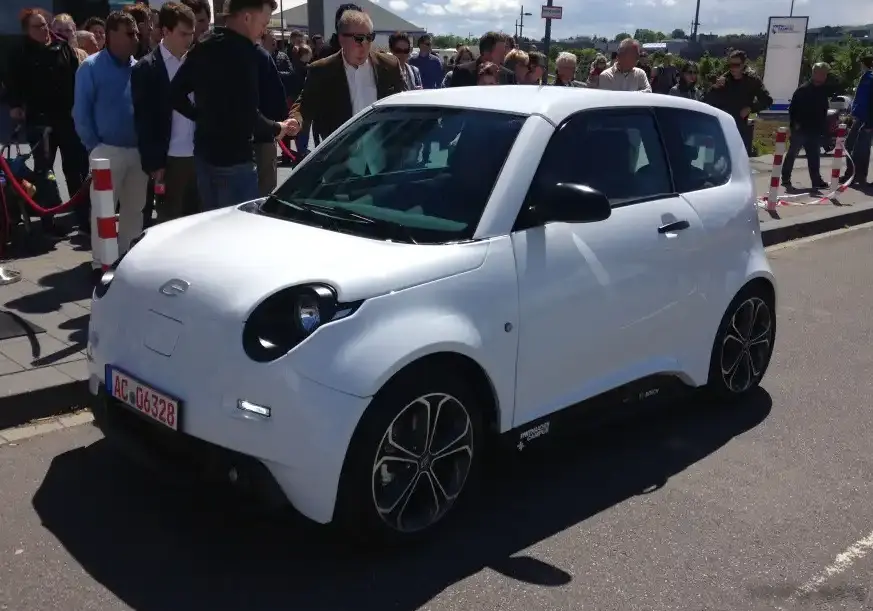
The e.GO Life Life 20, equipped with a 14.9 kWh battery and producing 27 horsepower, represents a unique entry into the burgeoning electric vehicle market. Introduced in 2018, the Life was the initial offering from e.GO Mobile, a German-based company focused on producing affordable and sustainable urban transportation. Positioned as a city car, the Life aimed to provide a practical and environmentally conscious alternative to traditional gasoline-powered vehicles, particularly within European urban centers. It’s a three-door hatchback designed for basic commuting and short trips, prioritizing functionality over outright performance. The “Life 20” designation refers to the estimated range of 200 kilometers (approximately 124 miles) under optimal conditions, though real-world range typically fell closer to 104 km (64.62 miles).
Technical Specifications
| Brand | e.GO |
| Model | Life |
| Generation | Life |
| Type (Engine) | Life 20 14.9 kWh (27 Hp) Electric |
| Start of production | 2018 |
| Powertrain Architecture | BEV (Electric Vehicle) |
| Body type | Hatchback |
| Seats | 4 |
| Doors | 3 |
| Fuel Type | Electricity |
| Maximum speed | 116 km/h (72.08 mph) |
| Weight-to-power ratio | 32.6 kg/Hp, 30.7 Hp/tonne |
| Gross battery capacity | 14.9 kWh |
| All-electric range | 104 km (64.62 mi) |
| Average Energy consumption | 11.9 kWh/100 km (19.15 kWh/100 mi) |
| MPGe | 176 |
| km/kWh | 8.4 |
| mi/kWh | 5.2 |
| Electric motor power | 27 Hp |
| System power | 27 Hp |
| Kerb Weight | 880 kg (1940.07 lbs.) |
| Max. weight | 1300 kg (2866.01 lbs.) |
| Max load | 420 kg (925.94 lbs.) |
| Length | 3348 mm (131.81 in.) |
| Width | 1700 mm (66.93 in.) |
| Height | 1567 mm (61.69 in.) |
| Wheelbase | 2200 mm (86.61 in.) |
| Front track | 1475 mm (58.07 in.) |
| Rear (Back) track | 1483 mm (58.39 in.) |
| Minimum turning circle | 9.0 m (29.53 ft.) |
| Drive wheel | Front wheel drive |
| Number of gears | 1 |
| Gearbox type | automatic transmission |
| Front brakes | Ventilated discs |
| Rear brakes | Drum |
| Assisting systems | ABS (Anti-lock braking system) |
| Tires size | 205/45 R17 |
| Wheel rims size | 17 |
Powertrain & Engine Architecture
The e.GO Life utilizes a purely electric powertrain, foregoing any internal combustion engine components. The heart of the system is a liquid-cooled lithium-ion battery pack with a gross capacity of 14.9 kWh. This battery powers a single electric motor, delivering a continuous output of 27 horsepower. The motor is directly coupled to the front wheels via a single-speed automatic transmission. The vehicle employs regenerative braking to recapture energy during deceleration, extending the overall range. The electrical architecture is relatively simple, prioritizing cost-effectiveness and ease of maintenance. The battery management system (BMS) monitors the battery’s state of charge, temperature, and overall health, ensuring safe and efficient operation. Charging is accomplished via a standard Type 2 connector, allowing for AC charging at various power levels.
Driving Characteristics
Given its modest 27 horsepower output, the e.GO Life is not designed for rapid acceleration or high-speed cruising. Performance is best described as adequate for urban environments. Acceleration from 0 to 50 km/h (31 mph) takes approximately 12 seconds, and the top speed is limited to 116 km/h (72 mph). The single-speed automatic transmission provides seamless power delivery, but lacks the gear ratios found in conventional vehicles. The car’s relatively light weight (880 kg / 1940 lbs) helps to mitigate the limited power output. The steering is light and responsive, making it easy to maneuver in tight city streets. The suspension is tuned for comfort, providing a reasonably smooth ride on paved surfaces. However, the limited range and slow charging times can be a drawback for longer journeys.
Equipment & Trim Levels
The e.GO Life was offered with a relatively basic level of standard equipment, reflecting its focus on affordability. Standard features included power windows, central locking, and an audio system with Bluetooth connectivity. The interior was characterized by its minimalist design and durable materials. Upholstery was typically cloth, and the dashboard featured a simple instrument cluster. Optional extras included air conditioning, a navigation system, and parking sensors. The car’s interior space is optimized for four passengers, but rear legroom is limited. Safety features included ABS brakes and a driver’s airbag. The overall trim level was intentionally kept simple, with limited customization options available.
Chassis & Braking
The e.GO Life utilizes a front-wheel-drive layout with a MacPherson strut suspension at the front and a twist-beam suspension at the rear. The front brakes are ventilated discs, providing adequate stopping power, while the rear brakes are drums, a cost-saving measure. The steering system is an electric power-assisted system (EPAS), offering light and precise steering control. The car’s relatively narrow track width contributes to its maneuverability in urban environments. The suspension is tuned for comfort, prioritizing ride quality over sporty handling. The chassis is constructed from a combination of steel and aluminum, balancing strength and weight. The car’s low center of gravity, due to the battery pack being mounted under the floor, enhances its stability.
Market Reception & Comparison
The e.GO Life received mixed reviews from automotive critics. While praised for its affordability and environmental credentials, it was criticized for its limited range, slow charging times, and basic interior. Compared to other electric vehicles available at the time, such as the Renault Zoe or the Nissan Leaf, the e.GO Life offered a significantly shorter range and lower performance. However, it was also considerably cheaper, making it an attractive option for budget-conscious buyers. Fuel economy, expressed as energy consumption, was rated at 11.9 kWh/100 km (19.15 kWh/100 mi), equating to approximately 176 MPGe. Reliability reports have been limited due to the relatively small production volume and short time on the market.
Legacy
The e.GO Life, despite its limited production run and eventual financial difficulties faced by e.GO Mobile, played a role in demonstrating the potential for affordable electric vehicles. The powertrain, while not particularly powerful, proved to be relatively reliable in early reports. On the used car market, the e.GO Life remains a niche offering, appealing to buyers seeking a simple and environmentally friendly city car. Its low running costs and zero emissions make it an attractive option for urban commuters. However, potential buyers should be aware of the limited range and the challenges of finding replacement parts, given the company’s restructuring. The e.GO Life served as a proof of concept for e.GO Mobile, paving the way for future electric vehicle projects.
