
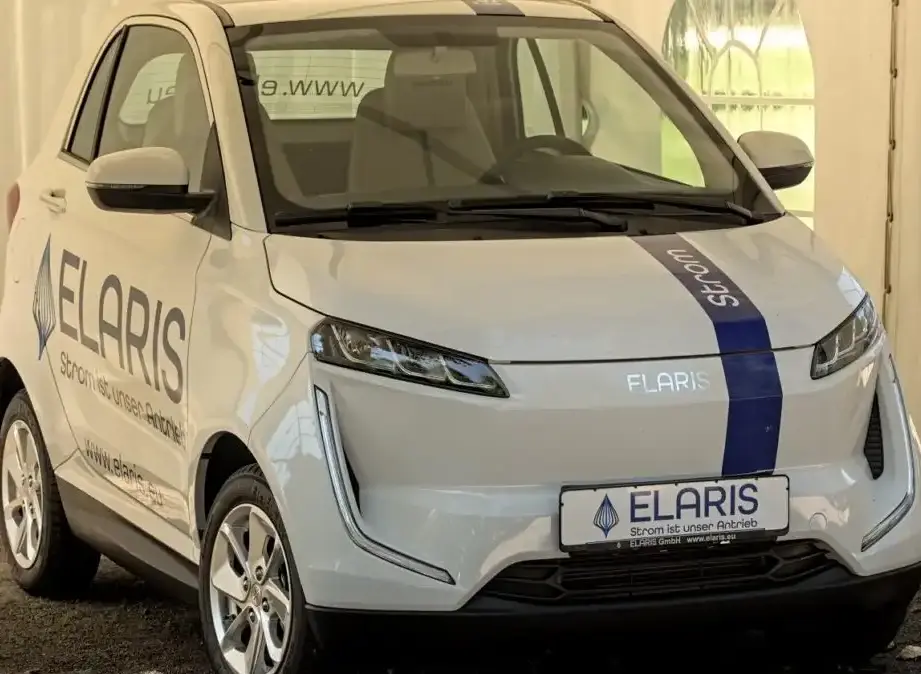
The Elaris Finn 31.5 kWh (48 hp) is a small, urban electric vehicle produced between 2021 and 2022. Positioned as an entry-level electric hatchback, the Finn aimed to provide affordable electric mobility, particularly in European markets. It represents one of the earliest offerings from Elaris, a relatively new automotive manufacturer focused on electric vehicles. The Finn is based on a simple, no-frills design philosophy, prioritizing functionality and low cost over extensive features or high performance. It’s a three-door hatchback with seating for two, designed primarily for city commuting and short trips.
Technical Specifications
| Brand | Elaris |
| Model | Finn |
| Generation | Finn |
| Type (Engine) | 31.5 kWh (48 Hp) |
| Start of production | 2021 |
| End of production | 2022 |
| Powertrain Architecture | BEV (Electric Vehicle) |
| Body type | Hatchback |
| Seats | 2 |
| Doors | 3 |
| Fuel Type | Electricity |
| Maximum speed | 115 km/h (71.46 mph) |
| Weight-to-power ratio | 17.8 kg/Hp, 56.1 Hp/tonne |
| Gross battery capacity | 31.5 kWh |
| Battery technology | Lithium-ion (Li-Ion) |
| Battery location | Below the floor |
| All-electric range (WLTP) | 265 km (164.66 mi) |
| All-electric range | 300 km (186.41 mi) |
| Average Energy consumption | 9.7-11.5 kWh/100 km (15.61 – 18.51 kWh/100 mi) |
| Average Energy consumption (MPGe) | 216 – 182 |
| Average Energy consumption (km/kWh) | 10.3 – 8.7 |
| Average Energy consumption (mi/kWh) | 6.4 – 5.4 |
| Electric motor power | 48 Hp |
| Electric motor location | Front axle, Transverse |
| Electric motor type | Synchronous |
| System power | 48 Hp |
| Kerb Weight | 855 kg (1884.95 lbs.) |
| Max. weight | 1080 kg (2380.99 lbs.) |
| Max load | 225 kg (496.04 lbs.) |
| Trunk (boot) space – minimum | 229 l (8.09 cu. ft.) |
| Length | 2871 mm (113.03 in.) |
| Width | 1563 mm (61.54 in.) |
| Height | 1568 mm (61.73 in.) |
| Wheelbase | 1765 mm (69.49 in.) |
| Front track | 1335 mm (52.56 in.) |
| Rear (Back) track | 1335 mm (52.56 in.) |
| Ride height (ground clearance) | 127 mm (5 in.) |
| Drivetrain Architecture | One electric motor drives the front wheels. |
| Drive wheel | Front wheel drive |
| Number of gears and type of gearbox | 1 gears, automatic transmission |
| Front suspension | Independent type McPherson |
| Rear suspension | Torsion |
| Front brakes | Disc |
| Rear brakes | Disc |
| Assisting systems | ABS (Anti-lock braking system) |
| Steering type | Steering rack and pinion |
| Power steering | Electric Steering |
| Tires size | 155/65 R14 |
| Wheel rims size | 14 |
Powertrain & Engine Architecture
The Elaris Finn utilizes a single synchronous electric motor, producing 48 horsepower. The motor is transversely mounted on the front axle, driving the front wheels. Power is derived from a 31.5 kWh lithium-ion battery pack located under the vehicle floor, contributing to a low center of gravity. The Finn employs a single-speed automatic transmission, typical of most battery electric vehicles (BEVs), simplifying the drivetrain and maximizing efficiency. The battery management system (BMS) is a crucial component, responsible for monitoring and controlling the battery’s charging and discharging processes, ensuring optimal performance and longevity. The vehicle does not have a traditional internal combustion engine, and therefore lacks components like a fuel injection system or valvetrain.
Driving Characteristics
With only 48 horsepower, the Elaris Finn’s performance is best described as adequate for urban driving. Acceleration is modest, and highway merging requires careful planning. The single-speed automatic transmission provides seamless power delivery, but lacks the gear ratios found in conventional vehicles, meaning the motor operates within a narrower RPM range. The vehicle’s relatively light weight (855 kg / 1885 lbs) helps to mitigate the low power output to some extent. The steering is electrically assisted, providing light and easy maneuverability, ideal for navigating tight city streets. The suspension, while simple, offers a reasonably comfortable ride on smooth surfaces, but can become unsettled on rough roads.
Equipment & Trim Levels
The Elaris Finn was offered with a fairly basic level of standard equipment, reflecting its position as an affordable EV. Standard features typically included power windows, central locking, and an ABS anti-lock braking system. Interior upholstery was typically a durable, easy-to-clean fabric. The dashboard layout was functional and straightforward, with a basic instrument cluster displaying essential information such as speed, battery charge level, and range. Optional extras were limited, potentially including air conditioning and a basic audio system. The focus was on providing essential transportation rather than luxury features.
Chassis & Braking
The Finn utilizes a McPherson strut independent suspension system at the front, providing a degree of ride comfort and handling precision. The rear suspension employs a torsion beam setup, a cost-effective solution commonly found in small hatchbacks. Braking is provided by disc brakes on all four wheels, offering adequate stopping power for the vehicle’s weight and performance. The ABS system helps to prevent wheel lockup during emergency braking, enhancing safety. The steering system is a rack and pinion type with electric power assistance, providing responsive and precise steering control.
Market Reception & Comparison
The Elaris Finn received mixed reviews. Critics generally praised its affordability and its contribution to the growing EV market. However, the limited range (265 km / 165 miles WLTP) and low power output were frequently cited as drawbacks. Compared to other EVs available at the time, the Finn offered a significantly lower price point, but at the expense of performance and range. Within the Elaris lineup, the Finn represented the entry-level model, with potential for future, higher-performance variants with larger battery packs and more powerful motors. Fuel economy, expressed as energy consumption, was rated at 9.7-11.5 kWh/100 km, which was competitive for its class.
Legacy
The Elaris Finn, while short-lived in production, served as an important stepping stone for the company in establishing itself in the electric vehicle market. Its simple design and affordable price point made it an accessible option for consumers looking to transition to electric mobility. Long-term reliability data is limited due to the vehicle’s brief production run, but the relatively simple electric powertrain suggests potential for good reliability. On the used car market, the Finn represents a very affordable entry point into EV ownership, but potential buyers should be aware of the limited range and performance. The Finn’s legacy lies in its contribution to making electric vehicles more accessible to a wider audience.
