
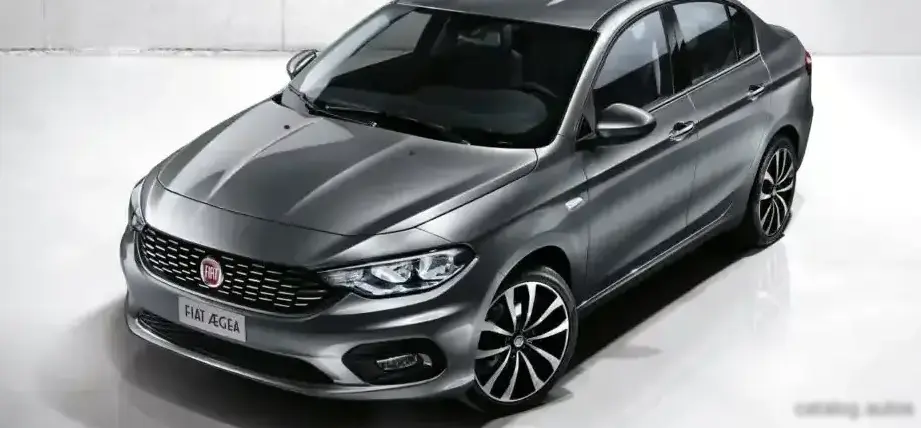
Technical Specifications
| Brand | Fiat |
| Model | Egea |
| Generation | Egea (356) |
| Type (Engine) | 1.4 Fire (95 Hp) |
| Start of production | 2015 |
| End of production | 2019 |
| Powertrain Architecture | Internal Combustion engine |
| Body type | Sedan |
| Seats | 5 |
| Doors | 4 |
| Fuel consumption (urban) | 7.7 l/100 km (30.5 US mpg) |
| Fuel consumption (extra urban) | 4.6 l/100 km (51.1 US mpg) |
| Fuel consumption (combined) | 5.7 l/100 km (41.3 US mpg) |
| CO2 emissions | 133 g/km |
| Fuel Type | Petrol (Gasoline) |
| Acceleration 0 – 100 km/h | 11.5 sec |
| Acceleration 0 – 62 mph | 11.5 sec |
| Acceleration 0 – 60 mph | 10.9 sec |
| Maximum speed | 185 km/h (114.95 mph) |
| Emission standard | Euro 6 |
| Weight-to-power ratio | 12.1 kg/Hp |
| Weight-to-torque ratio | 9.1 kg/Nm |
| Power | 95 Hp @ 6000 rpm |
| Torque | 127 Nm @ 4500 rpm (93.67 lb.-ft. @ 4500 rpm) |
| Engine layout | Front, Transverse |
| Engine Model/Code | 843A1000 |
| Engine displacement | 1368 cm3 (83.48 cu. in.) |
| Number of cylinders | 4 |
| Engine configuration | Inline |
| Cylinder Bore | 72 mm (2.83 in.) |
| Piston Stroke | 84 mm (3.31 in.) |
| Compression ratio | 11.2:1 |
| Number of valves per cylinder | 4 |
| Fuel injection system | Multi-port manifold injection |
| Engine aspiration | Naturally aspirated engine |
| Valvetrain | DOHC |
| Engine oil capacity | 2.95 l (3.12 US qt | 2.6 UK qt) |
| Coolant | 4.6 l (4.86 US qt | 4.05 UK qt) |
| Kerb Weight | 1150 kg (2535.32 lbs.) |
| Max. weight | 1650 kg (3637.63 lbs.) |
| Max load | 500 kg (1102.31 lbs.) |
| Trunk (boot) space – minimum | 520 l (18.36 cu. ft.) |
| Fuel tank capacity | 45 l (11.89 US gal | 9.9 UK gal) |
| Max. roof load | 55 kg (121.25 lbs.) |
| Permitted trailer load with brakes (12%) | 1200 kg (2645.55 lbs.) |
| Permitted trailer load without brakes | 500 kg (1102.31 lbs.) |
| Permitted towbar download | 60 kg (132.28 lbs.) |
| Length | 4532 mm (178.43 in.) |
| Width | 1792 mm (70.55 in.) |
| Width including mirrors | 2002 mm (78.82 in.) |
| Height | 1497 mm (58.94 in.) |
| Wheelbase | 2636 mm (103.78 in.) |
| Front track | 1542 mm (60.71 in.) |
| Rear (Back) track | 1543 mm (60.75 in.) |
| Front overhang | 893 mm (35.16 in.) |
| Rear overhang | 1003 mm (39.49 in.) |
| Minimum turning circle | 10.9 m (35.76 ft.) |
| Drivetrain Architecture | Front wheel drive |
| Drive wheel | Front wheel drive |
| Number of gears and type of gearbox | 6 gears, manual transmission |
| Front suspension | Independent type McPherson |
| Rear suspension | Torsion |
| Front brakes | Disc, 284×22 mm |
| Rear brakes | Drum, 228×40 mm |
| Assisting systems | ABS (Anti-lock braking system) |
| Steering type | Steering rack and pinion |
| Power steering | Electric Steering |
| Tires size | 195/65 R15; 205/55 R16; 225/45 R17 |
| Wheel rims size | 6J x 15; 6.5J x 16; 7J x 17 |
The Fiat Egea 1.4 Fire (95 hp) was produced between 2015 and 2019 as part of the 356 project, representing Fiat’s entry into the competitive C-segment sedan market. Built on the Compact Wide platform, shared with other Stellantis vehicles, the Egea aimed to offer a blend of practicality, comfort, and value. The 1.4 Fire engine, a mainstay in Fiat’s engine lineup for decades, was chosen for its fuel efficiency and affordability. This particular variant served as the base model, offering a more accessible price point for customers seeking a reliable and economical family car. It was primarily sold in Europe, Turkey, and select markets in North Africa and the Middle East.
Powertrain & Engine Architecture
The heart of the Egea 1.4 Fire is the 843A1000 engine, a 1.4-liter inline-four cylinder petrol engine. This engine is a naturally aspirated unit, meaning it doesn’t utilize a turbocharger or supercharger. It features a double overhead camshaft (DOHC) valvetrain with four valves per cylinder, contributing to improved breathing and efficiency. Fuel delivery is handled by a multi-point fuel injection system. The engine produces 95 horsepower at 6000 rpm and 127 Nm (93.67 lb-ft) of torque at 4500 rpm. The engine’s relatively low output is a result of its focus on fuel economy and emissions compliance. The Egea 1.4 Fire was typically paired with a six-speed manual transmission, although an automated manual transmission (Dualogic) was also offered as an option in some markets. The Dualogic transmission, while offering some convenience, was often criticized for its slow and jerky shifts compared to traditional automatic transmissions.
Driving Characteristics
The driving experience in the Egea 1.4 Fire is best described as comfortable and undemanding. With 95 horsepower, acceleration is not its strong suit; 0-60 mph takes around 10.9 seconds. However, the engine provides adequate power for everyday driving situations, such as commuting and highway cruising. The six-speed manual transmission allows drivers to keep the engine in its optimal power band, maximizing efficiency and responsiveness. The gear ratios are fairly well-spaced, providing decent acceleration in each gear. Compared to the more powerful 1.6 MultiJet diesel or 1.4 T-Jet turbocharged petrol variants, the 1.4 Fire feels noticeably slower. However, it offers a smoother and quieter driving experience than the diesel, and a more linear power delivery than the turbocharged engine. The suspension is tuned for comfort, absorbing bumps and imperfections in the road well. Steering is light and easy, making it suitable for city driving.
Equipment & Trim Levels
The Egea 1.4 Fire typically came with a reasonable level of standard equipment, although it was less lavishly equipped than higher-trim models. Standard features generally included air conditioning, power windows, central locking, a basic audio system with USB connectivity, and ABS brakes. Safety features such as airbags were also standard. Higher trim levels, such as the Lounge or Business, added features like alloy wheels, a touchscreen infotainment system, rear parking sensors, cruise control, and automatic climate control. Interior upholstery was typically cloth, with a simple and functional dashboard design. Optional extras included a sunroof, leather upholstery, and a navigation system.
Chassis & Braking
The Egea 1.4 Fire utilizes a McPherson strut independent suspension setup at the front and a torsion beam suspension at the rear. This configuration provides a good balance between ride comfort and handling. The front brakes are disc brakes, while the rear brakes are drum brakes – a cost-saving measure common in entry-level models. ABS (Anti-lock Braking System) is standard, providing enhanced braking performance and stability. The steering system is a rack and pinion type with electric power steering, offering light and precise steering feel. The chassis is designed to provide a stable and predictable driving experience, although it’s not particularly sporty.
Market Reception & Comparison
The Fiat Egea 1.4 Fire was generally well-received by critics as a practical and affordable family sedan. It was praised for its spacious interior, comfortable ride, and fuel efficiency. However, it was also criticized for its relatively low power output and the sometimes-clunky operation of the Dualogic automated manual transmission. Compared to its rivals, such as the Volkswagen Golf, Ford Focus, and Opel Astra, the Egea offered a more competitive price point, but lacked the brand prestige and refinement of some of its competitors. The 1.4 Fire engine offered better fuel economy than the 1.6 T-Jet, but significantly less performance. The diesel variants provided even better fuel economy, but came with a higher purchase price and potential maintenance costs.
Legacy
The Fiat Egea 1.4 Fire has proven to be a relatively reliable and durable vehicle. The 843A1000 engine is known for its simplicity and robustness, and with regular maintenance, it can provide many years of trouble-free service. In the used car market, the Egea 1.4 Fire represents a good value proposition for buyers seeking an affordable and practical family car. While it may not be the most exciting vehicle to drive, it offers a comfortable and reliable transportation solution. Parts availability is generally good, and maintenance costs are relatively low, making it an attractive option for budget-conscious buyers.

