
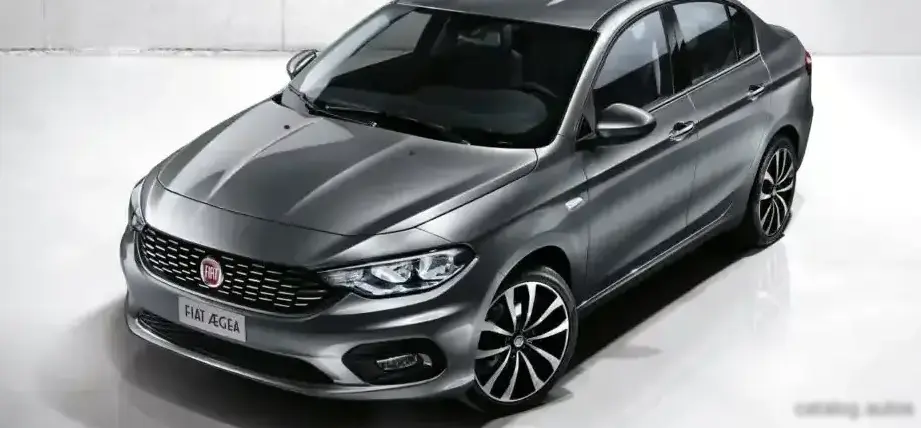
The Fiat Egea (project code 356) 1.4 T-Jet LPG, producing 120 horsepower, was a variant of the Egea compact sedan offered primarily in European and select international markets from 2015 to 2019. Positioned as a fuel-efficient and economically sensible option within the Egea range, it catered to buyers seeking lower running costs without sacrificing all practicality. The Egea itself represented Fiat’s attempt to create a more globally appealing and modern sedan, replacing the aging Bravo and Linea models. This particular 1.4 T-Jet LPG version aimed to capitalize on the growing popularity of alternative fuel vehicles, particularly in countries with favorable LPG infrastructure and taxation.
Technical Specifications
| Brand | Fiat |
| Model | Egea |
| Generation | Egea (356) |
| Type (Engine) | 1.4 T-Jet LPG (120 Hp) |
| Start of production | 2015 |
| End of production | 2019 |
| Powertrain Architecture | Internal Combustion engine |
| Body type | Sedan |
| Seats | 5 |
| Doors | 4 |
| Fuel consumption (economy) – urban | 8.2 l/100 km (28.7 US mpg, 34.4 UK mpg, 12.2 km/l) |
| Fuel consumption (economy) – urban (LPG) | 11.5 l/100 km |
| Fuel consumption (economy) – extra urban | 5.2 l/100 km (45.2 US mpg, 54.3 UK mpg, 19.2 km/l) |
| Fuel consumption (economy) – extra urban (LPG) | 6.6 l/100 km |
| Fuel consumption (economy) – combined | 6.3 l/100 km (37.3 US mpg, 44.8 UK mpg, 15.9 km/l) |
| Fuel consumption (economy) – combined (LPG) | 8.4 l/100 km |
| CO2 emissions | 146 g/km |
| CO2 emissions (LPG) | 136 g/km |
| Fuel Type | Petrol / LPG |
| Maximum speed | 200 km/h (124.27 mph) |
| Emission standard | Euro 6 |
| Weight-to-power ratio | 10.6 kg/Hp, 94.5 Hp/tonne |
| Weight-to-torque ratio | 5.9 kg/Nm, 169.3 Nm/tonne |
| Power | 120 Hp @ 5000 rpm |
| Power per litre | 87.7 Hp/l |
| Torque | 215 Nm @ 2500 rpm (158.58 lb.-ft. @ 2500 rpm) |
| Engine layout | Front, Transverse |
| Engine Model/Code | 940B7000 |
| Engine displacement | 1368 cm3 (83.48 cu. in.) |
| Number of cylinders | 4 |
| Engine configuration | Inline |
| Cylinder Bore | 72 mm (2.83 in.) |
| Piston Stroke | 84 mm (3.31 in.) |
| Compression ratio | 9.8:1 |
| Number of valves per cylinder | 4 |
| Fuel injection system | Multi-port manifold injection |
| Engine aspiration | Turbocharger, Intercooler |
| Valvetrain | DOHC |
| Engine oil capacity | 3.4 l (3.59 US qt | 2.99 UK qt) |
| Coolant | 5.2 l (5.49 US qt | 4.58 UK qt) |
| Kerb Weight | 1270 kg (2799.87 lbs.) |
| Max. weight | 1770 kg (3902.18 lbs.) |
| Max load | 500 kg (1102.31 lbs.) |
| Trunk (boot) space – minimum | 520 l (18.36 cu. ft.) |
| Fuel tank capacity | 50 l (13.21 US gal | 11 UK gal) |
| Fuel tank capacity (LPG) | 42 l |
| Length | 4532 mm (178.43 in.) |
| Width | 1792 mm (70.55 in.) |
| Width including mirrors | 2002 mm (78.82 in.) |
| Height | 1497 mm (58.94 in.) |
| Wheelbase | 2636 mm (103.78 in.) |
| Front track | 1542 mm (60.71 in.) |
| Rear (Back) track | 1543 mm (60.75 in.) |
| Front overhang | 893 mm (35.16 in.) |
| Rear overhang | 1003 mm (39.49 in.) |
| Minimum turning circle (turning diameter) | 10.9 m (35.76 ft.) |
| Drivetrain Architecture | The Internal combustion engine (ICE) drives the front wheels of the vehicle. |
| Drive wheel | Front wheel drive |
| Number of gears and type of gearbox | 6 gears, manual transmission |
| Front suspension | Independent type McPherson |
| Rear suspension | Torsion |
| Front brakes | Disc, 284×22 mm |
| Rear brakes | Drum, 228×40 mm |
| Assisting systems | ABS (Anti-lock braking system) |
| Steering type | Steering rack and pinion |
| Power steering | Electric Steering |
| Tires size | 205/55 R16; 225/45 R17 |
| Wheel rims size | 6.5J x 16; 7J x 17 |
INTRODUCTION
The Fiat Egea 1.4 T-Jet LPG, launched in 2015, was a key component of Fiat’s strategy to offer a competitive and modern sedan in the C-segment. Built on the 356 project platform, which is a modified version of the Compact Wide platform used in other Fiat and Chrysler vehicles, the Egea aimed to provide a compelling alternative to established rivals like the Volkswagen Golf, Ford Focus, and Opel Astra. The 1.4 T-Jet LPG variant specifically targeted buyers in markets where LPG (Liquefied Petroleum Gas) was a popular and cost-effective fuel source. It offered a dual-fuel system, allowing drivers to switch between gasoline and LPG, maximizing fuel economy and reducing emissions. This model was available throughout the Egea’s first generation, ending production in 2019 with the introduction of minor updates.
Powertrain & Engine Architecture
At the heart of the Egea 1.4 T-Jet LPG lies the 940B7000 engine, a 1368cc inline-four cylinder unit. This engine is part of Fiat’s T-Jet (Turbo Jet) family, known for its combination of turbocharging and direct fuel injection. The engine utilizes a single-scroll turbocharger with an intercooler to boost power and torque. Fuel delivery is managed by a multi-point fuel injection system for gasoline operation, while the LPG system features dedicated injectors and a vaporiser to convert liquid LPG into a gaseous state for combustion. The engine boasts a compression ratio of 9.8:1 and a double overhead camshaft (DOHC) valvetrain with four valves per cylinder. The LPG conversion is factory-fitted, ensuring optimal integration and reliability. The engine is transversely mounted at the front of the vehicle, driving the front wheels. The 6-speed manual transmission was standard on this variant, providing a balance between fuel efficiency and driver engagement.
Driving Characteristics
The 120 horsepower and 215 Nm (158.58 lb-ft) of torque produced by the 1.4 T-Jet LPG engine provided adequate performance for everyday driving. While not particularly sporty, the engine offered a usable powerband, with peak torque available from 2500 rpm. Acceleration was reasonable, but noticeably slower than the higher-powered 1.6 MultiJet diesel or the more potent gasoline variants. The 6-speed manual transmission was well-matched to the engine, offering smooth gear changes and allowing drivers to keep the engine in its optimal power range. The LPG system did result in a slight power reduction compared to the gasoline-only version, but the lower fuel costs often offset this difference. The suspension setup, tuned for comfort, provided a compliant ride, but handling was not as sharp as some of its rivals.
Equipment & Trim Levels
The Egea 1.4 T-Jet LPG typically came with a moderate level of standard equipment. Base models included air conditioning, power windows, central locking, and an audio system with USB connectivity. Higher trim levels added features such as alloy wheels, fog lights, cruise control, a touchscreen infotainment system, and rear parking sensors. Interior upholstery was typically cloth, with options for upgraded materials on higher trims. Safety features included ABS brakes, electronic stability control, and multiple airbags. The LPG system itself was integrated seamlessly, with a switch located on the dashboard allowing drivers to select between gasoline and LPG operation.
Chassis & Braking
The Egea utilized a McPherson strut independent suspension setup at the front and a torsion beam rear suspension. This configuration provided a good balance between ride comfort and handling. The front brakes were ventilated discs, measuring 284x22mm, while the rear brakes were drum brakes, sized at 228x40mm. ABS (Anti-lock Braking System) was standard, enhancing braking performance and safety. The steering system was an electric power-assisted rack and pinion setup, providing light and precise steering feel.
Market Reception & Comparison
The Fiat Egea 1.4 T-Jet LPG was generally well-received in markets where LPG was prevalent. Critics praised its fuel efficiency and low running costs, particularly in countries with high gasoline prices. However, some reviewers noted the engine’s lack of outright performance compared to other variants in the Egea lineup. Compared to the 1.6 MultiJet diesel, the LPG version offered similar fuel economy but with a smoother and quieter engine. Against the gasoline-only 1.4 T-Jet, the LPG version traded a small amount of power for significantly lower fuel costs. The Egea as a whole was often seen as a good value proposition, offering a lot of features for its price.
Legacy
The Fiat Egea 1.4 T-Jet LPG has proven to be a relatively reliable powertrain in the used car market. The LPG system, when properly maintained, is known for its longevity. However, regular servicing of the LPG components is crucial to ensure optimal performance and prevent potential issues. The engine itself is generally robust, but like any turbocharged engine, it requires regular oil changes and careful driving habits. Today, the Egea 1.4 T-Jet LPG remains a popular choice for budget-conscious buyers seeking a practical and fuel-efficient sedan. Its dual-fuel capability continues to appeal to those looking to reduce their fuel expenses and environmental impact.

