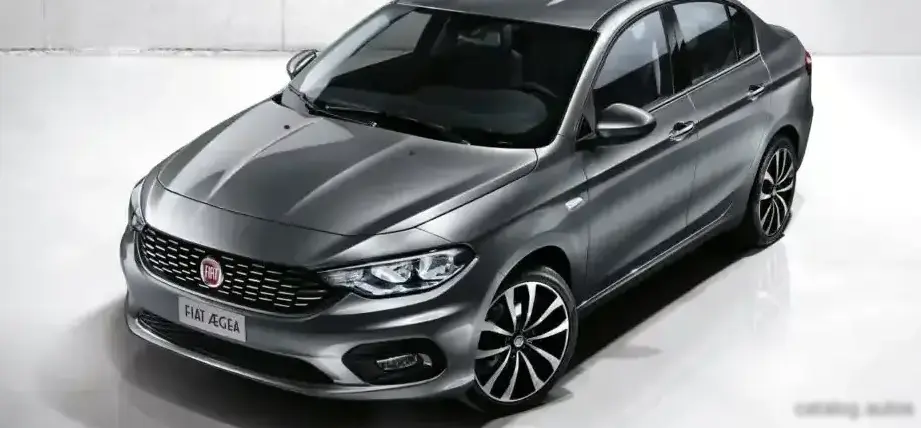
The Fiat Egea Hatchback, specifically the 1.3 Multijet II variant producing 95 horsepower, represents an entry-level diesel option within the Egea (also known as Tipo in some markets) lineup. Introduced with the 2020 facelift (model code 357), this version aimed to provide fuel efficiency and practicality for buyers seeking a compact, affordable hatchback. Positioned as the base diesel engine choice, it catered to customers prioritizing economy over outright performance. The Egea itself is Fiat’s offering in the competitive C-segment hatchback market, primarily targeted towards European consumers, though it has seen limited sales in other regions.
Technical Specifications
| Brand | Fiat |
| Model | Egea |
| Generation | Egea Hatchback (357, facelift 2020) |
| Type (Engine) | 1.3 Multijet II (95 Hp) |
| Start of production | 2020 |
| Powertrain Architecture | Internal Combustion engine |
| Body type | Hatchback |
| Seats | 5 |
| Doors | 5 |
| Combined fuel consumption (WLTP) | 4.3-4.5 l/100 km (54.7 – 52.3 US mpg, 65.7 – 62.8 UK mpg, 23.3 – 22.2 km/l) |
| CO2 emissions (WLTP) | 114-119 g/km |
| Fuel Type | Diesel |
| Acceleration 0 – 100 km/h | 13.3 sec |
| Acceleration 0 – 62 mph | 13.3 sec |
| Acceleration 0 – 60 mph | 12.6 sec |
| Maximum speed | 181 km/h (112.47 mph) |
| Emission standard | Euro 6d-FINAL |
| Weight-to-power ratio | 13.6 kg/Hp, 73.4 Hp/tonne |
| Weight-to-torque ratio | 6.5 kg/Nm, 154.4 Nm/tonne |
| Power | 95 Hp @ 3750 rpm |
| Power per litre | 76.1 Hp/l |
| Torque | 200 Nm @ 1500 rpm (147.51 lb.-ft. @ 1500 rpm) |
| Engine layout | Front, Transverse |
| Engine Model/Code | 46345266 |
| Engine displacement | 1248 cm3 (76.16 cu. in.) |
| Number of cylinders | 4 |
| Engine configuration | Inline |
| Cylinder Bore | 69.6 mm (2.74 in.) |
| Piston Stroke | 82 mm (3.23 in.) |
| Compression ratio | 16.8:1 |
| Number of valves per cylinder | 4 |
| Fuel injection system | Diesel Commonrail |
| Engine aspiration | Turbocharger, Intercooler |
| Valvetrain | DOHC |
| Engine oil capacity | 3.9 l (4.12 US qt | 3.43 UK qt) |
| Coolant | 6.1 l (6.45 US qt | 5.37 UK qt) |
| Kerb Weight | 1295 kg (2854.99 lbs.) |
| Max. weight | 1795 kg (3957.3 lbs.) |
| Max load | 500 kg (1102.31 lbs.) |
| Trunk (boot) space – minimum | 440 l (15.54 cu. ft.) |
| Fuel tank capacity | 50 l (13.21 US gal | 11 UK gal) |
| Max. roof load | 55 kg (121.25 lbs.) |
| Permitted trailer load with brakes (12%) | 1500 kg (3306.93 lbs.) |
| Permitted trailer load without brakes | 500 kg (1102.31 lbs.) |
| Permitted towbar download | 60 kg (132.28 lbs.) |
| Length | 4368 mm (171.97 in.) |
| Width | 1792 mm (70.55 in.) |
| Width including mirrors | 2002 mm (78.82 in.) |
| Height | 1495 mm (58.86 in.) |
| Wheelbase | 2638 mm (103.86 in.) |
| Front track | 1542 mm (60.71 in.) |
| Rear (Back) track | 1543 mm (60.75 in.) |
| Front overhang | 893 mm (35.16 in.) |
| Rear overhang | 837 mm (32.95 in.) |
| Minimum turning circle (turning diameter) | 10.9 m (35.76 ft.) |
| Drivetrain Architecture | The Internal combustion engine (ICE) drives the front wheels of the vehicle. |
| Drive wheel | Front wheel drive |
| Number of gears and type of gearbox | 5 gears, manual transmission |
| Front suspension | Independent type McPherson |
| Rear suspension | Torsion |
| Front brakes | Disc |
| Rear brakes | Drum |
| Assisting systems | ABS (Anti-lock braking system) |
| Steering type | Steering rack and pinion |
| Power steering | Electric Steering |
| Tires size | 195/65 R15; 205/55 R16; 225/45 R17; 225/40 R18 |
| Wheel rims size | 6J x 15; 6.5J x 16; 7J x 17; 7.5J x 18 |
Powertrain & Engine Architecture
The heart of this Egea variant is the 1.3-liter Multijet II diesel engine, bearing the code 46345266. This engine is a member of Fiat’s second-generation Multijet family, known for its improved refinement and efficiency compared to earlier iterations. It’s a four-cylinder, inline configuration with a displacement of 1248 cubic centimeters. The engine utilizes a turbocharger with an intercooler to boost power output, and features a common rail direct fuel injection system. The DOHC (Double Overhead Camshaft) valvetrain operates four valves per cylinder, optimizing gas flow for improved combustion. A relatively high compression ratio of 16.8:1 contributes to the engine’s thermal efficiency. The 5-speed manual transmission is the only gearbox option available with this engine.
Driving Characteristics
The 95 horsepower and 200 Nm (147.51 lb-ft) of torque produced by the 1.3 Multijet II engine deliver adequate, but not exhilarating, performance. Acceleration from 0 to 100 km/h (0-62 mph) takes approximately 13.3 seconds. The engine’s peak torque is available from a low 1500 rpm, providing reasonable responsiveness for everyday driving situations. However, compared to higher-powered Egea variants, such as those equipped with the 1.6-liter gasoline engine or the more potent diesel options, this version feels noticeably slower, particularly when fully loaded or tackling inclines. The 5-speed gearbox is well-matched to the engine’s characteristics, but the limited number of gears can result in higher engine speeds during highway cruising.
Equipment & Trim Levels
The 1.3 Multijet II 95 hp variant typically served as the entry point to the Egea Hatchback diesel range. Standard equipment generally included air conditioning, power steering, electric front windows, a basic audio system with USB connectivity, and ABS brakes. Safety features like ESP (Electronic Stability Program) were also commonly included. Higher trim levels, such as Lounge or Sport, added features like alloy wheels, a touchscreen infotainment system, rear parking sensors, cruise control, and automatic climate control. Interior upholstery was typically cloth, with options for upgraded materials on higher trims.
Chassis & Braking
The Egea Hatchback utilizes a McPherson strut independent suspension setup at the front and a torsion beam arrangement at the rear. This configuration provides a reasonable balance between ride comfort and handling. The front brakes are discs, while the rear brakes are drums – a cost-saving measure common in entry-level models. The steering is electrically assisted, providing light and easy operation. Stabilizer bars are fitted to both the front and rear axles to reduce body roll during cornering.
Market Reception & Comparison
The 1.3 Multijet II 95 hp Egea Hatchback was generally well-received for its fuel efficiency and affordability. Critics praised its low running costs and practicality, making it an attractive option for budget-conscious buyers. However, its performance was often cited as a drawback, particularly when compared to more powerful alternatives. Compared to the 1.6-liter gasoline engine, the diesel offered significantly better fuel economy but less overall power. Against other diesel variants within the Egea range, the 1.3 Multijet II provided a more economical entry point, but at the expense of performance and refinement.
Legacy
The 1.3 Multijet II engine has proven to be a relatively reliable unit, although, like all diesel engines, it requires regular maintenance, including oil changes and filter replacements. The Egea Hatchback, in general, has established a reputation for being a practical and affordable car. On the used car market, this specific variant represents a good value proposition for buyers seeking a fuel-efficient and reliable hatchback. However, potential buyers should be aware of the potential for diesel particulate filter (DPF) issues, particularly if the vehicle has primarily been used for short journeys. The Egea continues to be a popular choice in Europe, demonstrating Fiat’s commitment to providing affordable and practical transportation solutions.