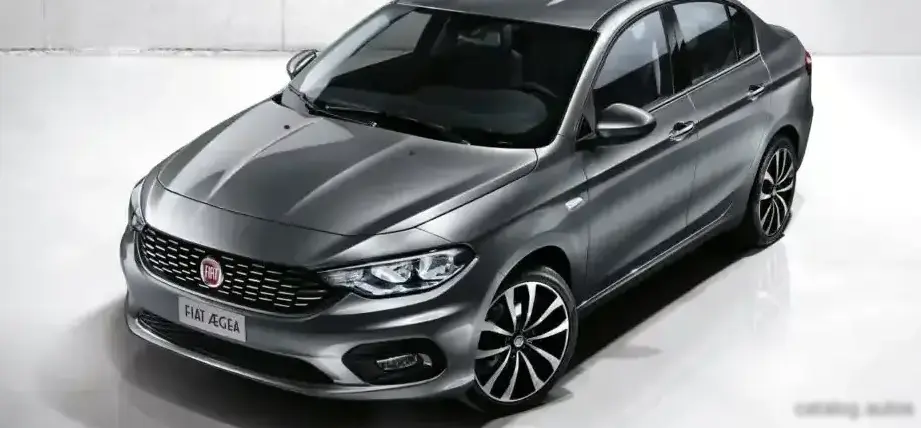
The Fiat Egea Hatchback, specifically the 1.6 Multijet II variant producing 130 horsepower, represents a significant offering in the European compact car segment. Introduced with the 2020 facelift (model code 357), this version aimed to balance fuel efficiency with respectable performance, appealing to buyers seeking a practical and economical hatchback. Positioned as a mid-range option within the Egea lineup, it slotted between the lower-powered diesel trims and the more potent gasoline engines. The Egea itself is a product of Fiat’s strategy to offer a globally competitive C-segment vehicle, initially designed for the Turkish market before expanding to other European countries.
Technical Specifications
| Brand | Fiat |
| Model | Egea |
| Generation | Egea Hatchback (357, facelift 2020) |
| Type (Engine) | 1.6 Multijet II (130 Hp) |
| Start of production | 2020 |
| Powertrain Architecture | Internal Combustion engine |
| Body type | Hatchback |
| Seats | 5 |
| Doors | 5 |
| Combined fuel consumption (WLTP) | 4.5-4.7 l/100 km (52.3 – 50 US mpg, 62.8 – 60.1 UK mpg, 22.2 – 21.3 km/l) |
| CO2 emissions (WLTP) | 118-123 g/km |
| Fuel Type | Diesel |
| Acceleration 0 – 100 km/h | 9.8 sec |
| Acceleration 0 – 62 mph | 9.8 sec |
| Acceleration 0 – 60 mph | 9.3 sec |
| Maximum speed | 208 km/h (129.25 mph) |
| Emission standard | Euro 6d-FINAL |
| Weight-to-power ratio | 10.3 kg/Hp, 97 Hp/tonne |
| Weight-to-torque ratio | 4.2 kg/Nm, 238.8 Nm/tonne |
| Power | 130 Hp @ 3750 rpm |
| Power per litre | 81.4 Hp/l |
| Torque | 320 Nm @ 1500 rpm (236.02 lb.-ft. @ 1500 rpm) |
| Engine layout | Front, Transverse |
| Engine Model/Code | 46346020 |
| Engine displacement | 1598 cm3 (97.52 cu. in.) |
| Number of cylinders | 4 |
| Engine configuration | Inline |
| Cylinder Bore | 79.5 mm (3.13 in.) |
| Piston Stroke | 80.5 mm (3.17 in.) |
| Compression ratio | 15.7:1 |
| Number of valves per cylinder | 4 |
| Fuel injection system | Diesel Commonrail |
| Engine aspiration | Turbocharger, Intercooler |
| Valvetrain | DOHC |
| Engine oil capacity | 4.8 l (5.07 US qt | 4.22 UK qt) |
| Coolant | 6.1 l (6.45 US qt | 5.37 UK qt) |
| Kerb Weight | 1340 kg (2954.19 lbs.) |
| Max. weight | 1840 kg (4056.51 lbs.) |
| Max load | 500 kg (1102.31 lbs.) |
| Trunk (boot) space – minimum | 440 l (15.54 cu. ft.) |
| Fuel tank capacity | 50 l (13.21 US gal | 11 UK gal) |
| Max. roof load | 55 kg (121.25 lbs.) |
| Permitted trailer load with brakes (12%) | 1500 kg (3306.93 lbs.) |
| Permitted trailer load without brakes | 500 kg (1102.31 lbs.) |
| Permitted towbar download | 60 kg (132.28 lbs.) |
| Length | 4368 mm (171.97 in.) |
| Width | 1792 mm (70.55 in.) |
| Width including mirrors | 2002 mm (78.82 in.) |
| Height | 1495 mm (58.86 in.) |
| Wheelbase | 2638 mm (103.86 in.) |
| Front track | 1542 mm (60.71 in.) |
| Rear (Back) track | 1543 mm (60.75 in.) |
| Front overhang | 893 mm (35.16 in.) |
| Rear overhang | 837 mm (32.95 in.) |
| Minimum turning circle (turning diameter) | 10.9 m (35.76 ft.) |
| Drivetrain Architecture | The Internal combustion engine (ICE) drives the front wheels of the vehicle. |
| Drive wheel | Front wheel drive |
| Number of gears and type of gearbox | 6 gears, manual transmission |
| Front suspension | Independent type McPherson |
| Rear suspension | Torsion |
| Front brakes | Disc |
| Rear brakes | Disc |
| Assisting systems | ABS (Anti-lock braking system) |
| Steering type | Steering rack and pinion |
| Power steering | Electric Steering |
| Tires size | 205/55 R16; 225/45 R17; 225/40 R18 |
| Wheel rims size | 6.5J x 16; 7J x 17; 7.5J x 18 |
Powertrain & Engine Architecture
The heart of this Egea variant is the 1.6 Multijet II diesel engine, a member of Fiat’s widely used family of common-rail direct injection diesel engines. The engine code 46346020 signifies a later iteration of this powerplant, incorporating improvements for emissions and efficiency. This four-cylinder, inline engine utilizes a turbocharger with an intercooler to boost power output to 130 horsepower at 3750 rpm and 320 Nm (236 lb-ft) of torque at a low 1500 rpm. The high compression ratio of 15.7:1 is typical for diesel engines, contributing to thermal efficiency. The engine employs a Double Overhead Camshaft (DOHC) valvetrain with four valves per cylinder, optimizing gas flow. The 6-speed manual transmission was the standard offering, providing a balance between fuel economy and driver control. The Multijet II system itself is a sophisticated common-rail injection system, allowing for multiple fuel injections per combustion cycle, resulting in smoother operation, reduced noise, and improved fuel economy.
Driving Characteristics
The 1.6 Multijet II with 130 hp in the Egea Hatchback delivers a practical and reasonably engaging driving experience. While not a performance-oriented model, the engine’s strong low-end torque makes it well-suited for everyday driving and overtaking maneuvers. Acceleration from 0 to 100 km/h (0-62 mph) takes approximately 9.8 seconds. The 6-speed manual transmission allows drivers to effectively utilize the engine’s powerband. Compared to lower-powered diesel versions, this 130 hp variant offers noticeably more responsiveness. However, it falls short of the performance offered by the gasoline engines in the Egea lineup. The gear ratios are tuned for fuel efficiency, meaning the engine doesn’t rev as freely as some competitors. The overall driving experience is comfortable and composed, with a focus on practicality rather than outright sportiness.
Equipment & Trim Levels
The 1.6 Multijet II 130 hp variant typically came equipped with a solid base level of features. Standard equipment often included air conditioning, power windows, central locking, a basic audio system with USB connectivity, and steel wheels with wheel covers. Higher trim levels, such as Lounge or Sport, added features like alloy wheels, a touchscreen infotainment system with Bluetooth connectivity, cruise control, rear parking sensors, and automatic climate control. Interior upholstery was typically cloth, with options for upgraded materials on higher trims. Safety features included ABS, electronic stability control, and multiple airbags.
Chassis & Braking
The Egea Hatchback utilizes a McPherson strut front suspension and a torsion beam rear suspension. This setup provides a good balance between ride comfort and handling. The front brakes are ventilated discs, while the rear brakes are typically solid discs, providing adequate stopping power for the vehicle’s weight class. Electric power steering is standard, offering light and precise steering feel. The chassis is designed to prioritize comfort and stability, rather than aggressive cornering. Stabilizer bars are fitted to both the front and rear axles to reduce body roll.
Market Reception & Comparison
The Fiat Egea 1.6 Multijet II 130 hp received generally positive reviews for its fuel efficiency, comfortable ride, and practical interior space. Critics praised the engine’s torque and responsiveness, but some noted that it could be somewhat noisy compared to some competitors. Compared to the lower-powered diesel variants, the 130 hp version offered a significant improvement in performance. Against gasoline-powered rivals, it provided superior fuel economy, but often lacked the same level of refinement. The Egea competed with other popular C-segment hatchbacks such as the Volkswagen Golf, Ford Focus, and Peugeot 308.
Legacy
The 1.6 Multijet II engine has proven to be a relatively reliable powertrain, with many examples still on the road today. Common maintenance items include regular oil changes, filter replacements, and timing belt service (typically every 120,000 km). The diesel particulate filter (DPF) can be a potential issue if the vehicle is primarily used for short trips, requiring periodic regeneration. On the used car market, the Egea 1.6 Multijet II 130 hp represents a good value proposition for buyers seeking an economical and practical hatchback. Its fuel efficiency and relatively low running costs make it an attractive option for those covering high mileage.