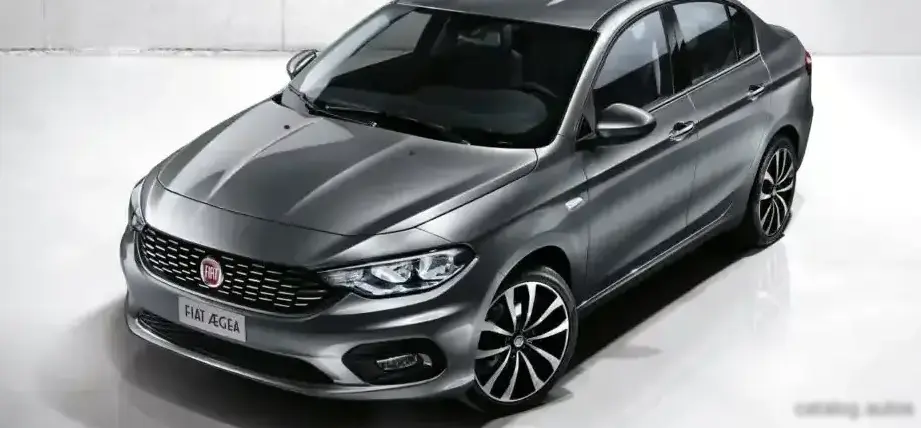
The Fiat Egea Station Wagon (Project 358) 1.6 E-Torq with the 110 horsepower engine and automatic transmission was a key variant in Fiat’s European lineup from 2016 to 2019. Positioned as a practical and affordable family vehicle, it offered a spacious interior and a large cargo area within the compact station wagon segment. This model aimed to provide a comfortable and convenient driving experience, particularly for those prioritizing ease of use over outright performance. It was part of the broader Egea family, which also included sedan and hatchback body styles, all built on Fiat’s C-segment platform.
Technical Specifications
| Brand | Fiat |
| Model | Egea |
| Generation | Egea Station Wagon (358) |
| Type (Engine) | 1.6 E-Torq (110 Hp) Automatic |
| Start of production | 2016 |
| End of production | 2019 |
| Powertrain Architecture | Internal Combustion engine |
| Body type | Station wagon (estate) |
| Seats | 5 |
| Doors | 5 |
| Fuel consumption (urban) | 9.2 l/100 km (25.6 US mpg) |
| Fuel consumption (extra urban) | 4.6 l/100 km (51.1 US mpg) |
| Fuel consumption (combined) | 6.3 l/100 km (37.3 US mpg) |
| CO2 emissions | 147 g/km |
| Fuel Type | Petrol (Gasoline) |
| Acceleration 0 – 100 km/h | 11.7 sec |
| Acceleration 0 – 62 mph | 11.7 sec |
| Acceleration 0 – 60 mph | 11.1 sec |
| Maximum speed | 192 km/h (119.3 mph) |
| Emission standard | Euro 6 |
| Weight-to-power ratio | 12 kg/Hp |
| Weight-to-torque ratio | 8.7 kg/Nm |
| Power | 110 Hp @ 5500 rpm |
| Torque | 152 Nm @ 4500 rpm (112.11 lb.-ft. @ 4500 rpm) |
| Engine layout | Front, Transverse |
| Engine Model/Code | 55268036 |
| Engine displacement | 1598 cm3 (97.52 cu. in.) |
| Number of cylinders | 4 |
| Engine configuration | Inline |
| Cylinder Bore | 77 mm (3.03 in.) |
| Piston Stroke | 85.8 mm (3.38 in.) |
| Compression ratio | 11.1:1 |
| Number of valves per cylinder | 4 |
| Fuel injection system | Multi-port manifold injection |
| Engine aspiration | Naturally aspirated engine |
| Valvetrain | SOHC |
| Engine oil capacity | 4.7 l (4.97 US qt | 4.14 UK qt) |
| Coolant capacity | 5.4 l (5.71 US qt | 4.75 UK qt) |
| Kerb Weight | 1320 kg (2910.1 lbs.) |
| Trunk (boot) space – minimum | 550 l (19.42 cu. ft.) |
| Fuel tank capacity | 50 l (13.21 US gal | 11 UK gal) |
| Max. roof load | 75 kg (165.35 lbs.) |
| Length | 4571 mm (179.96 in.) |
| Width | 1792 mm (70.55 in.) |
| Width including mirrors | 2002 mm (78.82 in.) |
| Height | 1512 mm (59.53 in.) |
| Wheelbase | 2638 mm (103.86 in.) |
| Front track | 1542 mm (60.71 in.) |
| Rear track | 1543 mm (60.75 in.) |
| Front overhang | 893 mm (35.16 in.) |
| Rear overhang | 1040 mm (40.94 in.) |
| Minimum turning circle | 10.9 m (35.76 ft.) |
| Drivetrain Architecture | Front wheel drive |
| Number of gears | 6 |
| Gearbox type | Automatic transmission |
| Front suspension | Independent type McPherson |
| Rear suspension | Torsion |
| Front brakes | Disc, 284×22 mm |
| Rear brakes | Disc, 264×10 mm |
| Assisting systems | ABS (Anti-lock braking system) |
| Steering type | Steering rack and pinion |
| Power steering | Electric Steering |
| Tires size | 195/55 R15; 205/55 R16; 225/45 R17 |
| Wheel rims size | 6J x 15; 6.5J x 16; 7J x 17 |
Powertrain & Engine Architecture
The heart of the Egea Station Wagon 1.6 E-Torq Automatic is the 1.6-liter inline-four cylinder gasoline engine, designated with engine code 55268036. This engine features a single overhead camshaft (SOHC) valvetrain and utilizes a multi-point fuel injection system. The 1598cc displacement is achieved with a bore of 77mm and a stroke of 85.8mm, operating with a compression ratio of 11.1:1. The engine produces 110 horsepower at 5500 rpm and 152 Nm (112 lb-ft) of torque at 4500 rpm. Paired with this engine is a six-speed automatic transmission, designed to provide smooth and convenient gear changes. This transmission was chosen to appeal to drivers seeking a less engaging, more relaxed driving experience.
Driving Characteristics
The 1.6 E-Torq Automatic offered a comfortable, if not particularly sporty, driving experience. Acceleration from 0-100 km/h (0-62 mph) took approximately 11.7 seconds, making it adequate for everyday driving but not ideal for quick overtaking maneuvers. The automatic transmission, while smooth, did contribute to a slight reduction in responsiveness compared to the available manual transmission options. The gear ratios were tuned for fuel efficiency and comfortable cruising, rather than maximizing performance. In real-world conditions, the car felt most at home on highways or in city traffic, where the automatic transmission’s convenience was most appreciated. Compared to the more powerful diesel variants, this version prioritized fuel economy and affordability over outright speed.
Equipment & Trim Levels
The Egea Station Wagon 1.6 E-Torq Automatic typically came with a reasonable level of standard equipment. This included air conditioning, power windows, central locking, and an audio system with USB connectivity. Higher trim levels offered additional features such as alloy wheels, a touchscreen infotainment system, rear parking sensors, and cruise control. Interior upholstery was generally cloth, with options for upgraded materials on higher trims. Safety features included ABS brakes, electronic stability control, and multiple airbags. The specific equipment levels varied depending on the market and optional packages selected by the buyer.
Chassis & Braking
The Egea Station Wagon featured a McPherson strut independent suspension at the front and a torsion beam suspension at the rear. This setup provided a good balance between ride comfort and handling. The front brakes were ventilated discs measuring 284x22mm, while the rear brakes were solid discs measuring 264x10mm. ABS (Anti-lock Braking System) was standard, enhancing braking performance and safety. The electric power steering provided light and easy steering, making it convenient for maneuvering in urban environments. The suspension was tuned to prioritize comfort, resulting in a slightly softer ride compared to sportier models.
Market Reception & Comparison
The Fiat Egea Station Wagon 1.6 E-Torq Automatic was generally well-received as a practical and affordable family car. Critics praised its spacious interior, large cargo area, and comfortable ride. However, some noted that the engine lacked the punch of the diesel alternatives and that the automatic transmission could feel somewhat sluggish. Fuel economy was considered respectable, averaging around 6.3 l/100 km (37.3 US mpg). Compared to the 1.6 diesel or the more powerful gasoline options, this variant offered a lower price point but sacrificed some performance and fuel efficiency. It appealed to buyers who prioritized convenience and affordability over driving excitement.
Legacy
The 1.6 E-Torq engine, while not known for being particularly groundbreaking, proved to be a relatively reliable unit. The automatic transmission, when properly maintained, also demonstrated good durability. In the used car market, the Egea Station Wagon 1.6 E-Torq Automatic remains a popular choice for budget-conscious buyers seeking a spacious and practical vehicle. Maintenance costs are generally reasonable, and parts availability is good. While it may not offer the same level of refinement or performance as some of its competitors, it represents a solid value proposition for those seeking a dependable and affordable station wagon.