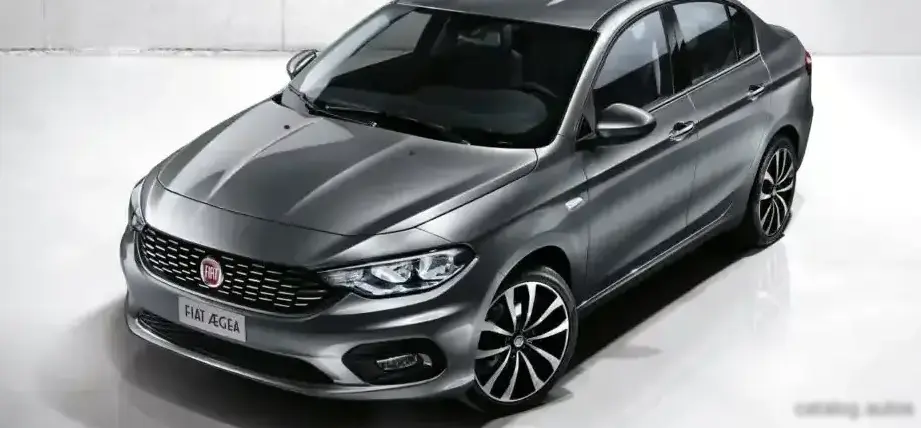
The Fiat Egea Station Wagon (project code 358) 1.6 Multijet II (120 hp) with a Dual Clutch Transmission (DCT) was a key variant in Fiat’s European lineup from 2016 to 2019. Positioned as a practical and fuel-efficient option within the Egea range, it aimed to appeal to families and individuals needing a versatile vehicle with reasonable performance and modern technology. The Egea, itself a replacement for the Bravo, was designed to compete in the crowded compact family car segment, and the station wagon body style offered increased cargo capacity compared to the hatchback and sedan versions.
Technical Specifications
| Brand | Fiat |
| Model | Egea |
| Generation | Egea Station Wagon (358) |
| Type (Engine) | 1.6 Multijet II (120 Hp) DCT |
| Start of production | 2016 |
| End of production | 2019 |
| Powertrain Architecture | Internal Combustion engine |
| Body type | Station wagon (estate) |
| Seats | 5 |
| Doors | 5 |
| Fuel consumption (urban) | 4.5 l/100 km (52.3 US mpg, 62.8 UK mpg, 22.2 km/l) |
| Fuel consumption (extra urban) | 3.5 l/100 km (67.2 US mpg, 80.7 UK mpg, 28.6 km/l) |
| Fuel consumption (combined) | 3.9 l/100 km (60.3 US mpg, 72.4 UK mpg, 25.6 km/l) |
| CO2 emissions | 102 g/km |
| Fuel Type | Diesel |
| Acceleration 0 – 100 km/h | 10.4 sec |
| Acceleration 0 – 62 mph | 10.4 sec |
| Acceleration 0 – 60 mph | 9.9 sec |
| Maximum speed | 200 km/h (124.27 mph) |
| Emission standard | Euro 6 |
| Weight-to-power ratio | 11.3 kg/Hp, 88.9 Hp/tonne |
| Weight-to-torque ratio | 4.2 kg/Nm, 237 Nm/tonne |
| Power | 120 Hp @ 3750 rpm |
| Power per litre | 75.1 Hp/l |
| Torque | 320 Nm @ 1750 rpm (236.02 lb.-ft. @ 1750 rpm) |
| Engine layout | Front, Transverse |
| Engine Model/Code | 55260384 |
| Engine displacement | 1598 cm3 (97.52 cu. in.) |
| Number of cylinders | 4 |
| Engine configuration | Inline |
| Cylinder Bore | 79.5 mm (3.13 in.) |
| Piston Stroke | 80.5 mm (3.17 in.) |
| Compression ratio | 16.5:1 |
| Number of valves per cylinder | 4 |
| Fuel injection system | Diesel Commonrail |
| Engine aspiration | Turbocharger, Intercooler |
| Valvetrain | DOHC |
| Engine oil capacity | 4.8 l (5.07 US qt | 4.22 UK qt) |
| Coolant | 6.1 l (6.45 US qt | 5.37 UK qt) |
| Kerb Weight | 1350 kg (2976.24 lbs.) |
| Trunk (boot) space – minimum | 550 l (19.42 cu. ft.) |
| Fuel tank capacity | 50 l (13.21 US gal | 11 UK gal) |
| Length | 4571 mm (179.96 in.) |
| Width | 1792 mm (70.55 in.) |
| Width including mirrors | 2002 mm (78.82 in.) |
| Height | 1512 mm (59.53 in.) |
| Wheelbase | 2638 mm (103.86 in.) |
| Front track | 1542 mm (60.71 in.) |
| Rear (Back) track | 1543 mm (60.75 in.) |
| Front overhang | 893 mm (35.16 in.) |
| Rear overhang | 1040 mm (40.94 in.) |
| Minimum turning circle | 10.9 m (35.76 ft.) |
| Drivetrain Architecture | Front wheel drive |
| Number of gears and type of gearbox | 6 gears, automatic transmission DCT |
| Front suspension | Independent type McPherson |
| Rear suspension | Torsion |
| Front brakes | Disc, 281×26 mm |
| Rear brakes | Disc, 264×10 mm |
| Tires size | 205/55 R16; 225/45 R17 |
| Wheel rims size | 6.5J x 16; 7J x 17 |
Powertrain & Engine Architecture
The heart of this Egea variant is the 1.6 Multijet II diesel engine, part of Fiat’s widely used family of common-rail direct injection diesel engines. The engine code 55260384 designates a specific iteration of this powerplant. It features a turbocharger with an intercooler to boost power and efficiency. The 16.5:1 compression ratio is typical for a diesel engine, contributing to its thermal efficiency. The engine utilizes a Double Overhead Camshaft (DOHC) valvetrain with four valves per cylinder, optimizing gas flow for improved performance. The diesel common rail system delivers fuel at extremely high pressure, ensuring fine atomization for cleaner combustion and reduced emissions. Paired with this engine is a 6-speed Dual Clutch Transmission (DCT). This DCT provides quicker and smoother gear changes compared to a traditional automatic transmission, enhancing both performance and fuel economy. The DCT operates by utilizing two separate clutches for odd and even gears, allowing for pre-selection of the next gear and seamless shifts.
Driving Characteristics
The 120 hp output, combined with the 320 Nm (236 lb-ft) of torque, provided adequate performance for everyday driving. Acceleration from 0-60 mph took around 9.9 seconds, and top speed was rated at 200 km/h (124 mph). While not a particularly sporty setup, the engine delivered strong low-end torque, making it easy to navigate city streets and maintain comfortable cruising speeds on the highway. The DCT transmission contributed to a more engaging driving experience than a traditional automatic, with quick and precise shifts. Compared to the higher-output 1.6 Multijet versions (typically around 130 hp), this variant offered a slightly more relaxed driving experience, prioritizing fuel efficiency over outright performance. Manual transmission versions of the 1.6 Multijet felt more responsive, but the DCT offered convenience and ease of use, particularly in stop-and-go traffic.
Equipment & Trim Levels
The 1.6 Multijet II DCT trim typically fell into the mid-range of the Egea Station Wagon lineup. Standard equipment generally included air conditioning, power windows, central locking, a basic audio system with USB connectivity, and stability control. Higher trim levels added features like alloy wheels, a touchscreen infotainment system with navigation, rear parking sensors, cruise control, and automatic climate control. Interior upholstery was typically cloth, with options for upgraded materials on higher trims. The dashboard layout was functional and straightforward, prioritizing usability over flashy design.
Chassis & Braking
The Egea Station Wagon utilized a McPherson strut front suspension and a torsion beam rear suspension. This setup provided a good balance between ride comfort and handling. The front brakes were ventilated discs, while the rear brakes were solid discs. ABS (Anti-lock Braking System) was standard. The suspension was tuned for comfort, absorbing bumps and imperfections in the road reasonably well. Stabilizer bars were fitted to both the front and rear axles to reduce body roll during cornering.
Market Reception & Comparison
The Fiat Egea Station Wagon 1.6 Multijet II DCT was generally well-received by automotive critics for its practicality, fuel efficiency, and competitive pricing. It was often praised for its spacious interior and large cargo area. However, some reviewers noted that the interior materials felt somewhat basic compared to some rivals. In terms of fuel economy, this variant consistently delivered impressive figures, making it an attractive option for drivers covering long distances. Compared to the petrol-powered Egea variants, the diesel offered significantly better fuel economy, but at the cost of slightly higher purchase price and potential maintenance costs associated with the diesel particulate filter (DPF).
Legacy
The 1.6 Multijet II engine proved to be a reliable and durable powerplant when properly maintained. The DCT transmission, while generally reliable, could require more specialized servicing than a traditional automatic. In the used car market, the Egea Station Wagon 1.6 Multijet II DCT remains a popular choice for those seeking a practical and fuel-efficient family car. Regular servicing, including oil changes and DPF maintenance, is crucial to ensure the long-term reliability of this powertrain. The Egea, as a whole, helped Fiat regain some market share in the competitive European compact car segment, and the station wagon variant offered a compelling alternative to more expensive rivals.