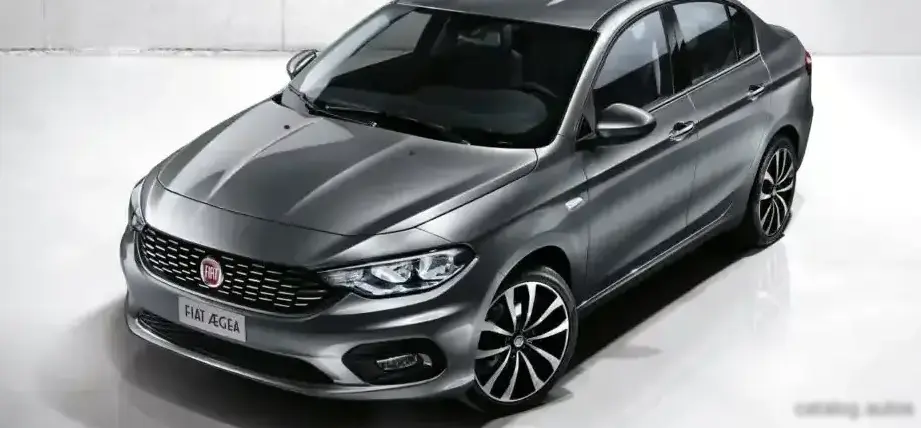
The Fiat Egea Station Wagon, specifically the 1.6 Multijet II variant producing 130 horsepower, represents a significant offering in the European compact estate market. Introduced with the 2020 facelift (model code 358), this version aimed to balance fuel efficiency, practicality, and affordability for families and individuals needing versatile cargo space. Positioned as a mid-range option within the Egea lineup, it slotted between the lower-powered diesel engines and the more expensive petrol variants. The Egea, a replacement for the Bravo, was designed to appeal to a broader customer base than its predecessor, and the station wagon body style further enhanced its appeal in markets where estates remain popular.
Technical Specifications
| Brand | Fiat |
| Model | Egea |
| Generation | Egea Station Wagon (358, facelift 2020) |
| Type (Engine) | 1.6 Multijet II (130 Hp) |
| Start of production | 2020 |
| Powertrain Architecture | Internal Combustion engine |
| Body type | Station wagon (estate) |
| Seats | 5 |
| Doors | 5 |
| Combined fuel consumption (WLTP) | 4.5-4.7 l/100 km (52.3 – 50 US mpg, 62.8 – 60.1 UK mpg, 22.2 – 21.3 km/l) |
| CO2 emissions (WLTP) | 119-125 g/km |
| Fuel Type | Diesel |
| Acceleration 0 – 100 km/h | 10.1 sec |
| Acceleration 0 – 62 mph | 10.1 sec |
| Acceleration 0 – 60 mph | 9.6 sec |
| Maximum speed | 207 km/h (128.62 mph) |
| Emission standard | Euro 6d-FINAL |
| Weight-to-power ratio | 10.7 kg/Hp, 93.2 Hp/tonne |
| Weight-to-torque ratio | 4.4 kg/Nm, 229.4 Nm/tonne |
| Power | 130 Hp @ 3750 rpm |
| Power per litre | 81.4 Hp/l |
| Torque | 320 Nm @ 1500 rpm (236.02 lb.-ft. @ 1500 rpm) |
| Engine layout | Front, Transverse |
| Engine Model/Code | 46346020 |
| Engine displacement | 1598 cm3 (97.52 cu. in.) |
| Number of cylinders | 4 |
| Engine configuration | Inline |
| Cylinder Bore | 79.5 mm (3.13 in.) |
| Piston Stroke | 80.5 mm (3.17 in.) |
| Compression ratio | 15.7:1 |
| Number of valves per cylinder | 4 |
| Fuel injection system | Diesel Commonrail |
| Engine aspiration | Turbocharger, Intercooler |
| Valvetrain | DOHC |
| Engine oil capacity | 4.8 l (5.07 US qt | 4.22 UK qt) |
| Coolant | 6.1 l (6.45 US qt | 5.37 UK qt) |
| Kerb Weight | 1395 kg (3075.45 lbs.) |
| Max. weight | 1945 kg (4287.99 lbs.) |
| Max load | 550 kg (1212.54 lbs.) |
| Trunk (boot) space – minimum | 550 l (19.42 cu. ft.) |
| Fuel tank capacity | 50 l (13.21 US gal | 11 UK gal) |
| Max. roof load | 75 kg (165.35 lbs.) |
| Permitted trailer load with brakes (12%) | 1500 kg (3306.93 lbs.) |
| Permitted trailer load without brakes | 500 kg (1102.31 lbs.) |
| Permitted towbar download | 60 kg (132.28 lbs.) |
| Length | 4571 mm (179.96 in.) |
| Width | 1792 mm (70.55 in.) |
| Width including mirrors | 2002 mm (78.82 in.) |
| Height | 1514 mm (59.61 in.) |
| Wheelbase | 2638 mm (103.86 in.) |
| Front track | 1542 mm (60.71 in.) |
| Rear (Back) track | 1543 mm (60.75 in.) |
| Front overhang | 893 mm (35.16 in.) |
| Rear overhang | 1040 mm (40.94 in.) |
| Minimum turning circle (turning diameter) | 10.9 m (35.76 ft.) |
| Drivetrain Architecture | The Internal combustion engine (ICE) drives the front wheels of the vehicle. |
| Drive wheel | Front wheel drive |
| Number of gears and type of gearbox | 6 gears, manual transmission |
| Front suspension | Independent type McPherson |
| Rear suspension | Torsion |
| Front brakes | Disc |
| Rear brakes | Disc |
| Assisting systems | ABS (Anti-lock braking system) |
| Steering type | Steering rack and pinion |
| Power steering | Electric Steering |
| Tires size | 205/55 R16; 225/45 R17; 225/40 R18 |
| Wheel rims size | 6.5J x 16; 7J x 17; 7.5J x 18 |
Powertrain & Engine Architecture
The heart of this Egea variant is the 1.6 Multijet II diesel engine, a member of Fiat’s widely used family of common-rail direct injection diesel engines. The engine code 46346020 signifies a later iteration of this powerplant, incorporating improvements for emissions and efficiency. This four-cylinder, inline engine utilizes a turbocharger with an intercooler to boost power output to 130 horsepower at 3750 rpm and 320 Nm (236 lb-ft) of torque at a low 1500 rpm. The high compression ratio of 15.7:1 is typical for diesel engines, contributing to thermal efficiency. The engine employs a Double Overhead Camshaft (DOHC) valvetrain with four valves per cylinder, optimizing gas flow. The 6-speed manual transmission was the standard offering, providing a balance between fuel economy and driver control. The Multijet II system itself is a sophisticated common-rail diesel injection system, allowing for multiple fuel injections per combustion cycle, resulting in smoother operation, reduced noise, and lower emissions.
Driving Characteristics
The 1.6 Multijet II with 130 hp in the Egea Station Wagon delivers a practical and economical driving experience. While not a performance-oriented variant, the engine provides sufficient power for everyday driving and highway cruising. The 320 Nm of torque available from 1500 rpm ensures good responsiveness in most situations, making overtaking maneuvers relatively effortless. The 6-speed manual transmission is well-matched to the engine’s characteristics, offering precise shifts and allowing the driver to keep the engine in its optimal power band. Acceleration from 0-100 km/h takes around 10.1 seconds. Compared to the lower-powered diesel versions, this 130 hp variant offers a noticeable improvement in performance, while remaining more fuel-efficient than the petrol options. The suspension setup prioritizes comfort, providing a reasonably smooth ride, although it may exhibit some body roll during spirited cornering.
Equipment & Trim Levels
The 1.6 Multijet II 130 hp Egea Station Wagon typically came equipped with a respectable level of standard features. These generally included air conditioning, power windows, central locking, a basic audio system with USB connectivity, and stability control. Higher trim levels added features such as alloy wheels, a touchscreen infotainment system with navigation, rear parking sensors, cruise control, and automatic climate control. Interior upholstery was typically cloth, with options for upgraded materials on higher trims. Safety features included multiple airbags, ABS brakes, and electronic brake-force distribution.
Chassis & Braking
The Egea Station Wagon utilizes a McPherson strut independent suspension setup at the front, providing a good balance of comfort and handling. The rear suspension employs a torsion beam, a cost-effective solution that offers adequate ride quality for everyday use. The braking system consists of disc brakes on all four wheels, providing sufficient stopping power for the vehicle’s weight and performance. ABS (Anti-lock Braking System) is standard, enhancing safety during emergency braking situations.
Market Reception & Comparison
The Fiat Egea Station Wagon 1.6 Multijet II 130 hp was generally well-received by automotive critics as a practical and fuel-efficient family car. It was praised for its spacious interior, large cargo capacity, and comfortable ride. The diesel engine was noted for its good fuel economy and reasonable performance. Compared to other compact estates in the European market, such as the Volkswagen Golf Estate or the Skoda Octavia Combi, the Egea offered a competitive price point and a generous level of equipment. However, some critics noted that the interior materials were not as premium as those found in some of its rivals.
Legacy
The 1.6 Multijet II engine has proven to be a reliable and durable powerplant, and the Egea Station Wagon has established a reputation as a dependable and practical vehicle. On the used car market, these models represent good value for money, offering a combination of fuel efficiency, space, and affordability. Regular maintenance, including timely oil changes and filter replacements, is crucial for ensuring the long-term reliability of the engine and transmission. While diesel engines have faced increased scrutiny in recent years due to emissions concerns, the Egea’s Multijet II engine meets Euro 6d-FINAL standards, making it compliant with current regulations.