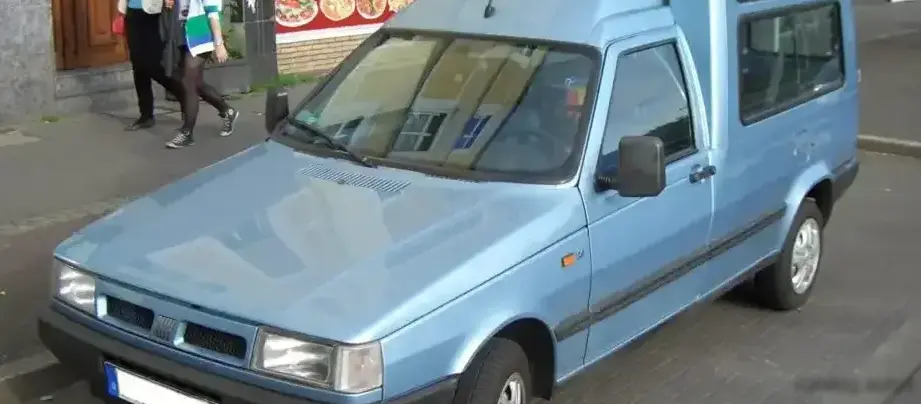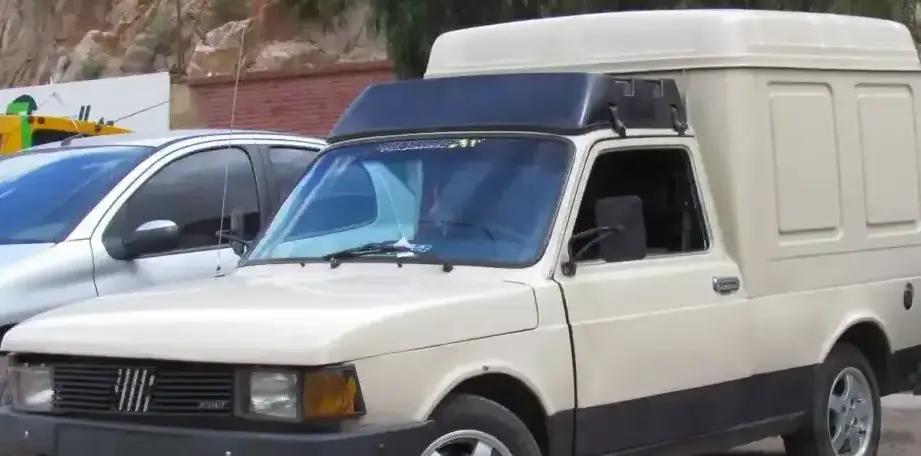
The Fiat Fiorino (127) 1050, produced from 1980 to 1987, represents a foundational entry in the compact van segment, particularly within the European market. Based heavily on the Fiat 127 supermini, the Fiorino was designed as a practical, affordable, and utilitarian vehicle aimed at small businesses, tradespeople, and families needing a versatile cargo solution. The “1050” designation refers to the engine displacement, and the “50 Hp” indicates the power output of this base-level variant. It occupied the lowest rung of the Fiorino lineup, offering a no-frills transportation option. This model played a significant role in establishing the Fiorino as a popular choice for commercial use in Italy and other European countries.
Technical Specifications
| Brand | Fiat |
| Model | Fiorino |
| Generation | Fiorino (127) |
| Type (Engine) | 1050 (50 Hp) |
| Start of Production | 1980 |
| End of Production | 1987 |
| Powertrain Architecture | Internal Combustion Engine |
| Body Type | Minivan |
| Fuel Type | Petrol (Gasoline) |
| Power | 50 Hp |
| Engine Model/Code | 127 A.000 |
| Engine Aspiration | Naturally Aspirated |
| Engine Oil Capacity | 3 l (3.17 US qt | 2.64 UK qt) |
Powertrain & Engine Architecture
The heart of the Fiorino 1050 is the Fiat 127 A.000 engine, a 1049cc inline-four cylinder petrol engine. This engine is a naturally aspirated unit, meaning it doesn’t employ a turbocharger or supercharger. It features a single overhead camshaft (SOHC) operating a two-valve per cylinder configuration. Fuel delivery is managed by a Weber carburetor, a common setup for vehicles of this era. The engine’s relatively simple design prioritized reliability and ease of maintenance over outright performance. The 127 A.000 engine is known for its robust construction, though it’s not particularly powerful or refined by modern standards. The engine’s block is cast iron, contributing to its durability. The Fiorino 1050 exclusively came with a four-speed manual transmission. This transmission was chosen for its simplicity and cost-effectiveness, aligning with the vehicle’s overall utilitarian purpose. The gear ratios were optimized for low-speed torque and fuel efficiency, rather than rapid acceleration. The transmission itself is a conventional manual, lacking synchromesh on first gear, a common characteristic of the time.
Driving Characteristics
The driving experience in the Fiorino 1050 is decidedly basic. With only 50 horsepower propelling a vehicle designed for carrying loads, acceleration is slow. Zero to sixty miles per hour takes a considerable amount of time, and passing maneuvers require careful planning. The four-speed manual transmission requires frequent shifting to maintain momentum, especially when loaded or traveling uphill. The gear ratios are relatively long, prioritizing fuel economy over spirited driving. Steering is light and relatively imprecise, typical of vehicles from the early 1980s. The suspension, consisting of independent front suspension with torsion bars and a rigid rear axle with leaf springs, provides a comfortable ride on smooth surfaces but can become unsettled on rough roads, particularly when the vehicle is lightly loaded. The Fiorino 1050’s braking system consists of drum brakes on all four wheels. While adequate for the vehicle’s weight and performance, they lack the stopping power and modulation of more modern disc brake systems. Compared to later Fiorino variants with larger engines, the 1050 feels significantly underpowered. The 1.3-liter and 1.5-liter engines offered in subsequent models provided a noticeable improvement in performance, making them more suitable for highway driving and heavier loads. The 1050’s strength lies in its ability to navigate city streets and handle light deliveries efficiently.
Equipment & Trim Levels
The Fiorino 1050 was offered with minimal standard equipment, reflecting its position as the entry-level model. The interior is spartan, with basic plastic trim and cloth upholstery. The seats are typically flat and offer limited support. The dashboard features a simple instrument cluster with a speedometer, fuel gauge, and warning lights. A basic two-spoke steering wheel is standard. Options were limited but could include a radio, upgraded seat upholstery, and rear window wiper. The Fiorino’s primary focus was functionality, so comfort and convenience features were kept to a minimum. The cargo area is the defining feature of the Fiorino, offering a generous amount of space for its size. The rear seats can be folded down or removed entirely to maximize cargo capacity. The side doors provide easy access to the cargo area, making loading and unloading convenient. The lack of sound insulation is noticeable, and the vehicle is relatively noisy at higher speeds.
Chassis & Braking
The Fiorino 1050 utilizes a unibody construction, providing a good balance of strength and weight. The front suspension features independent coil springs and torsion bars, offering a reasonable level of ride comfort. The rear suspension employs a rigid axle with leaf springs, which is more robust but less refined than independent suspension. The braking system consists of drum brakes on all four wheels, as mentioned previously. The Fiorino 1050’s tires are typically narrow and have a high aspect ratio, prioritizing fuel economy and ride comfort over grip. The steering system is a recirculating ball type, which is simple and reliable but lacks the precision of more modern rack-and-pinion systems. The Fiorino’s relatively lightweight construction helps to offset the lack of power, making it reasonably maneuverable in urban environments. The wheelbase is relatively short, contributing to its agility in tight spaces.
Market Reception & Comparison
The Fiat Fiorino 1050 was generally well-received in its target market. Critics praised its practicality, affordability, and fuel efficiency. However, its lack of power and basic equipment were also noted. Compared to other small vans of the era, such as the Renault 5 van and the Citroën C15, the Fiorino offered a competitive combination of price and functionality. The 1.3-liter and 1.5-liter Fiorino variants were often preferred by those who needed more power or regularly drove on highways. The 1050, however, remained popular with businesses and individuals who prioritized low running costs and simplicity. Fuel economy was a key selling point, with the Fiorino 1050 achieving around 45-50 miles per gallon in typical driving conditions. Reliability was generally good, thanks to the engine’s robust design and the vehicle’s relatively simple construction. The Fiorino’s compact size also made it well-suited for navigating narrow European streets.
Legacy
The Fiat Fiorino 127 1050 holds a significant place in automotive history as a pioneering example of a compact, affordable van. While it may not be known for its performance or luxury, it established the Fiorino as a practical and reliable workhorse. Today, the Fiorino 127 1050 is a relatively rare sight on the roads, but it has gained a following among classic car enthusiasts and collectors. The 127 A.000 engine is known for its durability, and many examples are still running today with proper maintenance. Parts availability can be a challenge, but many components are interchangeable with other Fiat 127 models. The Fiorino 127 1050 represents a simpler era of automotive design, where functionality and affordability were prioritized over all else. Its legacy continues in the modern Fiat Fiorino, which remains a popular choice for commercial use in Europe, though significantly more sophisticated and powerful than its ancestor.