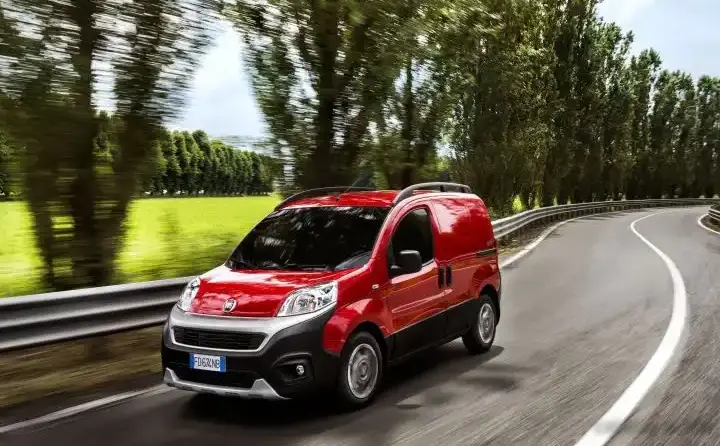
The Fiat Fiorino, particularly the facelifted version introduced in 2016, represents a practical and economical choice within the compact van segment. This iteration, powered by the 1.3 16V MultiJet2 engine producing 95 horsepower, was a mainstay of Fiat’s commercial vehicle lineup in Europe and other markets. Positioned as an entry-level to mid-range offering, it catered to businesses and individuals needing a versatile, fuel-efficient vehicle for urban deliveries and light commercial tasks. The 2016 facelift brought updated styling and improved equipment levels, enhancing the Fiorino’s appeal. It shares its platform with the Citroën Berlingo and Peugeot Partner, a result of the Sevel joint venture between Fiat and PSA (now Stellantis).
Technical Specifications
| Brand | Fiat |
| Model | Fiorino |
| Generation | Fiorino (facelift 2016) |
| Type (Engine) | 1.3 16V MultiJet2 (95 Hp) |
| Start of production | 2016 |
| Powertrain Architecture | Internal Combustion engine |
| Body type | Minivan |
| Seats | 2-5 |
| Doors | 5 |
| Fuel consumption (urban) | 5.6 l/100 km (42 US mpg, 50.4 UK mpg, 17.9 km/l) |
| Fuel consumption (extra urban) | 3.7 l/100 km (63.6 US mpg, 76.3 UK mpg, 27 km/l) |
| Fuel consumption (combined) | 4.4 l/100 km (53.5 US mpg, 64.2 UK mpg, 22.7 km/l) |
| CO2 emissions | 115 g/km |
| Fuel Type | Diesel |
| Maximum speed | 167 km/h (103.77 mph) |
| Emission standard | Euro 6 |
| Weight-to-power ratio | 11.5 kg/Hp, 87.2 Hp/tonne |
| Weight-to-torque ratio | 5.5 kg/Nm, 183.5 Nm/tonne |
| Power | 95 Hp @ 4000 rpm |
| Power per litre | 76.1 Hp/l |
| Torque | 200 Nm @ 1500 rpm (147.51 lb.-ft. @ 1500 rpm) |
| Engine layout | Front, Transverse |
| Engine Model/Code | 330 A1.000 |
| Engine displacement | 1248 cm3 (76.16 cu. in.) |
| Number of cylinders | 4 |
| Engine configuration | Inline |
| Compression ratio | 16.8:1 |
| Number of valves per cylinder | 4 |
| Fuel injection system | Diesel Commonrail |
| Engine aspiration | Turbocharger, Intercooler |
| Engine oil capacity | 3.9 l (4.12 US qt | 3.43 UK qt) |
| Coolant capacity | 6.5 l (6.87 US qt | 5.72 UK qt) |
| Kerb Weight | 1090 kg (2403.04 lbs.) |
| Max. weight | 1750 kg (3858.09 lbs.) |
| Max load | 660 kg (1455.05 lbs.) |
| Trunk (boot) space – maximum | 2800 l (98.88 cu. ft.) |
| Fuel tank capacity | 45 l (11.89 US gal | 9.9 UK gal) |
| Length | 3957 mm (155.79 in.) |
| Width | 1716 mm (67.56 in.) |
| Height | 1721 mm (67.76 in.) |
| Wheelbase | 2513 mm (98.94 in.) |
| Front track | 1469 mm (57.83 in.) |
| Rear track | 1465 mm (57.68 in.) |
| Front overhang | 854 mm (33.62 in.) |
| Rear overhang | 590 mm (23.23 in.) |
| Minimum turning circle | 9.95 m (32.64 ft.) |
| Drivetrain Architecture | Front wheel drive |
| Number of gears | 5 |
| Gearbox type | Manual transmission |
| Front suspension | Independent type McPherson |
| Rear suspension | Torsion |
| Front brakes | Ventilated discs |
| Rear brakes | Drum |
| Assisting systems | ABS (Anti-lock braking system) |
| Steering type | Steering rack and pinion |
| Tires size | 185/65 R15 |
| Wheel rims size | 15 |
Powertrain & Engine Architecture
The heart of this Fiorino variant is the 1.3-liter, 16-valve MultiJet2 diesel engine, identified by the code 330 A1.000. This engine is a member of Fiat’s second-generation MultiJet family, known for its efficiency and refinement. It features a common rail direct injection system, delivering fuel at extremely high pressure for optimized combustion. The engine utilizes a turbocharger with an intercooler to boost power output and improve torque across a wider rev range. The 16 valves (four per cylinder) contribute to improved breathing and overall engine performance. The engine’s relatively small displacement and turbocharging contribute to its fuel efficiency. The five-speed manual transmission was the standard offering, chosen for its simplicity and cost-effectiveness. The gearbox’s ratios were geared towards maximizing fuel economy and providing adequate performance for urban and highway driving.
Driving Characteristics
The 95 horsepower and 200 Nm (147.51 lb.-ft.) of torque offered by this Fiorino configuration provided adequate, though not exhilarating, performance. Acceleration was modest, but sufficient for typical commercial use and everyday driving. The engine’s peak torque, available from just 1500 rpm, meant that the van felt reasonably responsive in city traffic. The five-speed manual transmission allowed drivers to keep the engine in its optimal power band. Compared to higher-output versions of the Fiorino, such as those with the 1.6 MultiJet engine, this variant prioritized fuel economy over outright speed. The manual transmission offered more driver control than an automatic, but also required more driver involvement. The Fiorino’s suspension, tuned for comfort and load-carrying capacity, provided a reasonably smooth ride, even when fully loaded.
Equipment & Trim Levels
The 1.3 MultiJet2 95 Hp Fiorino typically came with a basic, functional equipment level. Standard features generally included power steering, central locking, an adjustable steering column, and a driver’s airbag. Air conditioning was often an optional extra. Interior upholstery was typically hard-wearing fabric. The dashboard layout was simple and utilitarian, prioritizing functionality over aesthetics. Depending on the market and optional packages, features like a radio with MP3 compatibility, electric windows, and a passenger airbag could be added. The Fiorino was available in various configurations, including a cargo van version with a fully enclosed load area and a passenger version with rear seats.
Chassis & Braking
The Fiorino’s chassis was designed to provide a balance between comfort and load-carrying capability. The front suspension utilized an independent McPherson strut setup, while the rear suspension employed a torsion beam. This configuration offered a good compromise between ride quality and handling. The braking system featured ventilated discs on the front wheels and drum brakes on the rear. ABS (Anti-lock Braking System) was standard, enhancing safety during emergency braking. The Fiorino’s relatively light weight contributed to its braking performance. The steering system used a rack and pinion setup, providing precise and responsive steering.
Market Reception & Comparison
The Fiat Fiorino 1.3 MultiJet2 95 Hp was generally well-received by critics for its fuel efficiency, practicality, and low running costs. It was often praised as an ideal vehicle for urban deliveries and small businesses. Compared to other vans in its class, such as the Renault Kangoo and Volkswagen Caddy, the Fiorino offered a competitive price point and a good level of standard equipment. The 1.6 MultiJet versions offered more power, but at the expense of fuel economy. The 1.3 MultiJet2 was considered a good all-rounder, offering a balance between performance, efficiency, and affordability. Reliability was generally good, with the MultiJet2 engine proving to be durable and long-lasting.
Legacy
The 1.3 MultiJet2 engine has proven to be a reliable and durable powertrain. The Fiorino, in this configuration, remains a popular choice in the used car market, particularly among businesses and individuals seeking an economical and practical van. While newer vans offer more advanced technology and features, the 2016 facelifted Fiorino continues to provide a cost-effective and dependable transportation solution. Its simple mechanical design makes it relatively easy and inexpensive to maintain, contributing to its long-term appeal. The Fiorino’s enduring popularity is a testament to its practicality and efficiency.