
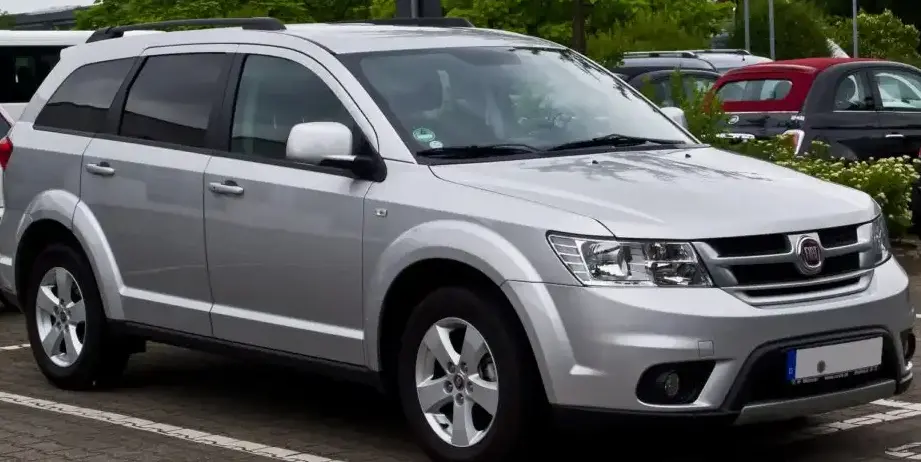
The Fiat Freemont 2.0 JTD (140 hp) was a diesel-powered SUV produced by Fiat from 2011 to 2016. Positioned as a mid-range offering within the Freemont lineup, it aimed to provide a balance of fuel efficiency, practicality, and affordability in the European market. The Freemont itself was a rebadged Dodge Journey, a result of Fiat’s ownership of Chrysler Group. This variant, equipped with the 2.0-liter JTD engine and a six-speed manual transmission, was designed to appeal to families seeking a spacious seven-seater with reasonable running costs. It occupied a space between the lower-powered, more basic trims and the higher-specification models with more potent engines.
Technical Specifications
| Brand | Fiat |
| Model | Freemont |
| Generation | Freemont |
| Type (Engine) | 2.0 JTD (140 Hp) |
| Start of production | 2011 |
| End of production | 2016 |
| Powertrain Architecture | Internal Combustion engine |
| Body type | SUV |
| Seats | 7 |
| Doors | 5 |
| Fuel consumption (urban) | 8.3 l/100 km (28.3 US mpg, 34 UK mpg, 12 km/l) |
| Fuel consumption (extra urban) | 5.3 l/100 km (44.4 US mpg, 53.3 UK mpg, 18.9 km/l) |
| Fuel consumption (combined) | 6.4 l/100 km (36.8 US mpg, 44.1 UK mpg, 15.6 km/l) |
| CO2 emissions | 169 g/km |
| Fuel Type | Diesel |
| Acceleration 0 – 100 km/h | 12.3 sec |
| Acceleration 0 – 62 mph | 12.3 sec |
| Acceleration 0 – 60 mph | 11.7 sec |
| Maximum speed | 185 km/h (114.95 mph) |
| Emission standard | Euro 5 |
| Weight-to-power ratio | 13.9 kg/Hp, 71.8 Hp/tonne |
| Weight-to-torque ratio | 5.6 kg/Nm, 179.6 Nm/tonne |
| Power | 140 Hp @ 4500 rpm |
| Power per litre | 71.6 Hp/l |
| Torque | 350 Nm @ 1750-2000 rpm (258.15 lb.-ft. @ 1750-2000 rpm) |
| Engine layout | Front, Transverse |
| Engine Model/Code | 939 B5.000 |
| Engine displacement | 1956 cm3 (119.36 cu. in.) |
| Number of cylinders | 4 |
| Engine configuration | Inline |
| Cylinder Bore | 83 mm (3.27 in.) |
| Piston Stroke | 90.4 mm (3.56 in.) |
| Number of valves per cylinder | 4 |
| Fuel injection system | Diesel Commonrail |
| Engine aspiration | Turbocharger, Intercooler |
| Valvetrain | DOHC |
| Engine oil capacity | 5.2 l (5.49 US qt | 4.58 UK qt) |
| Coolant | 9.1 l (9.62 US qt | 8.01 UK qt) |
| Kerb Weight | 1949 kg (4296.81 lbs.) |
| Trunk (boot) space – minimum | 145 l (5.12 cu. ft.) |
| Trunk (boot) space – maximum | 1461 l (51.59 cu. ft.) |
| Fuel tank capacity | 77.6 l (20.5 US gal | 17.07 UK gal) |
| Permitted trailer load with brakes (12%) | 1250 kg (2755.78 lbs.) |
| Permitted trailer load without brakes | 450 kg (992.08 lbs.) |
| Length | 4910 mm (193.31 in.) |
| Width | 1878 mm (73.94 in.) |
| Height | 1705 mm (67.13 in.) |
| Wheelbase | 2890 mm (113.78 in.) |
| Front track | 1571 mm (61.85 in.) |
| Rear (Back) track | 1582 mm (62.28 in.) |
| Minimum turning circle | 11.6 m (38.06 ft.) |
| Drivetrain Architecture | Front wheel drive |
| Number of gears | 6 gears, manual transmission |
| Front suspension | Independent type McPherson |
| Rear suspension | Independent multi-link spring suspension with stabilizer |
| Front brakes | Ventilated discs |
| Rear brakes | Disc |
| Assisting systems | ABS (Anti-lock braking system) |
| Steering type | Steering rack and pinion |
| Power steering | Hydraulic Steering |
| Tires size | 225/65 R17; 225/55 R19 |
| Wheel rims size | 17; 19 |
Powertrain & Engine Architecture
The Fiat Freemont 2.0 JTD utilized the 939 B5.000 engine, a four-cylinder diesel powerplant. This engine was part of Fiat’s JTD (Jet Diesel Technology) family, known for its direct injection and turbocharging. The 2.0-liter displacement provided a good balance between power and fuel economy. The engine employed a common rail direct injection system, delivering fuel at extremely high pressure for optimized combustion. A turbocharger with an intercooler further enhanced performance by forcing more air into the cylinders. The engine featured a double overhead camshaft (DOHC) valvetrain, contributing to efficient gas exchange. The six-speed manual transmission was chosen for this variant, offering drivers greater control over gear selection and contributing to improved fuel efficiency compared to an automatic.
Driving Characteristics
The 140 hp output and 350 Nm (258 lb-ft) of torque provided adequate performance for everyday driving. Acceleration from 0-60 mph took around 11.7 seconds, and the top speed was approximately 115 mph. While not particularly sporty, the engine delivered a usable amount of power for overtaking and highway cruising. The manual transmission allowed for precise gear changes, and the torque curve was relatively flat, meaning that good pulling power was available across a wide range of engine speeds. Compared to the more powerful 2.4-liter petrol engine offered in other Freemont trims, the 2.0 JTD prioritized fuel economy and lower running costs over outright performance. The manual gearbox also provided a more engaging driving experience than the optional automatic transmission available on other models.
Equipment & Trim Levels
The 2.0 JTD variant typically came with a reasonable level of standard equipment. This included air conditioning, power windows, power mirrors, a basic audio system with USB connectivity, and ABS brakes. Higher trim levels offered additional features such as alloy wheels, rear parking sensors, a more advanced audio system, and climate control. Interior upholstery was generally cloth, with options for leather upgrades. The Freemont’s spacious interior was a key selling point, offering comfortable seating for seven passengers. Optional extras included a panoramic sunroof, navigation system, and a DVD entertainment system for rear passengers.
Chassis & Braking
The Freemont utilized a front-wheel-drive layout. The front suspension consisted of independent McPherson struts, while the rear suspension employed an independent multi-link setup with a stabilizer bar. This configuration aimed to provide a comfortable ride and decent handling. The braking system featured ventilated discs on the front wheels and solid discs on the rear. ABS (Anti-lock Braking System) was standard, enhancing safety during emergency braking situations. The steering was a hydraulic rack and pinion system, providing a reasonably direct and responsive feel.
Market Reception & Comparison
The Fiat Freemont 2.0 JTD was generally well-received as a practical and affordable seven-seater. Critics praised its spacious interior, comfortable ride, and reasonable fuel economy. However, some reviewers noted that the interior materials were not as high-quality as those found in some competitors. Compared to other trims in the Freemont lineup, the 2.0 JTD offered a more economical option for buyers who prioritized fuel efficiency over performance. It competed with other mid-size SUVs such as the Ford S-Max, Renault Grand Scenic, and Citroën C4 Grand Picasso.
Legacy
The Fiat Freemont, while not a massive sales success, provided a relatively affordable entry point into the seven-seater SUV market. The 2.0 JTD engine proved to be reasonably reliable, although, like all diesel engines, it required regular maintenance and careful servicing. On the used car market, Freemonts with the 2.0 JTD engine are often sought after by buyers looking for a spacious and economical family vehicle. The engine’s relatively simple design and robust construction contribute to its longevity, making it a viable option for those seeking a dependable used SUV.
