
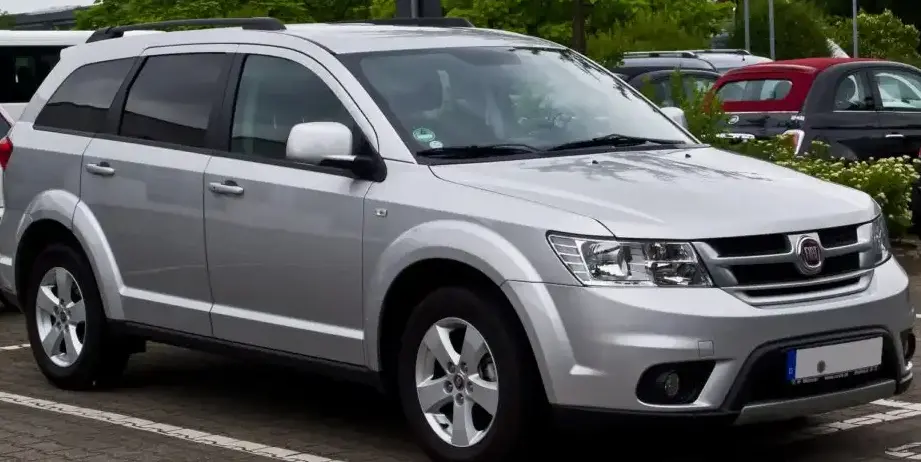
The Fiat Freemont 2.4 (170 Hp) Automatic, produced from 2014 to 2016, represents a unique chapter in Fiat’s foray into the mid-size crossover SUV segment, particularly for the North American market. This variant was positioned as a practical, family-oriented vehicle offering three-row seating and a relatively affordable price point. The Freemont itself was a rebadged Dodge Journey, a result of the alliance between Fiat and Chrysler. It primarily served as a more accessible alternative to larger, more expensive SUVs, aiming to provide space and utility without a premium price tag. The 2.4-liter engine paired with a six-speed automatic transmission was a core offering within the Freemont lineup, targeting buyers prioritizing comfort and convenience over outright performance.
Technical Specifications
| Brand | Fiat |
| Model | Freemont |
| Generation | Freemont |
| Type (Engine) | 2.4 (170 Hp) Automatic |
| Start of production | 2014 |
| End of production | 2016 |
| Powertrain Architecture | Internal Combustion engine |
| Body type | SUV |
| Seats | 7 |
| Doors | 5 |
| Fuel consumption (economy) – urban (NEDC) | 13.3 l/100 km (17.7 US mpg, 21.2 UK mpg, 7.5 km/l) |
| Fuel consumption (economy) – extra urban (NEDC) | 7.5 l/100 km (31.4 US mpg, 37.7 UK mpg, 13.3 km/l) |
| Fuel consumption (economy) – combined (NEDC) | 9.6 l/100 km (24.5 US mpg, 29.4 UK mpg, 10.4 km/l) |
| CO2 emissions (NEDC) | 225 g/km |
| Fuel Type | Petrol (Gasoline) |
| Acceleration 0 – 100 km/h | 13.3 sec |
| Acceleration 0 – 62 mph | 13.3 sec |
| Acceleration 0 – 60 mph | 12.6 sec |
| Maximum speed | 182 km/h (113.09 mph) |
| Emission standard | Euro 6 |
| Weight-to-power ratio | 10.7 kg/Hp, 93.8 Hp/tonne |
| Weight-to-torque ratio | 8.2 kg/Nm, 121.4 Nm/tonne |
| Power | 170 Hp @ 6000 rpm |
| Power per litre | 72 Hp/l |
| Torque | 220 Nm @ 4500 rpm (162.26 lb.-ft. @ 4500 rpm) |
| Engine layout | Front, Transverse |
| Engine Model/Code | World / ED3, EDG |
| Engine displacement | 2360 cm3 (144.02 cu. in.) |
| Number of cylinders | 4 |
| Engine configuration | Inline |
| Cylinder Bore | 88 mm (3.46 in.) |
| Piston Stroke | 97 mm (3.82 in.) |
| Compression ratio | 10.5:1 |
| Number of valves per cylinder | 4 |
| Fuel injection system | Multi-port manifold injection |
| Engine aspiration | Naturally aspirated engine |
| Valvetrain | DOHC, Dual VVT |
| Engine oil capacity | 4.3 l (4.54 US qt | 3.78 UK qt) |
| Coolant | 10.1 l (10.67 US qt | 8.89 UK qt) |
| Kerb Weight | 1812 kg (3994.78 lbs.) |
| Max. weight | 2404 kg (5299.91 lbs.) |
| Max load | 592 kg (1305.14 lbs.) |
| Trunk (boot) space – minimum | 136 l (4.8 cu. ft.) |
| Trunk (boot) space – maximum | 1461 l (51.59 cu. ft.) |
| Fuel tank capacity | 77.6 l (20.5 US gal | 17.07 UK gal) |
| Max. roof load | 68 kg (149.91 lbs.) |
| Permitted trailer load with brakes (12%) | 454 kg (1000.9 lbs.) |
| Permitted trailer load without brakes | 450 kg (992.08 lbs.) |
| Permitted towbar download | 27 kg (59.52 lbs.) |
| Length | 4910 mm (193.31 in.) |
| Width | 1878 mm (73.94 in.) |
| Height | 1705 mm (67.13 in.) |
| Wheelbase | 2890 mm (113.78 in.) |
| Front track | 1571 mm (61.85 in.) |
| Rear (Back) track | 1582 mm (62.28 in.) |
| Front overhang | 1005 mm (39.57 in.) |
| Rear overhang | 1015 mm (39.96 in.) |
| Minimum turning circle (turning diameter) | 11.6 m (38.06 ft.) |
| Drivetrain Architecture | The Internal combustion engine (ICE) drives the front wheels of the vehicle. |
| Drive wheel | Front wheel drive |
| Number of gears and type of gearbox | 6 gears, automatic transmission |
| Front suspension | Independent, type McPherson with coil spring and anti-roll bar |
| Rear suspension | Independent multi-link spring suspension with stabilizer |
| Front brakes | Ventilated discs, 330×28 mm |
| Rear brakes | Disc, 328×12 mm |
| Assisting systems | ABS (Anti-lock braking system) |
| Steering type | Steering rack and pinion |
| Power steering | Hydraulic Steering |
| Tires size | 225/65 R17; 225/55 R19 |
| Wheel rims size | 6.5J x 17; 7J x 19 |
Powertrain & Engine Architecture
The Fiat Freemont 2.4 Automatic utilizes the Chrysler-developed 2.4-liter inline-four cylinder engine, internally designated as the ED3 or EDG engine code. This engine is a naturally aspirated powerplant featuring multi-port fuel injection and a dual overhead camshaft (DOHC) valvetrain with variable valve timing (VVT) on both intake and exhaust camshafts. This configuration aimed to balance fuel efficiency with adequate power delivery. The engine produces 170 horsepower at 6000 rpm and 220 Nm (162 lb-ft) of torque at 4500 rpm. The six-speed automatic transmission, sourced from Chrysler, was the sole transmission option for this variant. It’s a conventional torque converter automatic, prioritizing smooth shifts and ease of use over sporty responsiveness. The transmission’s gear ratios are tuned for everyday driving and towing capability, rather than aggressive acceleration.
Driving Characteristics
The 2.4-liter engine and automatic transmission combination in the Freemont delivers adequate, but not exhilarating, performance. Acceleration from 0-60 mph takes around 12.6 to 13.3 seconds, making it slower than many competitors with more powerful engines. The automatic transmission contributes to a comfortable driving experience, with smooth gear changes. However, it can sometimes feel hesitant during quick acceleration or when attempting to overtake. The Freemont’s weight (approximately 3995 lbs) is a significant factor in its performance. Compared to potential manual transmission versions (not offered in the US market), the automatic sacrifices some responsiveness for convenience. The focus is on providing a relaxed and easy-to-drive experience, particularly suited for family transportation.
Equipment & Trim Levels
The 2.4-liter Automatic Freemont typically came standard with features like air conditioning, power windows and locks, a basic audio system with USB connectivity, and stability control. Higher trim levels added features such as leather upholstery, a touchscreen infotainment system, rear parking sensors, and a sunroof. The Freemont offered a relatively simple trim structure, with the 2.4L engine often serving as the base engine option. Optional extras included a DVD entertainment system for rear passengers, upgraded audio systems, and various appearance packages.
Chassis & Braking
The Freemont utilizes an independent McPherson strut suspension in the front and an independent multi-link suspension in the rear. This setup provides a reasonably comfortable ride, absorbing bumps and imperfections in the road. Front brakes are ventilated discs, while rear brakes are solid discs. Anti-lock Braking System (ABS) is standard. The Freemont’s suspension is tuned for comfort rather than sporty handling. Stabilizer bars are present on both axles to reduce body roll during cornering, but the vehicle’s high center of gravity and weight limit its cornering ability.
Market Reception & Comparison
The Fiat Freemont 2.4 Automatic received mixed reviews. Critics generally praised its spacious interior, comfortable ride, and relatively affordable price. However, the engine was often criticized for being underpowered, especially when fully loaded with passengers and cargo. Fuel economy was also considered average for its class. Compared to other SUVs in its segment, such as the Toyota Highlander or Honda Pilot, the Freemont offered less refinement and performance but a lower price point. The 2.4-liter engine was seen as a compromise to keep the vehicle accessible, while higher trims with the Pentastar V6 engine offered significantly more power.
Legacy
The Fiat Freemont was discontinued after a relatively short production run. While not a resounding success, it provided Fiat with a foothold in the North American SUV market. The 2.4-liter engine, while not known for exceptional reliability, is generally considered durable with proper maintenance. Used Freemonts are now available at very affordable prices, making them an attractive option for budget-conscious buyers seeking a spacious and practical vehicle. However, potential buyers should be aware of the engine’s limitations and the vehicle’s overall lack of refinement compared to more modern competitors. Parts availability is generally good, as the Freemont shares many components with the Dodge Journey.
