Technical Specifications
| Brand | Fiat |
| Model | Punto |
| Generation | Grande Punto (199) |
| Type (Engine) | 1.4 T-jet (120 Hp) |
| Start of production | 2007 |
| End of production | 2009 |
| Powertrain Architecture | Internal Combustion engine |
| Body type | Hatchback |
| Seats | 5 |
| Doors | 3-5 |
| Fuel consumption (urban) | 8.7 l/100 km (27 US mpg, 32.5 UK mpg, 11.5 km/l) |
| Fuel consumption (extra urban) | 5.4 l/100 km (43.6 US mpg, 52.3 UK mpg, 18.5 km/l) |
| Fuel consumption (combined) | 6.6 l/100 km (35.6 US mpg, 42.8 UK mpg, 15.2 km/l) |
| Fuel Type | Petrol (Gasoline) |
| Acceleration 0 – 100 km/h | 8.9 sec |
| Acceleration 0 – 62 mph | 8.9 sec |
| Acceleration 0 – 60 mph | 8.5 sec |
| Maximum speed | 195 km/h (121.17 mph) |
| Emission standard | Euro 4 |
| Weight-to-power ratio | 9.6 kg/Hp, 103.9 Hp/tonne |
| Weight-to-torque ratio | 5.8 kg/Nm, 173.2 Nm/tonne |
| Power | 120 Hp @ 5000 rpm |
| Power per litre | 87.7 Hp/l |
| Torque | 200 Nm @ 1750 rpm (147.51 lb.-ft. @ 1750 rpm) |
| Engine layout | Front, Transverse |
| Engine Model/Code | 198A4000 |
| Engine displacement | 1368 cm3 (83.48 cu. in.) |
| Number of cylinders | 4 |
| Engine configuration | Inline |
| Cylinder Bore | 72 mm (2.83 in.) |
| Piston Stroke | 84 mm (3.31 in.) |
| Compression ratio | 9.8:1 |
| Number of valves per cylinder | 4 |
| Fuel injection system | Multi-port manifold injection |
| Engine aspiration | Turbocharger, Intercooler |
| Valvetrain | DOHC |
| Engine oil capacity | 2.6 l (2.75 US qt | 2.29 UK qt) |
| Coolant | 6 l (6.34 US qt | 5.28 UK qt) |
| Kerb Weight | 1155 kg (2546.34 lbs.) |
| Max. weight | 1715 kg (3780.93 lbs.) |
| Max load | 560 kg (1234.59 lbs.) |
| Trunk (boot) space – minimum | 275 l (9.71 cu. ft.) |
| Trunk (boot) space – maximum | 1020 l (36.02 cu. ft.) |
| Fuel tank capacity | 45 l (11.89 US gal | 9.9 UK gal) |
| Length | 4030 mm (158.66 in.) |
| Width | 1687 mm (66.42 in.) |
| Height | 1490 mm (58.66 in.) |
| Wheelbase | 2510 mm (98.82 in.) |
| Front track | 1473 mm (57.99 in.) |
| Rear (Back) track | 1466 mm (57.72 in.) |
| Drag coefficient (Cd) | 0.34 |
| Minimum turning circle | 10.8 m (35.43 ft.) |
| Drivetrain Architecture | Front wheel drive |
| Number of gears | 5 |
| Gearbox type | Manual transmission |
| Front suspension | Independent, type McPherson with coil spring and anti-roll bar |
| Rear suspension | Semi-dependent beam with stabilizer lateral stability |
| Front brakes | Ventilated discs |
| Rear brakes | Drum |
| Assisting systems | ABS (Anti-lock braking system) |
| Steering type | Steering rack and pinion |
| Power steering | Electric Steering |
| Tires size | 175/65 R15 H; 185/65 R15 H |
| Wheel rims size | 15 |
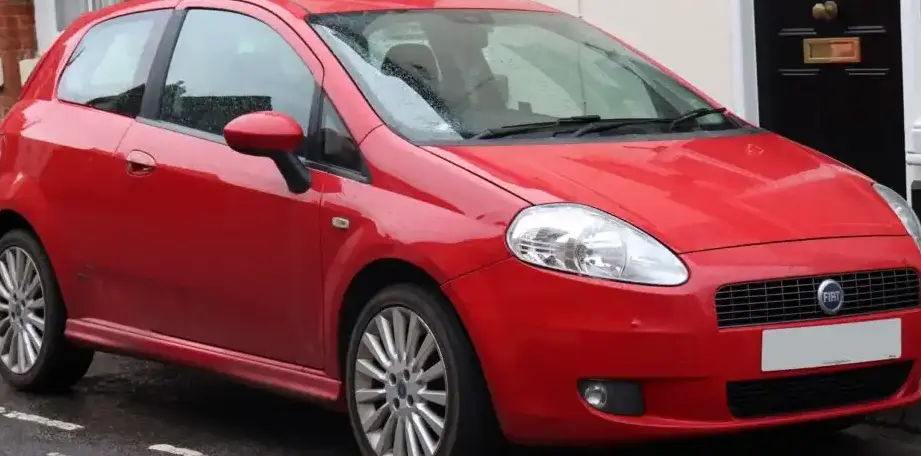
The Fiat Grande Punto 1.4 T-Jet 120 HP, produced from 2007 to 2009, represented a significant step forward for the Italian automaker’s B-segment hatchback. Part of the 199 project, the Grande Punto aimed to address criticisms of its predecessor, the Punto Mk2, by offering improved interior space, a more modern design, and a wider range of engine options. The 1.4 T-Jet 120 HP variant occupied a mid-range position in the lineup, offering a balance between performance, fuel economy, and affordability. It was designed to appeal to buyers seeking a more engaging driving experience than the base 1.2-liter engine could provide, without the higher cost associated with the more powerful 1.4 T-Jet 150 HP or diesel options.
Powertrain & Engine Architecture
The heart of the Grande Punto 1.4 T-Jet 120 HP is the 198A4000 engine, a 1.4-liter inline-four cylinder gasoline engine featuring turbocharging and an intercooler. This engine is a member of Fiat’s Fire family, known for its compact size and relatively simple design. The engine utilizes a multi-point fuel injection system and a double overhead camshaft (DOHC) valvetrain, contributing to its responsive nature. The turbocharger, a key component, provides a significant boost in power output compared to naturally aspirated engines of similar displacement. The 120 HP version was tuned for a balance of performance and fuel efficiency, with peak torque of 200 Nm (147.51 lb-ft) available at a relatively low 1750 rpm. This made it particularly well-suited for everyday driving. The engine was typically paired with a five-speed manual transmission, although an automated manual transmission (Dualogic) was also available as an option.
Driving Characteristics
The Grande Punto 1.4 T-Jet 120 HP offered a noticeable improvement in performance over the base 1.2-liter engine. Acceleration from 0 to 60 mph took approximately 8.5 to 8.9 seconds, and it could achieve a top speed of around 121 mph. The turbocharger provided a distinct power boost during acceleration, making overtaking maneuvers easier. While not as quick as the 150 HP T-Jet variant, the 120 HP version offered a more accessible and manageable power delivery. The five-speed manual transmission was well-matched to the engine’s characteristics, providing smooth gear changes and a decent level of driver engagement. The gear ratios were optimized for both city driving and highway cruising. Compared to the 1.3 Multijet diesel, the T-Jet offered a more spirited driving experience, albeit with slightly higher fuel consumption.
Equipment & Trim Levels
The Grande Punto 1.4 T-Jet 120 HP was typically offered in several trim levels, including Active, Dynamic, and Eleganza. The Active trim was the entry-level option, featuring basic amenities such as air conditioning, power steering, and an audio system. The Dynamic trim added features like alloy wheels, electric windows, and remote central locking. The Eleganza trim, the highest level, included upgrades such as climate control, a trip computer, and upgraded interior trim. Optional extras included a sunroof, parking sensors, and a more advanced audio system. Interior upholstery typically consisted of cloth seats, with the option of leather upholstery on higher trim levels. The dashboard layout was modern and functional, with a clear instrument cluster and easy-to-use controls.
Chassis & Braking
The Grande Punto featured a McPherson strut front suspension and a semi-independent torsion beam rear suspension. This setup provided a good balance between ride comfort and handling. The front suspension incorporated a stabilizer bar to reduce body roll during cornering. The braking system consisted of ventilated discs on the front wheels and drum brakes on the rear wheels. Anti-lock Braking System (ABS) was standard on all models. The steering was rack and pinion with electric power assistance, providing a light and precise steering feel. The chassis was designed to be relatively lightweight, contributing to the car’s agility and fuel efficiency.
Market Reception & Comparison
The Fiat Grande Punto 1.4 T-Jet 120 HP was generally well-received by automotive critics. It was praised for its stylish design, spacious interior, and engaging driving experience. The 1.4 T-Jet engine was considered a strong performer, offering a good balance of power and fuel economy. However, some critics noted that the interior plastics could feel a bit low-rent in certain areas. Compared to rivals such as the Ford Fiesta and Volkswagen Polo, the Grande Punto offered a more distinctive design and a more affordable price point. In terms of fuel economy, the 1.4 T-Jet 120 HP achieved around 35.6 US mpg on the combined cycle, which was competitive for its class. Reliability was generally good, although some owners reported minor issues with the electrical system.
Legacy
The Fiat Grande Punto 1.4 T-Jet 120 HP remains a popular choice in the used car market. The 198A4000 engine is known for its durability and relatively low maintenance costs, provided it is properly serviced. The availability of spare parts is generally good. While not as sought-after as the higher-powered 150 HP version, the 120 HP model offers a compelling combination of affordability, performance, and fuel efficiency. It represents a significant improvement over previous generations of the Punto and remains a capable and enjoyable small hatchback.